Performance Marketing vs Brand Marketing for Content Teams
Unified strategy beats the accidental brand-performance split.
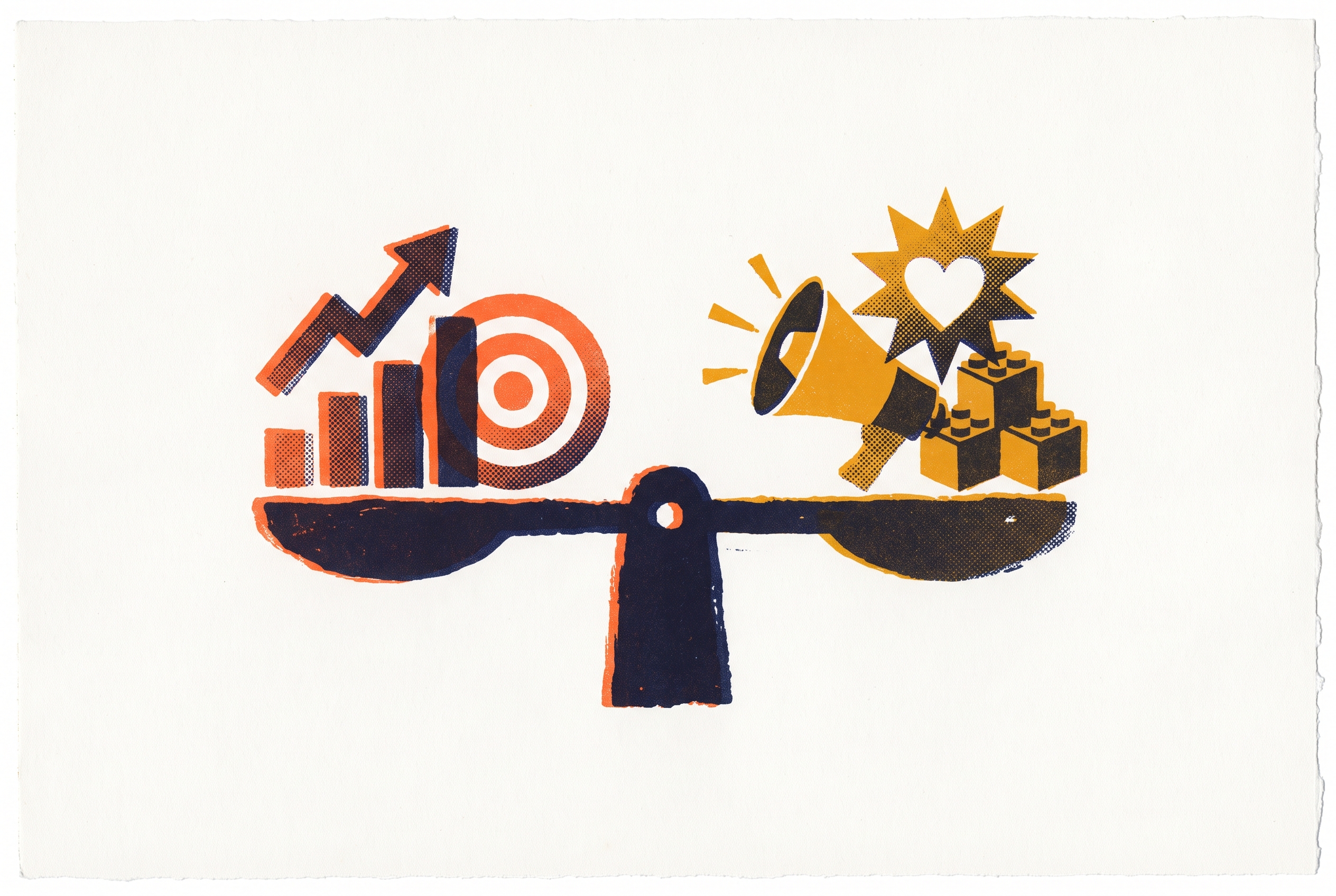
Most content teams still split brand from performance, but that split was never a strategic decision. It was a byproduct of how marketing departments happened to get organized decades ago, and most teams have inherited the structure without ever revisiting the logic behind it.
Why the brand-vs-performance split was an org-chart accident
Brand teams historically reported up to one VP, and they owned storytelling, awareness campaigns, and long-term perception. Performance teams reported to a different VP, and they owned paid acquisition, ROAS, and conversion. Each side answered to different incentives, and each carried different budgets, so they rarely sat in the same planning meeting. Content landed inside brand almost by default: it was editorial, organic, hard to attribute to a single sale, and there was no obvious third bucket to put it in. That placement had nothing to do with how customers actually experience a brand and everything to do with where a headcount line happened to sit.
The measurement tools of that era locked the split into place. Brand metrics such as reach, recall, and share of voice lived in one dashboard, tracked by one team. Performance metrics such as CPA, ROAS, and conversion rate lived in a different dashboard, tracked by a different team. Two separate systems of record made the division feel like a fact about marketing itself, when it was really a choice about how data got architected. Customers, meanwhile, never experienced any of this. A person moving from a social video to a search query to a purchase has no idea which internal team produced which asset, and no reason to care.
Some practitioners argue that the tension between brand and performance camps is productive. Rhone co-founder Nate Checketts has described wanting exactly that friction: "I want our brand team to say 'hey we hate this ad, it's not beautiful, it's not representative of what we do,' and our performance team to say, 'yes but it's performing twice as good as the ad that you've supplied us.'" That tension can sharpen decisions, but it only works when both sides argue from the same brief and the same budget. Split into separate reporting lines with separate scorecards, the same disagreement becomes two teams optimizing for different definitions of success.
How advertising platforms collapsed the funnel
Whatever logic once supported the brand-performance divide is gone now, because the platforms where content actually runs have erased it. Search engines, social networks, marketplaces, and streaming platforms now run on algorithms that optimize for discovery, engagement, and conversion at the same time. The platform does not know which internal team made the asset it's serving, and it does not sort content into funnel stages on the advertiser's behalf.
Consider how compressed the modern path to purchase has become: a person sees a short video ad on social media, searches for reviews within minutes, gets served a retargeting ad shortly after, and completes the purchase on a marketplace, all inside a single sitting. What used to unfold over days or weeks now happens in minutes or hours. AI now builds campaigns that optimize across touchpoints, across the entire funnel, and across networks and channels at once, so you no longer need a separate awareness campaign and a separate conversion campaign. The algorithm allocates spend across both at once, in real time, based on what works.
Social platforms have turned into shopping platforms. When you search, you see video, reviews, and commerce listings side by side on the same results page. Retail media networks now shape your decisions at the exact point of purchase. Each of these shifts erases a boundary the traditional funnel treated as fixed. A piece of content built purely for brand storytelling and a piece built purely to drive clicks now compete inside the same algorithmic feed, and that feed rewards whatever does both jobs at once. A content team still organized around the old funnel stages is optimizing for a structure the platforms themselves no longer recognize.
Committing fully to performance content
Rhone, the activewear brand that has grown from a direct-to-consumer startup into a wholesale and retail presence, built its marketing almost entirely on performance for years. Bethany Evans, who joined as CMO in November 2024 after leading marketing at The North Face, described the pattern plainly: "We were really focused on performance media for a long time, and I get it: It's easy to measure, it's really focused on e-comm." Performance spend is attractive precisely because it's legible. Every dollar maps to a click, a conversion, a return on ad spend figure that shows up cleanly on a dashboard. But that legibility came at a cost Rhone eventually had to confront: as the brand's wholesale and retail business grew alongside its e-commerce arm, a purely performance-trained marketing function had no muscle for building the broader brand presence that wholesale and retail distribution depend on.
The deeper problem with performance-only content is how it reshapes incentives over time. When you optimize for ROAS, budget pulls toward whatever products and channels are easiest to track and already generate revenue. That starves two things that don't show up cleanly in a ROAS calculation: customer retention, which accrues slowly and resists attribution to any single campaign, and brand equity, the asset that keeps acquisition costs low. If left unchecked, this creates a loop: performance spend keeps rising to compensate for the brand erosion it caused.
Performance marketing creates the conditions for revenue; it doesn't close the deal by itself. This is especially visible in B2B, where the final conversion rarely happens through an ad click. It usually arrives through a sales call or an outreach effort triggered by the intent signals a paid campaign surfaced days or weeks earlier. A team measuring only last-click attribution will miss that entire chain and conclude, wrongly, that the campaign didn't work.
The politics compound the problem. Many B2B marketers struggle to attribute ROI to content efforts or to trace a customer's full journey, and that attribution gap makes brand content an easy target at budget review time. Money flows toward whatever is easiest to defend with a number attached to it, regardless of what's actually driving the result.
The measurement tools of that era locked the split into place.
Brand equity as a performance input
Brand equity works as a multiplier on performance results, not as a separate line item competing for the same budget. Strong brand recognition improves click-through rates and conversion rates inside performance campaigns directly, and it lowers the cost of acquiring a customer through the same paid channels a performance team already runs. The two disciplines add to each other rather than trading off against one another, which means content that builds brand recognition is, in a measurable sense, also performance content.
Brand affinity also drives customer lifetime value well beyond the initial sale, but pure performance measurement tends to undercount this figure, because it accumulates slowly, outside the window of any single campaign. Rhone's experience after moving away from a performance-only approach makes the commercial case concrete: the brand named Kepler Group its first media agency of record ever, after a three-month review that considered eight competing agencies, and the resulting integrated strategy drove strong revenue growth and stronger brand loyalty during Cyber Week. That result came from combining both disciplines under one strategy, not from either one operating alone.
Brand equity also builds an advantage that performance spend can't replicate. A competitor can match your cost-per-click bid dollar for dollar. But a competitor cannot as easily match years of accumulated trust and recognition. The rise of AI-powered search raises the stakes further: a strong brand now improves visibility inside AI-driven discovery tools, because the same qualities that make content trustworthy, authoritative, and well-sourced are what these systems use to decide what to surface. That dynamic closes off one of the last arguments for treating brand and performance content as two separate briefs written by two separate teams.
What the current balance looks like across team types
Most content teams remain weighted toward performance at the precise moment when brand investment pays off the most and performance spend runs into the steepest diminishing returns. Marketing team structures in 2026 look measurably different than they did just two years earlier: headcount ratios have tightened, roles have sharpened around AI-augmented workflows, and teams increasingly favor senior operators over entry-level generalists. None of that restructuring has corrected the underlying imbalance between brand and performance work.
E-commerce and DTC teams sit furthest toward the performance end of the spectrum. A mid-scale DTC brand typically staffs performance-focused marketers at a share of headcount far higher than other business models carry, because paid acquisition on Meta and Google drives most new customer revenue, with TikTok playing a smaller supporting role. B2B teams show the imbalance in a different shape: most B2B buyers are out of market at any given moment, so most performance targeting in B2B reaches people who have no near-term reason to buy. So brand-building is a competitive necessity in B2B, not a nice-to-have, yet most B2B teams are still built around activation rather than long-term demand creation.
Across both models, most teams sit much closer to activation-heavy than to the integrated approach the evidence supports. Leadership often knows the balance is off. The structural incentives that built the original split, separate budgets, separate reporting lines, separate dashboards, keep reproducing the same imbalance even after the strategic case against it has been made.
Content that serves both disciplines
Integration doesn't mean merging the brand team and the performance team into one undifferentiated group. It means working from a shared brief, a common creative language, and a workflow that produces assets able to build equity and drive conversion in the same piece of content. Rhone's shift away from purely performance-driven creative toward a UGC-driven testing model shows what that looks like operationally. Instead of producing a small number of polished brand assets, the content team began producing testable, scalable creative that looked native to the platforms it ran on, but it still carried the brand's visual and tonal signals. The volume of testing increased dramatically under this model, and the resulting creative drove a 3 to 4 times increase in ROAS compared with the internal content the old, performance-only process had produced.
Performance marketing itself now runs through a multi-channel approach, not just one switched-on channel. Content marketing, event presence, and founder-led outreach all feed into the performance system now, instead of running alongside it as separate brand activities. That shift has changed who the most valuable hire on a performance team actually is. The creative strategist, someone who reads data and visual composition with equal fluency, has become central precisely because the brief that used to go to a brand creative team and the brief that used to go to a performance team now need to be a single document.
An integrated framework works in stages that build on each other rather than competing: brand marketing generates broad awareness, performance marketing captures the interest that awareness created with targeted messaging, optimized performance campaigns convert that interest into a sale, and brand marketing then sustains engagement while performance drives the repeat purchase. Each stage depends on the one before it. AI-generated creative has also lowered the cost of producing distinctive assets to the point where production itself is no longer the main constraint. Phantom Farm's content pipeline, for instance, is built around that same premise: that the bottleneck has shifted from how much content a team can produce to how well a team briefs what gets made. The competitive edge now belongs to teams that brief well, not teams that simply produce the most.
Measuring content work across both disciplines
The real obstacle is that teams apply performance measurement tools to brand outcomes, get noisy or inconclusive results, and conclude the work itself is unaccountable. Performance marketing's core appeal is that it's measurable, but measurable and measured correctly aren't the same thing. The same gap applies on the brand side: teams frequently track proxies like reach and impressions instead of the equity signals that actually predict future performance.
Performance metrics, ROAS, CPA, conversion rate, and CTR, remain the right frame for content explicitly built to capture demand that already exists. That work should be judged on those terms and no others. Brand metrics, including aided and unaided brand awareness among a defined target audience, brand sentiment, and other equity indicators, belong to content built to create demand that doesn't yet exist, and that work needs a longer reporting cadence to mean anything. If you hold both frameworks at once, instead of forcing one discipline's scorecard onto the other's output, you let a content team defend brand investment in a budget conversation dominated by performance numbers, while keeping the accountability that makes performance work valuable.
Sources
- Brand vs Performance Marketing: Why You Need Both (2026 Data) — Porter Wills
Provided context on why brand and performance marketing function as complements rather than rivals, including the argument that brand equity lowers acquisition costs.
- Why Performance Marketing is Taking Over Brand Marketing in 2025
Provided background on the trend toward performance-heavy marketing structures and the diminishing returns that come with ignoring brand investment.
- Performance vs Brand Marketing: Strategy Guide 2026
Supplied framing for how integrated brand-plus-performance strategies operate in stages that build on each other rather than competing.
- Performance Marketing vs Brand Marketing: What’s the Difference?
Provided detail on how AI-powered campaign tools now optimize across the full funnel simultaneously, dissolving the traditional awareness-vs-conversion divide.