Content Briefing Templates That Cut Revision Rounds
Better briefs eliminate guesswork that costs writers and editors hours in revision cycles.

Revision rounds don't come from bad writers. They come from briefs that leave decisions unmade, decisions someone has to make anyway, usually the writer, usually alone, usually wrong in some small way that costs everyone three more passes to fix.
How the volume problem made strong briefs non-negotiable
The instinct is to blame the usual suspects: a writer who missed the point, feedback that never quite says what it means, a stakeholder who takes five days to answer a message in a team chat tool. Those things happen. But they're symptoms sitting on top of a structural problem, and the structural problem is this: when a brief leaves a gap, the writer fills it with a guess. Every guess is a decision made without the information needed to make it right. The stakeholder reviews the draft, spots the gap, and corrects it after the fact, in the most expensive place in the pipeline to correct anything.
That's the actual mechanism. Not skill, not communication style. A clear brief turns the writing part into something close to transcription: the thinking already happened, the writer just has to execute it. An unclear brief pushes all that thinking downstream, into a draft, a review cycle, and a round of stakeholder notes that could have been a single sentence added to the brief before anyone opened a document. A 2026 content brief and handoff framework from an industry publisher states that one-line fix at the brief stage is free. Making the same fix after drafting and review costs the most time in the whole process, because it means re-litigating a decision three people already spent time on rather than editing a document.
Four rounds of revision where one would have done the job: not a bad-luck outcome, but the predictable result of a brief that never forced the hard calls up front. Once you see it that way, the fix stops being about hiring better writers or running tighter stand-ups. It's about the document itself.
Enterprise content teams have added vendors and AI tools far faster than they've added editors. Animalz has documented Fortune 500 companies multiplying their content vendor count by something close to tenfold over a decade, while headcount on the editorial side grew by well under 15%, leaving editors badly outpaced by vendor growth. That gap is the whole story. Nobody on staff can personally read every draft closely enough to catch every misalignment anymore, so the brief becomes the only quality-control surface that scales. A template is the mechanism by which a five-person editorial team governs a hundred-vendor content operation in that world. It's the mechanism by which a five-person editorial team governs a hundred-vendor content operation.
There's a second shift stacked on top of the volume increase: the audience for the brief itself has changed. The same document now has to work for a human writer and for an AI generation run, and a spec written with only one of those readers in mind tends to fail the other. A brief that says "make it authoritative" might survive a good freelancer's judgment. When that same line is handed to a model generating a draft, the output drifts: entities go missing, and claims appear in the text with nothing backing them.
Add to that a finding from monday.com's research: only 43% of employees at large enterprises say they clearly understand how success gets measured in their own organization. That finding applies to content specifically: it explains why briefs that lock in KPIs before drafting starts are rare, and why the ones that do it see outsized returns. The brief is a machine-readable spec, a quality gate, and, increasingly, a compliance record, all living in the same fields. It's a machine-readable spec, a quality gate, and, increasingly, a compliance record, all living in the same fields.
What structured briefing changes, in measured terms
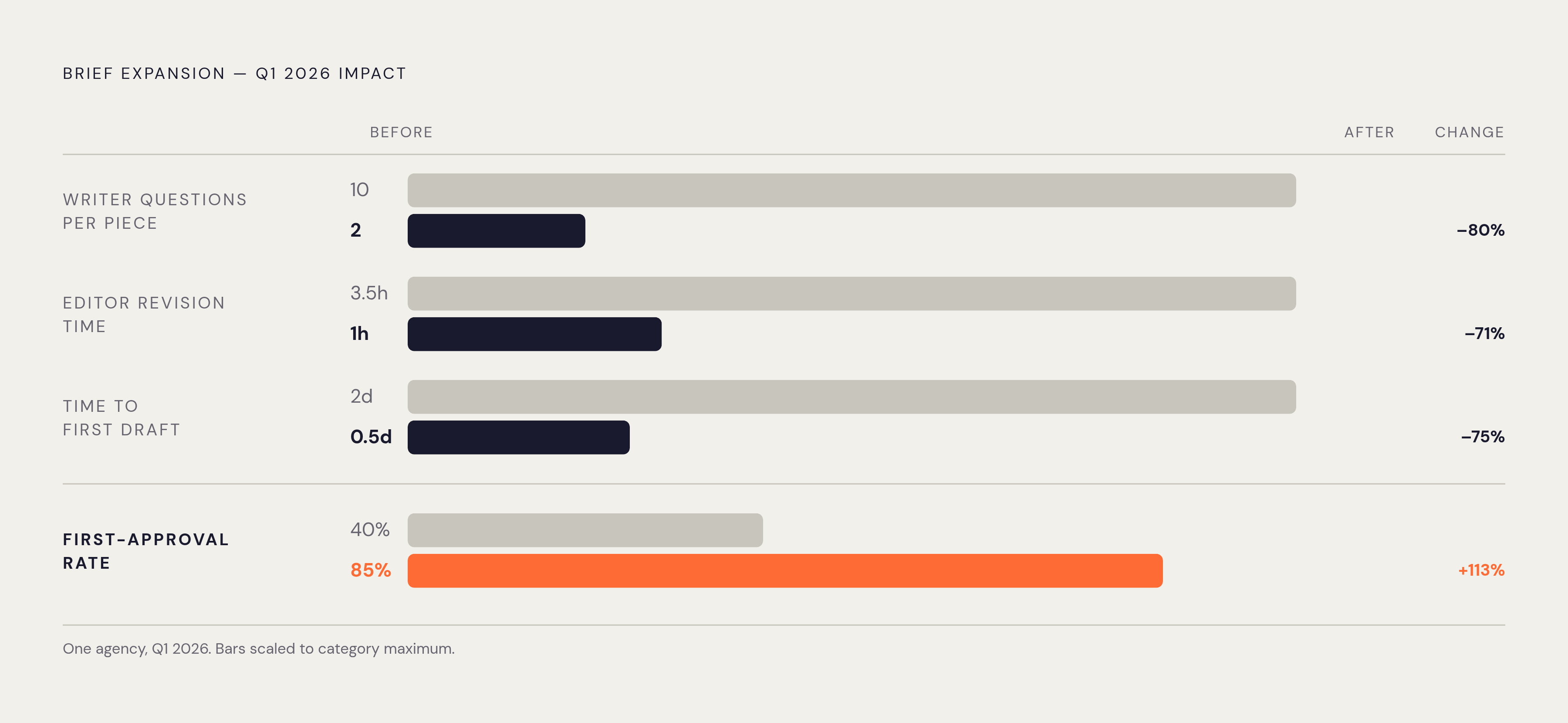
One agency's numbers make the case better than any argument could. Reporting from rankdraft.io found that an agency dramatically expanded its brief template in the first quarter of 2026. The results: writer questions per piece dropped from 10 to 2, an 80% reduction. Editor revision time fell from 3.5 hours to 1 hour, down 71%. Time to first draft dropped from two days to half a day, a 75% cut. First-approval rate rose from 40% to 85%, a jump of 113%.
That last figure deserves a second look before anyone treats it as gospel. A 40% baseline is low enough that almost any structural improvement produces a dramatic-looking percentage jump. A 40% baseline is low enough that almost any structural improvement produces a dramatic-looking percentage jump, so the size of the number says as much about how broken the starting point was as it does about the fix. What's more durable, across every source cited here, is the direction: revisions go down, consistently, regardless of the specific operation or agency.
Other benchmarks in the field, gathered from agency and vendor reporting rather than independent audit, point the same way. Digital Applied's data cites roughly 40% fewer revision cycles, production-time cuts in the 60-80% range, and first-pass approval rates moving from a manual baseline near 40-50% toward a target above 75%. These are vendor-stated figures, directional rather than guarantees, but the pattern across separate sources is hard to wave away.
monday.com's research found that standardized templates raised documentation completeness from 38.2% to 87.2% when properly adopted. That's not a revision-count metric, it's a completeness metric, and it matters because incomplete documentation is exactly the mechanism driving everything else in this piece. A brief that's actually filled out closes the gaps a writer would otherwise have to guess at.
None of this is a magic switch. The brief is a lever, and how far it moves depends on whether the fields actually get filled in every time, not just when someone remembers.
The decisions a brief must force before a writer opens a document
Think of a brief less as a form and more as an inventory of decisions that have to be made by someone, at some point, before a draft exists. The question for each field isn't "is it included," it's "what happens when it's missing."
Strategic objectives and success metrics come first. Without this, a writer optimizes for whatever goal seems most plausible, usually traffic or general education, while the reviewer is quietly holding a different target, maybe conversion, maybe brand positioning. Nobody's wrong, exactly. They're just solving different problems. The fix is specific: name the primary business objective, name the actual KPIs, and set a timeline for when success gets measured.
Target audience and journey stage work the same way. A demographic label like "marketing managers, 30-45" tells a writer almost nothing about tone or depth. Without the psychographics, the specific pain points, the awareness level, pieces get written for the wrong stage of the funnel: an awareness-level explainer landing in the middle of a decision-stage campaign, or a comparison page written for someone who hasn't yet realized they have a problem.
Core message and value proposition sound obvious until they're missing, at which point writers default to leading with features because features are concrete and benefits require interpretation. The reviewer then asks for a reframe, and a reframe isn't an edit, it's a rewrite dressed up as one. The brief should isolate, in a sentence, the single thing a reader should walk away knowing, separated cleanly from every supporting point that supports it.
SEO requirements are table stakes at this point, primary and secondary keywords, heading guidance, internal link targets. That publisher's 2026 framework identifies collapsing search intent and answer intent into a single field as what most templates still get wrong. They're not the same thing. Search intent gets a page into the conversation happening in the search results. Answer intent is what wins a featured snippet or an AI citation. A brief needs both targets stated explicitly, because leaving one implied by the other means a writer optimizes for the one they noticed and misses the one they didn't.
Tone and voice guidance fails in a specific, predictable way: adjectives. "Make it authoritative" or "keep it conversational" gives a writer nothing to act on, and gives an AI model even less. What works instead is a paragraph example, a competitor piece marked up with what to avoid, a note on which claims need legal review before publication. Tell the writer what to avoid as clearly as what to hit.
Deliverables and structure, word count range, heading structure, content type, set the scope of the piece, not just its style. A subtler failure is conflating entity coverage with structural targets in the same field. That publisher's framework holds that doing that leads writers to over-optimize the structure (perfect headers, ideal keyword placement) at the direct expense of actually covering the topic completely. Keep those as two separate fields, and both get their due attention.
E-E-A-T mandates need to stop being aspirational language and start being fields with actual entries: a named author with stated credentials, a requirement for first-hand experience signals somewhere in the piece, and named proof sources a given claim has to cite, not a generic instruction to "cite sources" but the actual sources required.
Finally, the approval chain. Without this, stakeholders assume they can redirect the piece at any point in the review process, while writers have no ground to stand on when a fourth-round note contradicts a first-round instruction. Spell out who approves what, in what sequence, and at which stage of the draft.
A 2026 content brief and handoff framework from an industry publisher states that one-line fix at the brief stage is free.
The 2026 additions: GEO and AEO fields that most templates still omit
Search itself changed shape, and most brief templates haven't caught up. Gartner predicted that traditional search engine volume would fall by 25% by 2026. Writer.com reports that prediction had become reality by July of that year.
The consequence for anyone ranking a page is blunt. Ahrefs' research, cited by writer.com, found that where AI Overviews show up in a search result, click-through to the top-ranking organic page falls by as much as 58%, dropping from 7.3% to 1.6% on the affected keywords. And the population of content that wins in traditional rankings isn't the same population winning AI citations: research indicates that URLs cited by AI assistants and those ranking in Google's top 10 for the same query overlap far less than most teams assume. A brief built purely around ranking leaves the entire AI-citation channel unaddressed, untouched, off the table.
So what does a brief field for this actually look like? A direct answer block, mandated in the brief, requiring a complete and extractable answer within the first 200 words of the piece. AI systems using real-time retrieval weigh relevance heavily on opening content, which is the same logic behind the TLDR-first structure that top-performing GEO content already uses. Each major section should open with its answer too, rather than building up to it across three paragraphs, because a retrieval system reading the section isn't going to wait for the reveal.
Beyond that: FAQ formatting standards and schema markup as brief fields, not afterthoughts added in editing. Readability targets that serve a human reader and an extraction algorithm at once. An entity coverage field, kept separate from the structural targets covered earlier. Practitioners recommend noting what's showing up in AI Overviews, People Also Ask boxes, and relevant Reddit or forum threads. E-E-A-T proof slots, already part of the core brief, become mandatory rather than optional guidance once GEO enters the picture.
A citation-density requirement stands out on its own. Research consistently finds that content carrying verifiable statistics and named citations achieves meaningfully higher AI visibility than content without them. So the brief should require, for every quantified claim in the piece, a number, the population it applies to, a timeframe, and a source, stated as a requirement rather than left to the writer's discretion.
Where do those citations actually come from? Overwhelmingly, from earned media rather than a brand's own site or paid placement. Muck Rack's research, cited by omnibound.ai, found 82% of AI citations trace back to earned coverage. That means credibility and citation-worthy sourcing have to get built into the plan before a single word gets drafted, not stapled on during a final editing pass.
GEO and AEO aren't the same target, and a brief should say which one it's aiming at. GEO shapes what an AI engine says when it generates a response to a user. AEO targets direct-answer surfaces, featured snippets, knowledge panels, the boxes that sit above the regular results. The structural requirements differ enough that a brief naming both without distinguishing between them is really naming neither.
For anyone handing work to an AI system for drafting, mark, explicitly, which sections require original data, an expert quote, a real case example, or proprietary analysis. Call these human-only zones. These are the sections carrying the most differentiation value in the piece, and they're also exactly the sections an AI system can't generate on its own.
Modular templates: matching brief structure to content type
A single brief template used for every piece a team publishes is itself a briefing failure, just a quieter one. The level of detail a comparison page needs isn't the level of detail an FAQ article needs, and treating them the same wastes fields on one and starves the other.
Trysight.ai's fix is a modular structure: separate brief templates for listicles, how-to guides, comparison pages, pillar pages, and FAQ content, each built around what that format actually requires. A comparison page needs a competitive framing field, plus a note on what happens to the piece if a competitor ships a new feature or product update mid-cycle. A pillar page needs an entity map and a plan for internal link architecture across the cluster it anchors. An FAQ article needs schema fields and the section-opening answer requirements covered in the GEO section above. A how-to guide needs the steps sequenced properly and a stated success criterion, meaning what the reader should be able to actually do once they've finished reading.
Some fields don't change no matter the format: business objective, target audience, success metrics, E-E-A-T mandates, the answer-intent target, the approval chain. Those are the core of the brief regardless of what's being written, and they're non-negotiable across every template variant.
For agencies running multiple client accounts at once, modular templates matter for a second reason: they prevent what's worth calling brief debt, the slow buildup of workarounds, verbal instructions passed along outside the document, and tribal knowledge that quietly substitutes for a properly built field. That debt is invisible until someone new joins the team and has no way to access any of it.
There's a blank-page cost too, easy to overlook. monday.com's 2026 research found pre-built modular structures cut brief creation time from hours down to minutes. That's editorial time recovered for actual judgment calls, rather than time spent reformatting the same document from scratch every single time.
Tools that generate and manage briefs at agency scale
Uplifted.ai reports that briefing software moved in 2026 from static template libraries toward systems that pull context automatically, analyzing what's already performed well and recommending direction based on that data. The mechanic, as described in reporting on tools like Uplifted, works as follows: a tool reviews a repository of high-performing content, then drafts new briefs using pattern recognition to pre-fill sections with relevant data rather than leaving a blank form for someone to fill in by hand.
A handful of named tools illustrate the range on offer. One tool combines SERP research, model-generated outlines, and a built-in writing assistant into one workflow, according to a review site covering the category: a user enters a keyword, pulls SERP data, gets a structured outline, and can start drafting inside the same session. A review site covering the category reports that another platform runs as an all-in-one system generating search- and generative-engine-optimized briefs and full articles through more than a dozen specialized AI agents, and also tracks how a brand gets mentioned across AI platforms. Uplifted's own reporting states that it pairs AI briefing with creative asset discovery and performance analytics, auto-generating briefs from an account's best-performing ads or from a custom prompt, and ties strategy directly to performance data. Clearscope fits teams of any size, from an individual freelancer up through enterprise marketing departments and agencies, built around onboarding new writers fast while keeping content quality consistent, and it's known for being easy to use with reliable grading.
Some platforms take a different angle, built specifically for agencies juggling multiple client accounts on AI visibility work. Such tools aim to give account teams consolidated visibility across a full portfolio, and generates reports agencies can share with clients as evidence of AI visibility performance. Supporting account teams in communicating AI visibility results to clients is a growing expectation for tools in this category. That matters here because brief quality is only half the equation: a well-built brief means nothing if nobody's tracking whether the resulting content is actually earning AI citations, and that gap is one a pure brief-generation tool typically leaves open.
Practitioners recommend checking structured templates, collaboration and approval workflows, version control, flexibility across different brief types, AI guidance that actually flags missing fields rather than just generating text, and a link between brief decisions and the output metrics that follow when evaluating any of these. Aismartventures.com breaks down measuring whether any of it works into two categories of data: speed metrics like time to first draft, revision round count, and time from a completed brief to client sign-off, and quality metrics like conversion rates on the resulting content and client satisfaction scores.
How to audit an existing brief template for the gaps that cause revisions
Start by pulling the last ten revision requests a team has logged and tracing each one back to its source. Was the note about tone, structure, factual accuracy, or strategic direction? Sort them into those buckets, and a pattern usually becomes visible fast: most teams find the bulk of their revisions cluster around two or three categories, not spread evenly across everything.
Check the strategic objectives field against what the piece actually needed. If revisions keep circling back to "this isn't the angle we wanted" or "this misses the point of the campaign," the objectives field either doesn't exist or isn't specific enough to act on. The same test applies to tone: if notes keep asking for a different voice, the brief's tone guidance is running on adjectives instead of examples.
Look specifically for the SEO fields discussed earlier, search intent, and answer intent, and check whether the template treats them as one field or two. If it's one, that's a gap. Check whether entity coverage and structural targets share a field or sit separately. If E-E-A-T requirements exist only as a line reading "ensure credibility" rather than as named fields for author credentials, first-hand experience signals, and required sources, that's a gap too.
Then check for the newer additions: is there a field for a direct-answer block in the opening 200 words? A note on which AI surface, GEO or AEO, the piece is targeting? A marked human-only zone for anything requiring original data or a real quote? If none of that exists in the current template, the brief is still built for a search landscape that's already shrinking.
The sources checked for this guide are listed below.
Sources
- Creative brief template: step-by-step guide for effective projects in 2026
Provided the statistics on employee understanding of success metrics (43%), documentation completeness improvement (38.2% to 87.2%), vendor headcount growth figures (15%), and brief creation time savings.
- The 2026 SEO Content Brief Template & Handoff Framework
Supplied the 2026 handoff framework findings on revision cycle reductions, production-time cuts, first-pass approval rate targets, and the distinction between search intent and answer intent as separate brief fields.
- Top 10 Creative Brief Tools for 2026, Compared
Described the 2026 shift in briefing software toward systems that auto-generate briefs from high-performing content using pattern recognition, and detailed Uplifted's own AI briefing and performance analytics features.
- AI Briefing Templates for Agencies: How to Pre-Brief AI Right - AI Smart Ventures
Provided the framework for measuring briefing effectiveness through speed metrics and quality metrics.
- How to Write a Content Brief: Complete Guide for 2026
Supplied the specific agency Q1 2026 case study figures: writer questions dropping 80%, editor revision time falling 71%, time to first draft cut 75%, and first-approval rate rising 113%.
- https://www.trysight.ai/blog/content-automation-tools-for-agencies
Provided the recommendation for modular brief structures with separate templates for different content formats such as listicles, how-to guides, comparison pages, pillar pages, and FAQ content.