Content Localization Workflow for Multi-Market Campaigns
Majority of global buyers won't convert without native language content.
Content Localization Workflow for Multi-Market Campaigns.
Localizing for multiple markets as a baseline business requirement
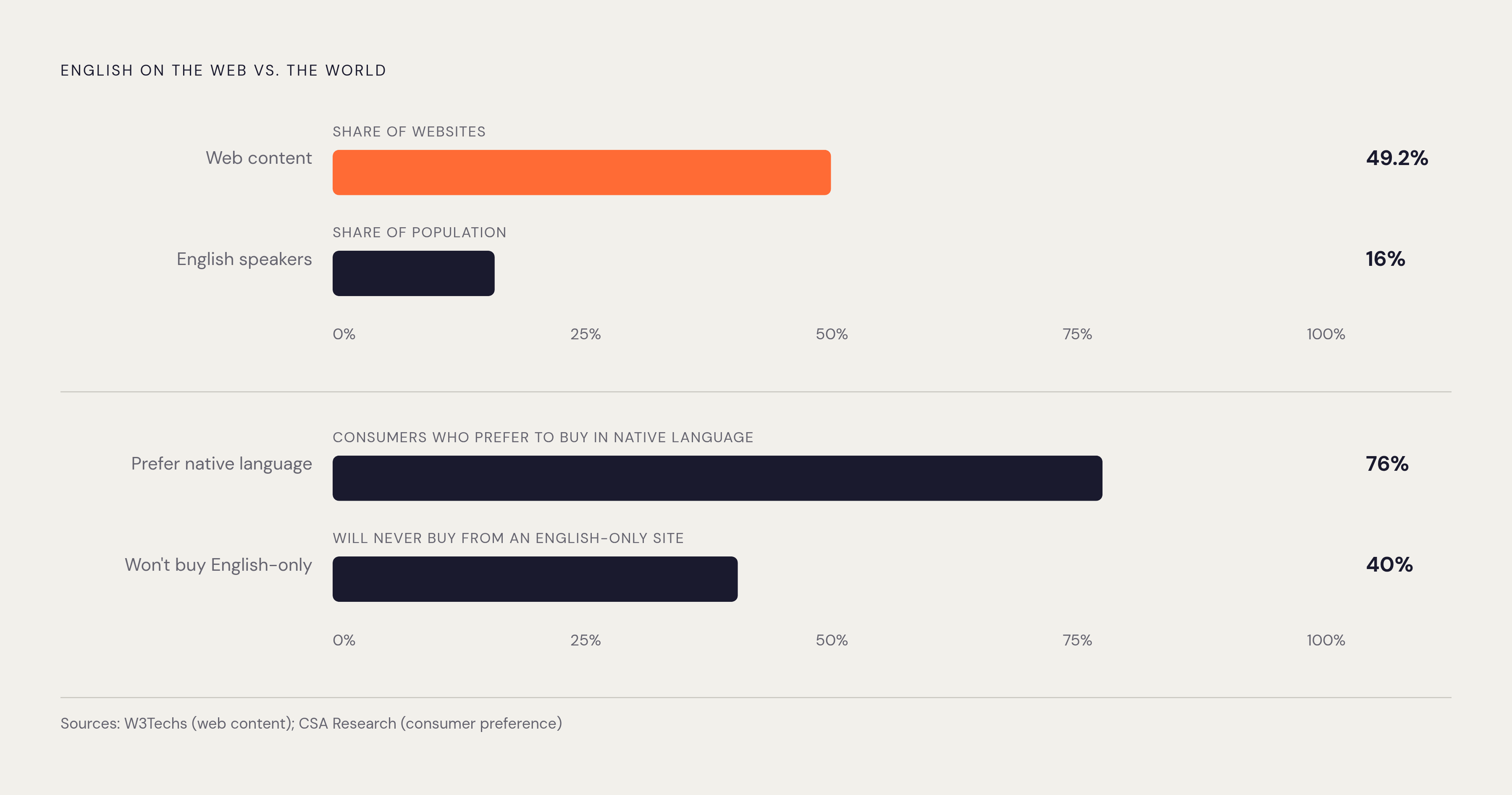
Running a campaign in more than one language used to be a bonus feature. It isn't anymore, and the numbers explain why. A CSA Research survey of 8,709 consumers across 29 countries found that 76% prefer to buy products described in their native language, and 40% say they will never buy from a website in another language https://innovalang.eu/en/blog-en/why-language-matters-in-global-online-sales/. A more recent update from Capital One Shopping put the figure for international shoppers who rarely or never buy from English-only sites at 59%, so the trend has gotten sharper, not softer, over time https://www.conveythis.com/blog/76-percent-of-shoppers-prefer-native-language-website.
The gap between where content lives and where buyers actually are is stark. W3Techs reports that English makes up 49.2% of the web, while only 16% of the world's population speaks it https://www.conveythis.com/blog/76-percent-of-shoppers-prefer-native-language-website. That mismatch is the entire localization industry in two numbers. Dr. Donald A. DePalma of CSA Research has pointed to the commercial consequence directly: brands that skip localization risk losing 40% or more of their total addressable market https://csa-research.com/Blogs-Events/CSA-in-the-Media/Press-Releases/Consumers-Prefer-their-Own-Language. Shopify merchants that translate their storefronts for non-English markets see conversion lifts ranging from 20% to 70%, averaging around 35% https://easyappsecom.com/guides/shopify-translation-multilingual-statistics. That's not a rounding error on a dashboard. A storefront that converts loses customers quietly when it doesn't, and those customers never file a complaint, they just leave.
The market has responded accordingly. The marketing localization service industry was valued at $6.53 billion in 2025 and is projected to reach $14.42 billion by 2034, a 9.2% compound annual growth rate https://dataintelo.com/report/marketing-localization-service-market. Cross-border e-commerce, the trade all this localization work ultimately supports, sat at $1.21 trillion in 2025 and is expected to climb to $1.84 trillion by 2030 https://www.conveythis.com/blog/76-percent-of-shoppers-prefer-native-language-website. This isn't a niche concern anymore, and treating it as one is the actual mistake most companies still make. It behaves like infrastructure: invisible when it works, expensive the moment it's missing.
Localization: translation, cultural adaptation, and transcreation as distinct workflow inputs
Localization gets used as a catch-all term, but the work underneath it splits into three distinct disciplines produced by that ambiguity. Translation converts source text into a target language with accuracy and fluency as the goal. It's the right tool for informative content where clarity matters more than persuasion. Localization goes further, adapting content to cultural context: regional preferences, legal norms, imagery, color meaning, date formats, and seasonal references that a straight translation would miss. Transcreation sits at the far end, blending translation with creative rewriting so the emotional impact and brand voice survive even when the actual words change completely. That's the discipline slogans, taglines, and campaign concepts need, because the goal there is persuasion over lexical accuracy.
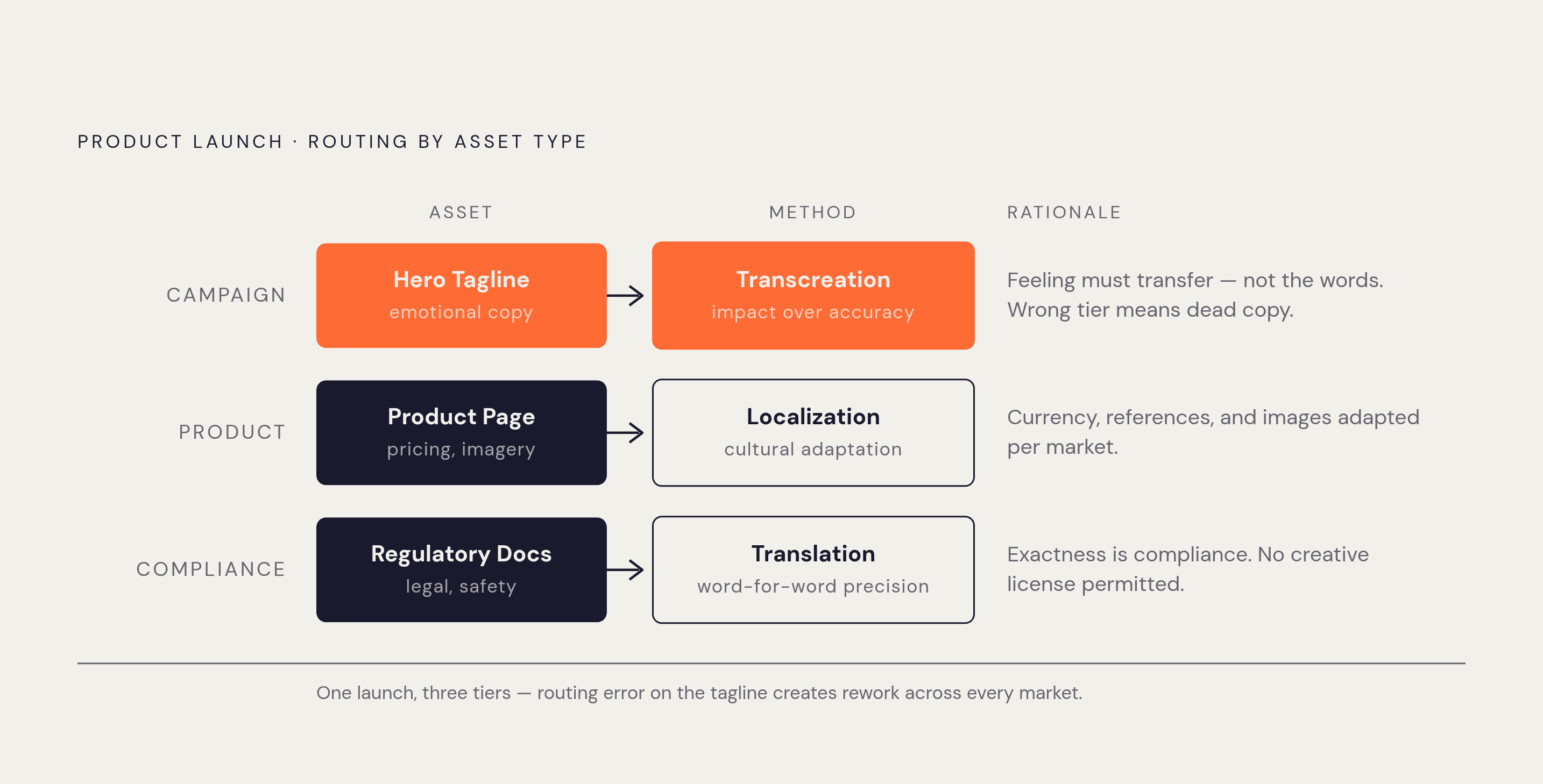
A single product launch might transcreate the hero tagline, localize the product page, and translate the regulatory documentation directly, three different methods inside one campaign. The tagline gets transcreated so the joke or the hook still lands. The product page gets localized so pricing, imagery, and cultural references fit the market. The regulatory documentation gets translated word for word, because a compliance officer reading it needs precision above everything else. Some platforms have formalized this routing logic into what they call a creative intent score: content with low creative intent routes to AI translation, medium-to-high intent goes to transcreators, and fully localized campaigns go to native copywriters. That's the model Translated.com runs on.
Commissioning the wrong service tier for a given asset creates rework loops that eat the time savings localization was supposed to deliver. A tagline sent to a translation vendor instead of a transcreator comes back grammatically correct and emotionally flat, and someone downstream has to notice, reject it, and re-route it, which costs more than getting the routing right the first time would have. Mapping content type to method before a single brief goes out is what prevents that loop.
Stage 1: Market research and content audit before a single word is written
The workflow starts before any copy gets drafted, and skipping this stage is the single most common reason localized campaigns underperform. Two research streams run in parallel ahead of briefing. The first is keyword and search research: what customers in the target market actually type into a search bar, which can differ substantially from search patterns in the source market. The second is social listening, used to surface local needs, complaints, and frustrations that appear in customer conversations but are absent from a keyword list.
Neither stream replaces direct human input. Interviewing customers in the target market builds a regional buyer persona grounded in how people there actually think, not how a central marketing team assumes they think. Consulting local marketing experts fills in the calendar gaps: the holidays, seasonal patterns, and traditions a team based in one country simply won't have on its radar.
Before any of that gets acted on, a content audit has to happen. The audit inventories what already exists so a team can tell what's adaptable for a new market and what has to be built from scratch, which avoids paying twice for content a translator or transcreator could have reworked instead. At many B2B marketing organizations, content planning runs from a centralized corporate function, which creates friction with local relevance and produces content waste along with diluted campaign performance. The audit is where that waste gets caught before the money is spent.
Stage 2: Content planning: mapping each asset type to the right localization method and workflow track
Planning is where the routing decision from Stage 1 gets locked in. Every content type on the calendar gets assigned to one of three tracks, translation, localization, or transcreation, based on its creative intent and audience risk. Doing this at the program level, rather than deciding case by case as each asset gets briefed, produces more consistent outcomes and more predictable costs across the campaign.
Part of that planning work is deciding what's locked and what's flexible. Visual identity and the core brand message usually stay fixed across markets. Copy, imagery, cultural references, and calls-to-action are what local teams get permission to adapt. Building shared template libraries around that split cuts production time for social and campaign assets from what would otherwise take days down to hours, because regional teams aren't rebuilding an asset from scratch every time. They're swapping components inside a structure that's already approved.
The other planning decision concerns authority, not assets: where does a piece of content need central sign-off, and where can a regional marketer just ship it? Routing everything through central approval slows execution to a crawl as market count grows, and that bottleneck is what actually kills localization programs, more often than bad translation does. Giving local teams the authority to move within clearly defined limits is what keeps the workflow from choking on itself at scale.
The gap between where content lives and where buyers actually are is stark.
Stage 3: Source content creation designed for localization from the start
Localization quality gets decided upstream of the localization team, at the point where source content gets written. Copy built with neutral, idiomatic language, free of culture-specific humor, slang, or references that don't survive translation, gives every downstream market a fair shot at a clean adaptation.
Length is a related, often underestimated issue. Translated text frequently runs longer than its English source, and UI components, ad formats, and print layouts need room to expand without a redesign.
Glossaries and style guides need to exist before content reaches a linguist, not after. Brand terminology, product names, and any phrase that must stay untranslated, or must be translated the exact same way every time, belongs in a document that feeds directly into the translation management system's terminology function in the next stage. Structuring source content modularly, headlines, body copy, CTAs, and image blocks as separate, swappable components, is what makes the template-first model from Stage 2 actually work, because regional variants can swap one piece without rebuilding the whole asset.
Stage 4: TMS-integrated translation and machine-assisted production
A translation management system in 2026 does a lot more than track a spreadsheet of pending jobs. It pulls content directly from source systems, whether that's a CMS, a code repository, or a design tool, applies translation memory and terminology rules, coordinates the handoff between AI and human translators, runs quality checks, and pushes finished translations back into production automatically. It functions less like a tracker and more like a dispatcher keeping several moving parts on the same schedule.
The pipeline itself follows a consistent loop: human linguists post-edit, QA, and approve.
The resourcing behind that loop is now explicitly hybrid. AI handles somewhere around 80 to 90% of content volume. The efficiency gains come from that share. Professional linguists concentrate on the harder remaining share, the creative adaptation and quality judgment that actually defines brand voice, and that's the part no model handles reliably yet. Lokalise reported that 70% of professional language workflows are now machine-assisted in some form, which tracks with how far this hybrid model has already spread https://www.conveythis.com/blog/76-percent-of-shoppers-prefer-native-language-website.
Platform choice tends to follow team type rather than company size alone. Developer teams translating software strings gravitate toward Lokalise or Crowdin. Enterprise teams running complex, multi-system pipelines lean on Smartling or Phrase. Business teams translating documents and marketing content, without a developer-heavy stack, often use Taia. XTM Cloud positions itself around workflow automation and AI-powered translation, with more than 60 integrations across CMS, design, developer, and marketing platforms.
Stage 5: Legal, compliance, and cultural review before regional deployment
Legal exposure isn't uniform across markets, and treating it that way is where localization programs get burned. Privacy law, advertising standards, and product claims requirements vary significantly from one country to the next, and a compliance failure in a new market can do reputational damage faster than the same mistake at home, simply because there's less institutional trust to absorb it.
Review at this stage has to split into two separate functions, not one. Legal and compliance review checks that localized materials meet the target market's advertising law, data privacy rules, and any sector-specific regulation. Cultural review asks a different question entirely: does the adapted imagery, color palette, humor, and call-to-action actually land the way it's supposed to? Content can pass legal review cleanly and still damage brand perception if the cultural read is off. A color that signals celebration in one market can signal mourning in another, and no compliance checklist catches that, because compliance checklists are built to catch legal exposure, not offense.
The people running cultural review need to sit in-market, not centrally. A team based at headquarters, however experienced, is structurally not positioned to catch resonance problems a local reviewer would flag on first read. Localization testing, verifying the final content actually resonates before it goes live, deserves its own formal checkpoint. Folding it quietly into a general sign-off is how it gets skipped.
Stage 6: Regional deployment and channel-specific distribution
Deployment is a set of channel-specific decisions. It's a set of channel-specific decisions. TikTok, Instagram Reels, YouTube Shorts, LinkedIn, WeChat, LINE, and VKontakte each carry distinct format requirements, algorithmic behavior, and audience expectations, and an asset approved for one of them frequently needs reformatting before it works on another. A vertical video cut for Reels doesn't automatically translate, format-wise, to a LinkedIn feed post, even after the language work is finished.
The decision to launch simultaneously across markets or stagger the rollout by region shapes everything downstream. Continuous localization workflows make simultaneous global launches realistic in a way older, batch-based processes never allowed, replacing the delayed regional rollouts that used to be the default. That choice, made early, determines how the TMS gets configured and how review gets scheduled, so it isn't something to leave open until the week before launch.
A properly integrated TMS delivers its clearest mechanical benefit here. Approved translations push automatically to regional subdomains, localized app store listings, and market-specific landing pages, without manual uploads, and manual uploads are exactly where version errors tend to occur. On the SEO side, updates to the primary site replicate automatically across local subdomains in a continuous localization setup, which protects organic search rankings market by market. Localized, culturally aware content also performs better on-page on its own, which feeds back into visibility without any extra work.
Stage 7: Measurement, feedback loops, and iterating the workflow as market count grows
Once content is live, the signals to watch are open rates, click-through rates, shares, and on-page engagement, measured against a non-localized control where one exists. If the localized version is doing its job, those numbers climb relative to a generic, one-size-fits-all campaign.
Weak performance in a given market doesn't automatically mean the translation was bad, and assuming so is the laziest read of the data available. It could mean the source content itself was never aligned with local buyer behavior, or the channel mix was wrong for that region, or the cultural adaptation missed, or a content type got routed to the wrong method back in Stage 2. Measurement's real job is diagnostic. It points at where in the workflow something broke, rather than confirming that everything downstream of translation worked fine.
The results should flow back into the system and inform a quarterly review. Phrasing that performs well in a market ought to get added to the TMS's translation memory and terminology database, so it's ready and reusable the next time similar content needs to go out. Translation memory grows, templates get reused, review processes become routine, and the marginal cost of adding a new market keeps falling as the system matures. None of that compounding happens by accident. It happens because the earlier stages were built with structure in mind from the start.
Organizational structure that makes the workflow repeatable (centralized strategy with local execution rights)
The organizational model that keeps this from collapsing under its own weight splits authority cleanly. Central teams own brand strategy, meaning core themes, visual identity, and brand voice, while local teams hold execution authority over copy, cultural references, imagery, and calls-to-action. That split is the actual answer to the standardization-versus-adaptation debate, and companies that keep re-litigating it market by market are solving a problem that's already been solved.
What stays locked centrally is brand identity, the campaign concept, and any claim that's already cleared compliance review. Everything else, language choices, examples, seasonal references, imagery selection, and platform-specific formatting, gets delegated to the people closest to the market. It's a response to what the data already shows, not a concession made for morale. It's a response to what the data already shows: 76% of online shoppers prefer to buy when product information is available in their own language, and 40% won't buy from a site in another language at all https://insights.csa-research.com/aim/en/reports/305013126/marketing. A centralized team half a world away cannot make those local judgment calls fast enough to matter, and pretending otherwise is how good campaigns die in committee. Nimdzi Insights puts the global language services industry's annual growth rate at 6% https://linguaserve.com/en/blog/website-localization-examples/.
Sources
- Continuous Localization: Benefits, Tools and Best Practices
Informed the discussion of continuous localization workflows enabling simultaneous global launches instead of delayed regional rollouts.
- Localization technology in 2026 – a complete guide to the modern localization ecosystem | RWS
Informed the description of what a modern TMS does in 2026, including pulling content from source systems, applying translation memory, and coordinating AI and human translators.
- https://lokalise.com/blog/best-ai-translation-tools/
Provided the statistic that 70% of professional language workflows are now machine-assisted in some form.
- Marketing Localization: A Guide to Connecting with International Audiences
Informed the workflow routing logic mapping content type to localization method and the discussion of TMS integration with source systems.
- Multilingual and Multi-Market Campaigns: How to Balance Global Strategy with Localized Creative Content - DropSure - Make Dropshipping Sure
Informed the organizational model section describing the split between centralized brand strategy and local execution authority.
- https://csa-research.com/l/media/Consumers-Prefer-their-Own-Language
Provided the CSA Research figures on consumer language preferences and the warning that brands skipping localization risk losing 40% or more of their total addressable market.
- https://phrase.com/blog/posts/transcreation-marketing-across-cultures/
Informed the explanation of transcreation as blending translation with creative rewriting so emotional impact and brand voice survive even when actual words change.
- https://translated.com/resources/cultural-adaptation-strategies-beyond-translation
Provided the creative intent scoring model where content routes to AI translation, transcreators, or native copywriters based on creative intent level, attributed to Translated.com.