Campaign Launch Timeline for Content-Heavy Campaigns
Backward timelines and locked approval gates prevent production collapse.

Content-heavy campaigns rarely fail because the creative was weak. They fail because production, review, and distribution collapse into each other, and by the time anyone notices, there's no runway left to fix it. Teams blame the copywriter, the video editor, the agency, when the real problem sits upstream in a timeline that was never built to hold the weight of what it was carrying.
A campaign runs as a phased, interdependent system: each phase only works if the one before it finished cleanly. Skipping that causes the team to borrow time from a future phase that has none to spare.
Somewhere between 60 and 70% of B2B content never gets used at all, built without real alignment to buyer intent or a distribution plan. Volume-first production doesn't build a campaign. It produces output, and output without sequencing is just noise with a due date. The teams that skip straight to production, convinced that more assets equal more coverage, are the ones running dry by week six.
The backward-build principle changes how you scope a campaign
Backward-building means anchoring the whole timeline to the launch date and working back, phase by phase, until landing on a briefing date. Most teams do the opposite: they plan forward from whenever they happen to be ready to start. That habit is the wrong default, and it's the single most common cause of the compression that follows.
Forward planning fails for a structural reason. It assumes handoffs go smoothly, stakeholders answer when needed, and nothing sits in someone's inbox for four days. When reality runs slower than the plan, the compression lands hardest on whatever phase sits closest to launch, which happens to be the phase where compression does the most damage.
Building backward forces honesty early. It shows, in black and white, whether the production window even fits between the brief date and the go-live date. Resource conflicts appear in week one of planning instead of week three of production because that's when the team discovers the video editor is already booked on another job. "Figure it out later" The "figure it out later" mindset turns the resource conflict into a visible gap on a calendar that someone has to explain out loud.
Timeline length varies by campaign type, and pretending otherwise is part of what gets teams into trouble. Campaign timelines vary considerably by type; video-led work needs longer than most. Influencer-integrated campaigns tracked in Q1 2026 ranged from as short as 4 weeks to as long as 14, and the primary delay driver wasn't creator sourcing, as most people would guess. It was legal review and claim approvals.
Phase one: strategy and briefing as a hard gate, not a formality
This phase has to produce two concrete things: an approved strategy document covering goals, audience, offer, channels, and success metrics, and a detailed campaign brief covering budget, messaging, formats, and deadlines. Neither is a slide deck people nod along to in a meeting. Both need formal sign-off before a single asset gets built. Skipping that sign-off is the single most common false shortcut in this phase, and it's the one teams take most often because it feels harmless in the moment.
Without that gate, production begins before alignment is confirmed. Misalignment surfaces at review, when fixing it costs far more than it would have on day one.
Vague goals are where this usually starts to go wrong. "Increase leads" is a hope, not a campaign goal. A workable goal is specific, measurable, and bound to a date: something closer to "generate 500 qualified leads from enterprise accounts within 60 days." That specificity is what lets phase three and phase six of the campaign get measured against something real, later.
Budget clarity belongs here too, not bolted on once production is already underway. A campaign that starts building before budget is locked will renegotiate scope mid-production, and that renegotiation always costs more time than settling it up front would have.
Phase two: the brief must ship before shooting starts
For video-led campaigns, the production brief needs to go out by week two, even if principal shooting doesn't start until week four. That gap isn't dead time. Scripting, pre-production, and scheduling fill it, and none of that work is optional padding, whatever it looks like on a project timeline chart.
A quality 30-second video unit requires substantial lead time spanning scripting, shooting, and editing. Starting that clock late compresses every phase behind it, editing, review, distribution prep, at the same time, not one at a time. Late starts don't push the problem down the line a step at a time. They stack it, all at once, right before launch.
Production covers more than the creative itself. Landing pages, copy, and channel-specific formats all need building against the brief, then checking for brand consistency, accessibility, and platform specs before any of it reaches an approver. That checking step gets skipped more often than it should, usually under time pressure, and skipping it doesn't remove the problem. It just moves the problem into the approval phase.
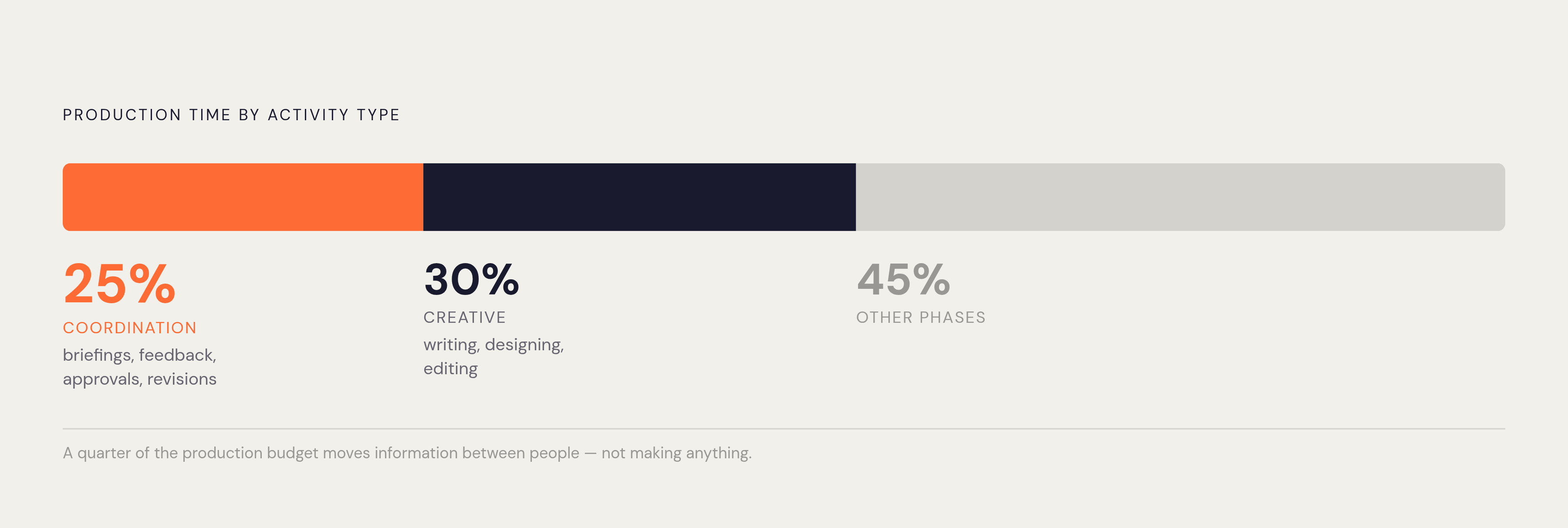
Roughly 30% of total production time goes to the creative work itself: writing, designing, editing. Another 25% gets eaten by coordination: briefing, gathering feedback, managing revisions, processing approvals. A quarter of the entire production budget goes to moving information between people, not making anything, and that ratio alone should tell a team where its next bottleneck is coming from.
Somewhere between 60 and 70% of B2B content never gets used at all, built without real alignment to buyer intent or a distribution plan.
The approval bottleneck: where timeline control is lost
Most campaigns lose their schedule here, not in production. Teams misdiagnose this most consistently: they add editors and designers to fix a delay that's actually sitting in a review queue. Adobe's research puts the scale in stark terms: 89% of marketers say content has to pass through three or more approval stages, and 58% say more than 40% of their time goes to managing reviews and approvals rather than strategy or creative work.
The downstream effect is predictable. Data from blogsync.io shows 52% of companies miss deadlines specifically because of approval delays, with the average approval cycle running eight days from submission to sign-off. Eight days, repeated across a dozen assets, eats most of a production sprint before anyone touches distribution.
The root causes repeat across organizations in a recognizable pattern. Too many people hold approval authority with no clarity on who actually has final say. Feedback guidelines stay vague, so revisions turn subjective and circular, a loop where round three of edits contradicts round one. Handoffs between teams have no defined procedure, so every new campaign reinvents its own workflow from scratch, mistakes included.
Manual process drives most of this. Recent industry analysis found that 60% of teams name manual process as their single biggest content production issue. Research from business.adobe.com adds detail: 36% of marketers cite time constraints on creation and ideation, 33% cite siloed team collaboration, 31% cite lengthy manual approvals. Friction stacked on friction, none of it related to the quality of the creative itself, is the actual shape of this bottleneck.
Phase three: pre-launch audience warm-up as a campaign phase, not a countdown
The point of this phase is to arrive at launch week with an audience already primed to act. Treating pre-launch as a countdown, a few days of teaser posts before the "real" campaign starts, gets the function of the phase backwards, and it's the mistake that turns a launch into a cold open.
Email list building, influencer seeding, paid social warm-up, and PR outreach all belong here, and each runs on its own lead time. Seed content with a creator too late and the post goes out flat. Starting paid warm-up too late means the algorithm never gets the signal it needs before spend ramps.
Most teams underbudget this window badly. A standard content-heavy campaign needs several weeks of pre-launch engagement just to get an audience warm. Large seasonal pushes, with the major year-end shopping weekend as the clearest example, now run 90 to 120 days of warm-up as a matter of course.
That long runway matches how buyers actually behave: roughly 75% of B2B buyers take up to four months to reach a final purchasing decision. A pre-launch window built on the assumption that buyers are ready to act the moment the campaign goes live misreads the sales cycle it's supposed to serve.
Launch week execution and the first-week optimization window
Launch day needs a minute-by-minute timeline. Documented go-live times for each asset, defined monitoring start points, checkpoints built in ahead of time for the first round of decisions: none of that gets improvised well in real time.
Every milestone date has to be written down and shared: launch date, key content delivery dates, paid spend ramp dates, optimization phase windows, campaign end date. Ambiguity here breaks team coordination at precisely the moment speed matters most, a strange time to discover nobody agreed on what launch actually meant.
The first week of live data is the highest-value stretch of the entire campaign for optimization. Click-through rates, cost, and conversion rates need daily monitoring, not weekly. If one channel is clearly outperforming the others by day three, budget should move toward it immediately, not sit until the scheduled mid-campaign review because that's what the plan says. The schedule exists to serve the campaign.
Post-launch measurement and the ROI loop 83% of marketing leaders still can't close
83% of marketing leaders call ROI demonstration a priority, yet only 36% say they can actually measure it with any accuracy. That gap is a planning problem that existed from the start: measurement infrastructure built as a post-launch afterthought fails right when it's needed most.
A working cadence looks like daily reviews during launch week, weekly component-level reviews in the weeks after, and a full end-of-campaign analysis measured against the specific, time-bound goal set back in phase one. Skipping that last step, or never setting a real goal in phase one, leaves nothing concrete left to measure against.
Done properly, post-launch analysis attributes performance by channel, showing which distribution channels drove qualified results rather than just impressions. It flags which content assets underperformed relative to what was spent producing them. And it feeds a documented loop back into the next campaign's brief phase, so campaigns run as repeatable systems improve each cycle, while campaigns run as one-off events repeat the same errors, because nobody wrote down what went wrong the first time.
Many brands now run hybrid models: an always-on baseline maintaining visibility, with short-term activations layered on top for spikes. Post-launch analysis needs to separate what the burst activation actually contributed from what the baseline was already delivering. Conflate the two, and every campaign ends up looking more successful, or less, than it actually was.
Compounding failures from compressing a single phase
Each phase gates the next one. That's the whole logic of building backward, and it's also why compressing a single phase never stays contained to that phase. A shortened phase deforms whatever depends on it, which deforms the phase after that, all the way to launch day.
Trace it through concretely. A brief that skips formal sign-off means production starts on assumptions nobody validated, so approval cycles multiply because stakeholders correct direction instead of reviewing finished execution. A production brief that ships late pushes shooting later, which compresses review time, which worsens the approval bottleneck, which shrinks or eliminates the pre-launch warm-up window. No warm-up window means the campaign launches cold, so first-week data reads as noise instead of signal, so budget reallocation decisions get made without enough information to trust them. By the time post-launch analysis runs, nobody can tell if the campaign failed or the audience simply wasn't ready.
The real cost of compressing a phase is never just delay. Every phase after it arrives with less time, less information, and less margin to absorb the problems that phase was always going to surface anyway.
Agencies running formal, documented approval processes complete campaigns 35% faster, and that number is the whole argument in miniature. Documenting phase gates, brief sign-off, production handoff, and approval authority is what compounds speed instead of eroding it, across the entire timeline, not just at the point where the documentation lives.
Sources
- What’s the ideal timeline for influencer marketing campaigns?
Provided the statistic that 75% of B2B buyers take up to four months to reach a final purchasing decision, used in the pre-launch section.