Content Repurposing Workflow From Long-Form to Multi-Channel
Strategic extraction before formatting turns one piece into many faster.
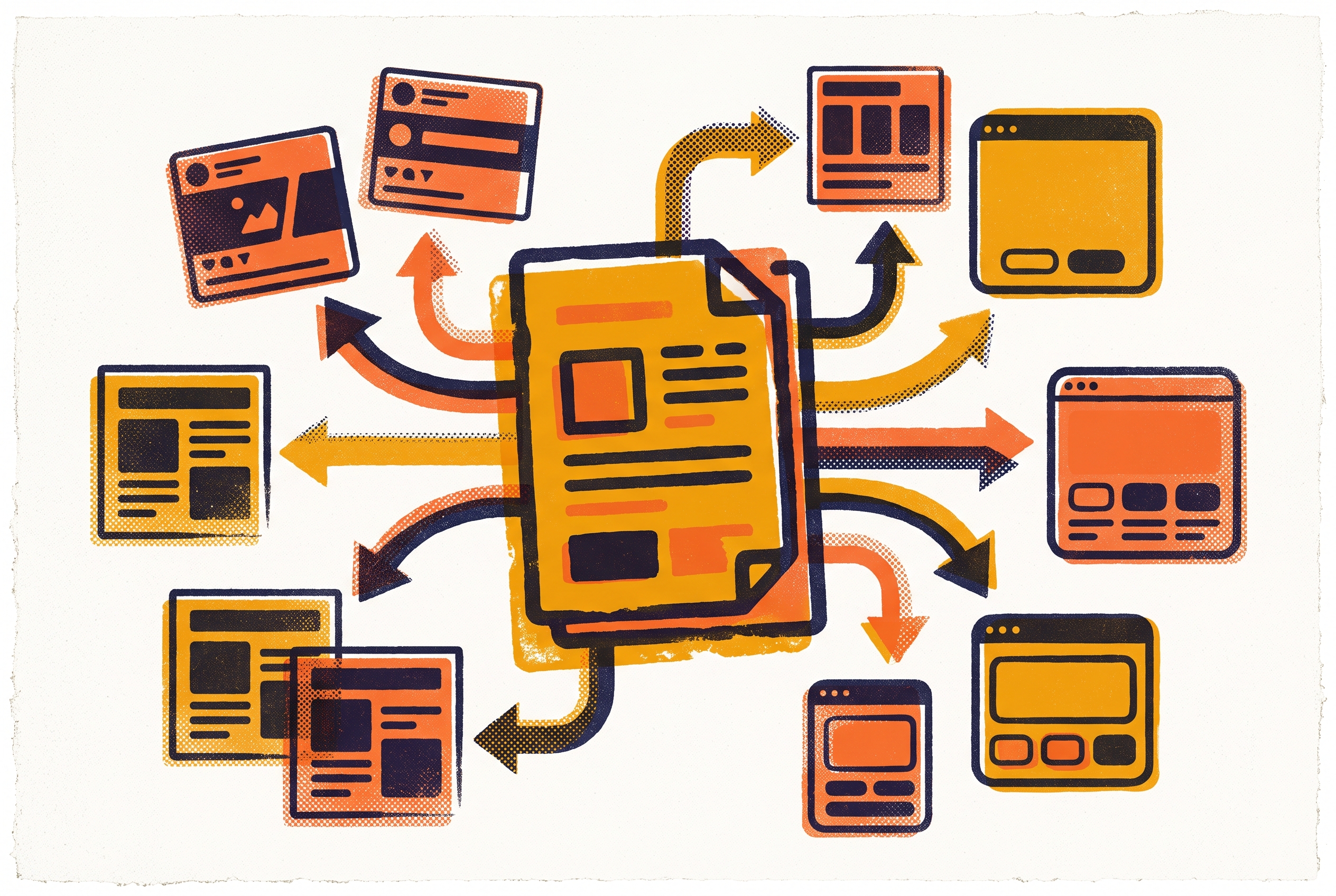
Content repurposing has a math problem before it has a creative one. Most long-form assets reach maybe a tenth of their potential audience because turning one asset into many takes longer by hand than most teams can sustain (CreatorSkills, May 2026). The fix people reach for is more tools. That approach has it backwards, treating more tools as the fix when the sequence itself is reversed. The fix that actually works starts with a strategic extraction step, deciding which ideas inside a long-form piece are durable enough to travel, before a single format decision gets made.
About 80% of marketers now use AI somewhere in content production, and yet 61% say the industry is living through its biggest disruption in twenty years (Playable, April 2026), making the urgency behind this concrete rather than abstract. About 80% of marketers now use AI somewhere in content production, and yet 61% say the industry is living through its biggest disruption in twenty years (Playable, April 2026). More software has produced more noise, not more clarity. That's the paradox this piece is built to untangle: the answer isn't another app in the stack, it's a sequence, starting with what to extract, followed by where it goes and in what order.
Repurposing, done right, is not reposting the same paragraph five places with a different logo on it. It's taking one core message and rebuilding it, format by format, to match how each platform's audience actually reads, watches, or scrolls. That distinction carries the rest of this argument.
What the zero-click and AI-search shifts mean for where repurposed content must appear
Search results have stopped sending people anywhere. Nearly 60% of searches now end without a click, because Google's AI Overviews and other generative engines answer the question right there on the results page (Playable, April 2026). That number was not always this high. In the twelve months after AI Overviews launched in May 2024, the zero-click rate climbed from 56% to 69%, a 13-point jump in a single year (Similarweb, July 2025, via writer.com).
The click-through damage is concentrated exactly where it hurts most. Ahrefs looked at 300,000 keywords and found that when an AI Overview shows up, the top-ranking organic result's click-through rate falls from 0.073 to 0.016, a drop of about 58% (via writer.com), most of the traffic that used to land on the number-one spot simply not arriving anymore. That's not a dip. That's most of the traffic that used to land on the number-one spot simply not arriving anymore.
The traffic that does come through AI surfaces converts far better than what's left of organic search. AI referral visitors convert at 14.2%, against 2.8% for regular Google organic traffic. Break it down by engine and it gets sharper still: 15.9% conversion from ChatGPT referrals, 10.5% from Perplexity, 5% from Claude, all measured against a 1.76% organic baseline (Seer Interactive, June 2025, via omnibound.ai). Fewer visitors, but far more of them ready to act.
B2B buying behavior backs this up from the demand side. A survey found 84% of B2B CMOs now use AI or LLMs somewhere in vendor discovery (Wynter). Getting cited inside an AI answer isn't a nice-to-have anymore, it's top-of-funnel infrastructure.
So the repurposing workflow can't stop at social captions and a newsletter blurb. It has to output formats an AI engine can actually lift and cite: structured Q&As, definition-first posts, claims backed by a specific number, plain factual summaries. Once that's settled, the next question is which ideas inside the source asset deserve that treatment, and which belong somewhere else entirely.
The strategic extraction step: identifying which ideas inside a long-form asset are worth repurposing
Start with what's already proven itself. Pull GA4 for the website content, YouTube Analytics for video, the email platform's own reporting for newsletters, native analytics for podcasts. Rank by impressions, clicks, dwell time, conversion, and put the outperformers at the front of the repurposing queue.
The real question at this stage isn't "how do I chop this article into pieces." It's narrower and harder: which ideas inside this asset stand on their own, for a specific audience, on a specific surface. Not every paragraph deserves a second life. Some ideas only make sense in the argument's full context; others are self-contained enough to become a LinkedIn post or a 45-second clip with nothing lost.
Design the pillar content like a set of LEGO bricks from the start, not as one continuous argument that has to be broken apart after the fact (playable.video). A webinar or long article structured around discrete, complete points, rather than one unbroken narrative thread, produces cleaner extraction later. The logic holds up simply because a complete idea, cut loose from its neighbors, still makes sense on its own. A half-finished thought does not.
That's also the operating principle behind the COPE model, Create Once, Publish Everywhere: one pillar asset, a long article, a research report, a podcast episode, sits at the source, and everything downstream is derived from it (Playable, April 2026). Nobody's writing five separate pieces of content. They're writing one and mining it five different ways.
AI tools have gotten genuinely good at the mechanical half of this. Feed a transcript into the right tool and it'll pull out key insights and spit back platform-specific drafts in minutes; organizations running these workflows report cutting content production time by 60 to 75% (koanthic.com). Organizations running these workflows report cutting content production time by 60 to 75% (koanthic.com), a genuine time-saver.
What it doesn't do is decide which ideas matter. An algorithm can find the sentence with the highest engagement signal in a transcript. It can't tell you which idea supports the brand's long-term authority positioning and which one is just a throwaway aside that happened to sound punchy. That judgment call stays human. Apply this test: does this idea explain a mechanism, define a term precisely, cite a specific number, or answer a question the audience keeps asking. Ideas that do one of those four things travel. Ideas that only make sense wrapped in the surrounding argument don't, no matter how quotable they sound in isolation.
Mapping extracted ideas to formats and channels based on how each platform consumes content
Once the durable ideas are pulled out, they need a home that fits how people actually use that platform. Website and blog content, built for SEO, remains the number-one ROI-generating channel by Playable's April 2026 accounting, and it's the natural anchor for the long-form pillar itself.
Short-form video, TikTok, Reels, YouTube Shorts, delivers the highest ROI of any video format tracked. It's the right home for narrative moments and data points that run under 90 seconds; anything that needs more setup than that belongs somewhere else. LinkedIn is a different animal: video viewership there has grown substantially year over year, but carousels consistently outperform both video and static images, because the reader controls the pace of a carousel in a way they can't with autoplay video. That makes carousels the natural fit for frameworks and step-by-step arguments, the kind of content where the reader benefits from pausing on slide three before moving to slide four.
Email stays a direct line: a short summary of the top three or four lessons from the source asset, with a link back to the full piece, gives a subscriber something useful immediately and a clear path deeper if they want it.
One interview can become ten distinct assets (podcastvideos.com). Three vertical video clips, 30 to 90 seconds each, auto-captioned, for LinkedIn, TikTok, and Shorts. One long-form article expanding the core themes, built for search indexing. Three social posts, each built around a single lesson or data point. One quote graphic pulling the most provocative line from the conversation. One newsletter recap with a link to the full episode. One executive summary formatted for a fast LinkedIn read.
That list gets people most of the way there, but it's missing something the zero-click shift makes mandatory: the AI-citability formats. Structured Q&As, definition-lead posts, factual summaries, claims tied to a specific stat, aren't social content in the traditional sense. They're built for a different reader entirely, a generative engine scanning for something quotable and precise, and they need to be part of the standard output, not an afterthought bolted on later.
The shape of the idea should decide the format, not the other way around. A mechanism explanation becomes a carousel or a definition-led article. A narrative beat becomes a video clip. A number becomes a quote graphic, or a cited claim inside a piece built for AI retrieval.
Repurposing, done right, is not reposting the same paragraph five places with a different logo on it.
Building the repurposing workflow: the tool stack and the sequence that makes it repeatable
The tool stack breaks into roughly four categories, and getting the order right affects which tools actually deliver results (CreatorSkills, May 2026).
First, transcription. YouTube's automatic captions are free and good enough for most repurposing work. Descript adds speaker labels, useful for podcast interviews with more than one voice. For custom builds at scale, API-level services like AssemblyAI or Deepgram do the job. This step comes before anything else, because every downstream tool works off the transcript, not the raw audio or video.
Second, AI text adapters, tools that take the cleaned transcript and generate platform-specific drafts: a thread, a LinkedIn post, a newsletter section. The real differentiator between these tools isn't speed, it's whether the output remembers the brand's voice from one run to the next or forces a manual rewrite every time to sound like the brand again.
Third, video-to-clips tools. Opus Clip, running $15 to $29 a month, auto-identifies the highest-engagement moments in a video and outputs caption-ready vertical clips. Descript, at $16 to $35 a month, handles both editing and clip extraction in one place, which suits podcasters who don't want to juggle two separate tools.
Fourth, scheduling and distribution. Buffer, at $6 to $12 per channel per month, and Later, running $25 to $110 a month, handle posting across Instagram, TikTok, LinkedIn, Twitter/X, Pinterest, and YouTube. These tools distribute content. They don't create it, and they won't fix a weak extraction decision made three steps earlier.
The sequence itself runs in five steps. Grab the transcript first, maybe five minutes of work, cleaning out timestamp codes so what's left is the full text, examples, anecdotes, and specific numbers intact. Run that cleaned transcript through the AI text adapter to generate the derivative drafts, a thread, LinkedIn posts, captions, newsletter copy, a Shorts script, a blog outline, all in one pass. That step alone used to take three to four hours by hand; with AI assistance it runs 20 to 45 minutes (CreatorSkills, May 2026).
Then comes the step nobody should skip: human review. AI output is a starting point, not finished copy. Someone has to check the voice matches the brand, confirm the claims are still accurate once pulled out of context, and make sure each piece actually fits the audience it's headed toward. After that, run the source video through the clips tool and check its auto-selected moments against the ideas flagged during extraction, because the algorithm optimizes for engagement signals, not for which idea the team actually decided was strategically important. Only then does scheduling happen.
Governance matters more as volume goes up, not less. When one asset becomes a blog post, a sales deck slide, and three social captions, the context around a claim shifts each time it moves, and claims can quietly drift from what the source actually said. Each version needs a check for audience fit and factual accuracy, because scale only helps if the meaning survives the trip.
For agencies juggling several brands at once, multi-agent AI systems can split the load, research, drafting, optimization, distribution, each running under shared brand rules, with the full pipeline treated as distinct stages: ingestion, synthesis, governance, distribution. The time savings compound from there. Work that took three to four hours by hand now runs 20 to 45 minutes with AI in the loop, and that gap is what turns repurposing from an occasional bonus project into the default thing that happens to every long-form asset the moment it ships.
Distribution sequencing: how to release repurposed formats in an order that builds rather than fragments attention
Order matters here, and it's not arbitrary. Start with the written pillar, the blog or website piece built for SEO and AI citability. Follow with short-form video. Layer in LinkedIn and other social formats after that. The logic tracks where attention actually compounds: publish the anchor first so everything else has somewhere solid to point back to.
AI engines lean toward fresh, recently updated content, especially on topics that shift quickly. A staggered release, spread across days or weeks rather than dumped all at once, signals ongoing activity instead of a single publish-and-forget event, and that keeps the material easier to retrieve later (Playable, April 2026).
A content calendar is what actually makes this operational rather than aspirational. It coordinates the release across platforms and across whoever's responsible for each one, and it heads off the most common failure mode: publishing every derivative format on the same day, which compresses ten pieces of content into one narrow window of attention instead of spreading reach across weeks.
One long-form asset, sequenced properly across its ten derivative formats, can sustain a presence across multiple platforms for weeks rather than days. The goal isn't hitting every channel simultaneously, it's maximizing reach per hour spent producing the thing in the first place.
Publish the AEO-optimized formats, the Q&As, the definition-led pieces, the structured summaries, before or alongside the social push, not after it. That way, when social traffic starts searching the topic, the AI-citable version is already indexed and ready to be pulled into an answer.
Skip the sequencing and the failure mode is obvious enough: social posts referencing an article that hasn't gone live yet, video clips whose context makes no sense without a long-form piece that isn't published. That reads as sloppy, not strategic, and it undercuts the very reach the repurposing was supposed to build.
How repurposed content feeds AI visibility and why GEO-specific formats must be part of every workflow
Most AI citations don't come from a brand's own website. About 85% of brand mentions inside AI search answers originate from third-party pages, and a brand is roughly 6.5 times more likely to get cited through someone else's site than through its own. That single fact changes what repurposing is for: getting derivative content placed in earned media and third-party coverage isn't a bonus tactic, it's close to the main point of the exercise for AI visibility specifically.
Academic research backs up which formatting choices actually move the needle. Research published on arXiv found that content optimized along generative-engine-specific lines can see up to 40% higher visibility inside AI-generated answers, with citation density, definition-first structure, and statistical enrichment identified as the primary drivers of what gets picked up and cited (Princeton University et al., arXiv:2311.09735). That maps directly onto what a well-run repurposing workflow should already be producing: FAQ-style articles, definition-led posts, pieces enriched with specific numbers rather than vague claims. The formats and the research converge; the workflow just has to be built with citability in mind from the start rather than as an afterthought.
Staying visible once is not the same as staying visible. Only 30% of brands remain visible from one AI answer to the next on the same query, and just 20% hold visibility across five consecutive runs (AirOps, 2026 State of AI Search). That's not a volume problem, more content alone won't fix it, it's a structure and authority problem, and it means GEO-specific formatting has to sit inside the repurposing workflow permanently, not as a one-time optimization pass.
Early movers are pulling ahead measurably. Brands that adopted AEO and GEO practices early report brand mention rates 60 to 80% higher than competitors who haven't optimized yet (omnibound.ai). Once a competitor builds topical authority across a hundred or more interlinked pages built for AI retrieval, unwinding that lead takes six to twelve months of sustained work, not a quick sprint. That timeline alone is the argument for treating GEO formatting as a permanent line item in the workflow.
AI source patterns and buyer prompts shift fast enough that a GEO strategy needs a quarterly refresh: check which formats are actually getting cited, and adjust what gets produced next based on that, rather than running the same playbook indefinitely and hoping it still works.
Sources
- How to Repurpose Content Across Multiple Channels
Provided the statistics on AI use in content production, the zero-click rate figures, and the COPE model framework referenced throughout the article.
- Maximizing Content Efficiency in 2026 Through Strategic Podcast and Video Repurposing Workflows
Supplied the example breakdown of how one interview can become ten distinct assets across formats.
- AI-Powered Content Repurposing: Tools and Workflows for
Provided the workflow sequence details, tool stack categories, and the time-savings figures comparing manual versus AI-assisted repurposing.
- Content Repurposing AI: Complete Multi-Channel Guide 2026
Sourced the figure that organizations using AI repurposing workflows cut content production time by 60 to 75%.
- Zero-Click Marketing: What the 2026 Data Means | Similarweb
Provided data on the zero-click rate climbing from 56% to 69% in the year following AI Overviews' launch.
- How to Create a Scalable Content Repurposing Workflow
Informed the section on building a scalable, repeatable repurposing workflow with distinct stages and sequencing.