Content Production Workflow for Small In-House Teams
Define roles and assign ownership before adding tools or scaling output.
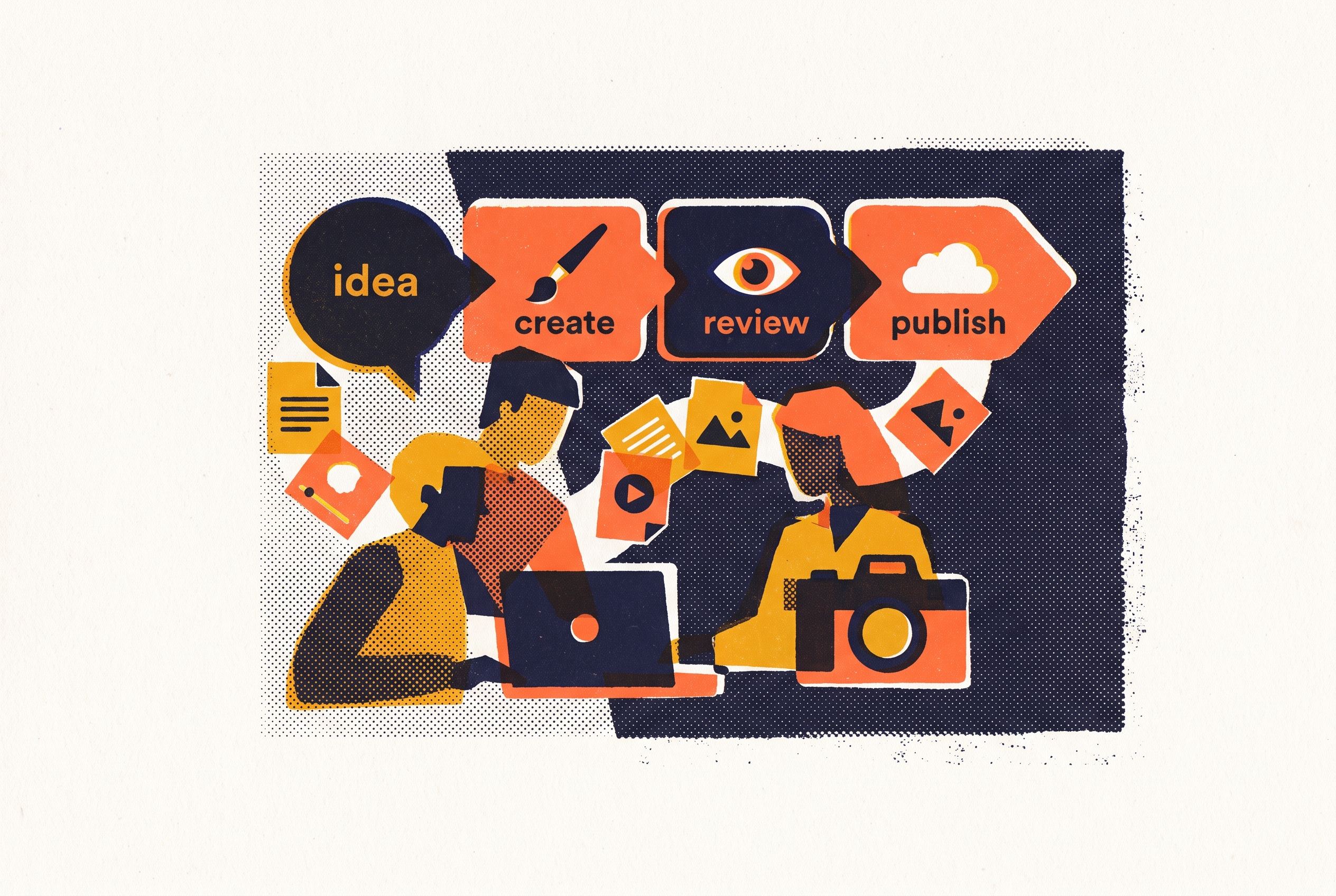
Small in-house content teams rarely fail because the writing is bad. They fail because nobody defined who owns the brief, who owns the draft, and who holds the line before something goes live. That undefined ownership produces output that is slow, inconsistent, or both, and it's the single most fixable problem in lean content operations. The teams doing this well aren't bigger or more talented than the ones falling behind. They built a process that survives contact with a normal week, and that's the entire difference.
What a functional content workflow looks like for a team of two to five people
Content operations, stripped to its actual mechanics, runs across five layers. Planning and strategy decide what gets made, for whom, and when. Creation and drafting turn that plan into a first version of the thing. Optimization and QA check it for search performance, brand voice, and factual accuracy. Collaboration and governance route it through review and approval. Analytics and iteration measure how it performed and feed that back into the next planning cycle.
None of that changes for a team of two or five people. What changes is staffing. A five-person marketing department might assign each layer to a different person. A two-person team has one person covering planning and governance while the other handles drafting and optimization, and that's fine, because the layers describe roles, not headcount. The mistake lean teams make is assuming that because they don't have five specialists, they don't need five functions. They do. Someone still has to plan, someone still has to draft, someone still has to check the work, and someone still has to decide it's ready to publish.
"Structured" is a lower bar than most teams think, and that's precisely why skipping it is inexcusable. It means a shared calendar everyone actually looks at, a brief template that gets filled out before drafting starts, a clear point where a draft moves from writer to reviewer, and a checklist before anything publishes. None of that requires a procurement process or a new platform. It requires someone deciding, once, how the work moves from idea to published piece, then holding the team to it without exception. Research on structured AI-assisted workflows consistently finds that content teams with defined processes produce significantly more content while maintaining brand consistency. Structure is the variable there, not team size and not the tool stack. The tools come later, deliberately: the shape of the process has to exist first, or the tools just make the chaos move faster.
How clear role definition prevents the handoff failures that kill output consistency
The most common failure in small teams is a missing name. It's a missing name. A draft sits in a shared drive for four days because everyone assumed someone else was reviewing it. A publish date slips because the person who was supposed to check the final version thought that step happened already. Nobody did anything wrong individually. Collectively, the piece fell into a gap nobody was assigned to cover, and that gap is entirely preventable.
The fix is a minimum viable role structure, and for a team of two to five, three seats cover it. One person owns the brief and the calendar, the strategy seat, even if that same person also writes. One person or one AI tool owns first-draft production, the creation seat. One named person holds the gate before anything goes live, the QA and governance seat. That third seat is the one lean teams skip most often, usually because it feels redundant when the team is small enough that "everyone" reads everything. Everyone reading something is not the same as one person being accountable for it, and that distinction is where most consistency problems trace back to.
A lightweight RACI works well here: for each content type, write down who is Responsible, who Approves, and who is Informed. Three columns, one document, done. The same person can hold different roles across different content types (the strategist on blog posts might be the drafter on social captions), which is a normal consequence of running a small team. But every individual piece needs exactly one owner at each stage.
Skipping the review stage whenever a deadline tightens is the single worst habit a lean team can develop, because it feels efficient in the moment and costs far more later. Skipping the gate lets brand inconsistency accumulate one rushed piece at a time, until the archive reads like it was written by five different companies. The output of this exercise should be a one-page role map, updated per content type, posted somewhere the whole team actually sees it daily. Not a process document nobody rereads after week one. A living reference.
Where AI-assisted tools fit inside a structured workflow
AI writing tools change the math for lean teams, but only inside a structure that was already working, and teams that skip that precondition end up disappointed for reasons that have nothing to do with the tool. Research on AI writing tools finds substantial output gains for teams managing high asset volumes, but the qualifier matters as much as the multiplier: those gains occur specifically for teams operating inside a defined workflow, not teams using AI to paper over a broken one.
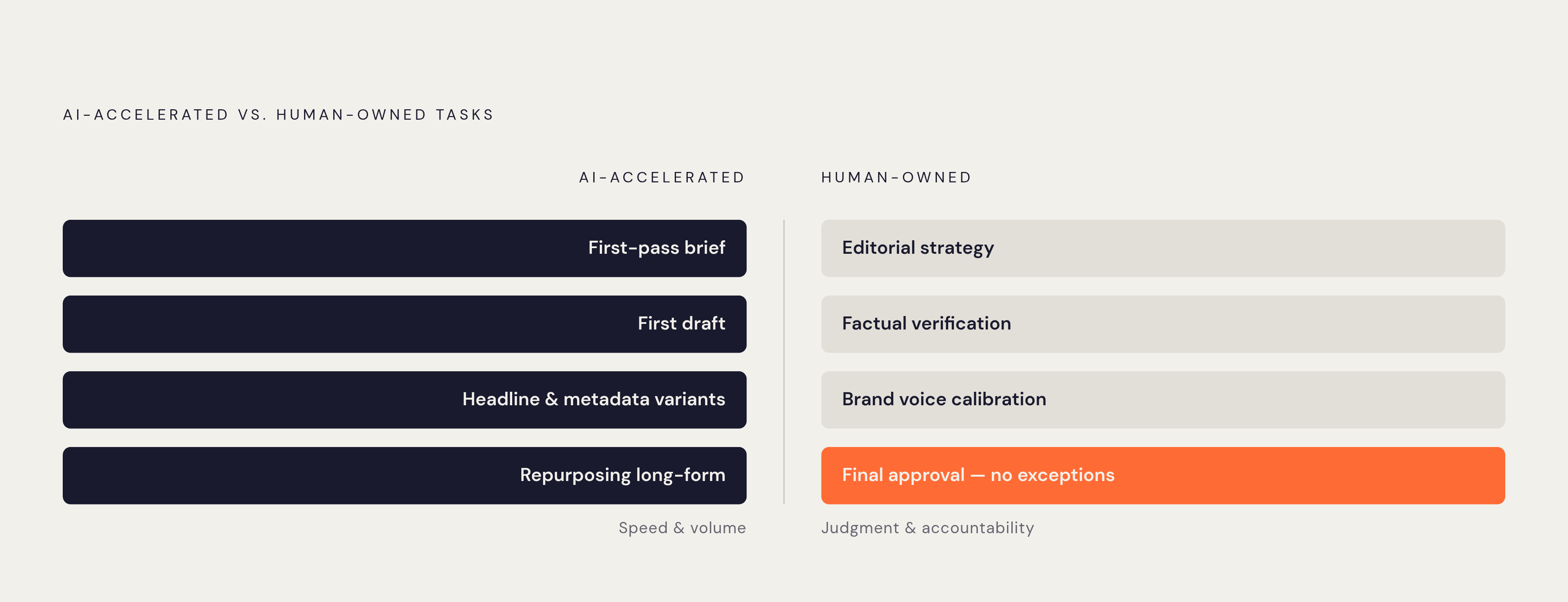
AI genuinely accelerates a small team in four specific spots: generating a first-pass brief from a keyword or topic prompt, producing a first draft against a brief and a brand voice document that already exist, spinning out headline and metadata variants, and repurposing one long-form piece into social posts, an email, or a short summary. Each of those tasks has a clear input and a clear output, which is exactly the kind of task AI handles well.
Editorial strategy, the actual decision about what topics serve the audience and the business, stays a human call, full stop. Factual verification does too, since the tool has no way of knowing whether the number it produced is accurate; any AI-generated statistic or product detail needs a human to check it before it goes near a reader. Brand voice calibration is another gap; first drafts from any AI tool need a human editing pass to close the distance between generic and distinct. Final approval, the governance gate described above, has to stay human-owned as well, no exceptions carved out for busy weeks.
Choosing tools for a lean team comes down to three practical questions. Can it be onboarded without hiring a dedicated ops person? Does it produce multiple formats from a single brief instead of one? Does it fit into the existing workflow rather than demanding a new one for every layer? That last question is where teams sabotage themselves most often. Adding a separate tool for drafting, another for optimization, another for social repurposing, and another for analytics doesn't streamline anything. It multiplies the number of places a handoff can fail, and that's a cost most teams don't notice until the fourth tool is already live.
Building the brief: the single document that keeps AI output on-strategy
The brief is the highest-leverage document in this entire workflow. An AI tool won't push back on a vague prompt the way a skeptical staff writer might, and that missing friction is why the brief has to do the pushing back instead.
A brief that prevents a major revision cycle needs a few specific things. One named audience persona, described specifically rather than with a generic label like "marketing professionals." One primary goal: the single action the reader should take after reading. The specific claim or argument the piece makes, not just the topic it covers. A format spec laying out section structure, a word count range, and whether an FAQ belongs at the end. Two or three concrete brand voice examples pulled from already-approved content, showing what to do and what to avoid. Named sources to draw from or avoid, not a vague gesture at "industry data."
The angle is the field almost everyone skips, and skipping it is the single biggest reason AI drafts come back sounding like nothing. Without it, an AI draft produces competent, generic coverage of a topic instead of a piece that argues something specific. Before opening any AI tool, the brief's author should be able to answer one question in a single sentence: what is the one thing this piece argues? If that answer doesn't exist yet, the brief isn't done, no matter how many fields are filled in.
Building one reusable template per content type (blog post, landing page, social series) cuts brief-writing time without sacrificing the brief's quality. A shared template constrains AI output before a human reviewer ever sees the draft, so less of the QA burden lands on Stage 2 review. Writing the brief well matters because it does part of governance's job before governance even starts.
Content operations, stripped to its actual mechanics, runs across five layers.
Staged review as a quality gate, not a bottleneck
Review gets blamed for slowing teams down, and that blame is misplaced. The actual bottleneck is unstructured review, where anyone can comment on a draft at any time with no defined scope. That creates far more delay than a clean two-stage gate ever would, because a comment thread with no boundaries turns into a renegotiation of the whole piece.
Stage 1 is a structural review. Does the piece argue what the brief asked for? Is the format right? Does the opening deliver on the headline? This should take about fifteen minutes and belongs to the brief owner or strategist. Stage 2 is the final pass: brand voice, factual accuracy, links, metadata, and any compliance flags that apply. That belongs to the publishing owner or a senior editor.
Scope discipline matters as much as the stages themselves. Stage 1 reviewers shouldn't be line-editing sentences. Stage 2 reviewers shouldn't be restructuring the argument. The moment either stage starts doing the other stage's job, review becomes the bottleneck everyone feared it would be.
Reviews should happen asynchronously, inside the document itself as comments, never as a meeting on the calendar, since meetings expand to fill whatever time is available and comments don't. A 48-hour turnaround expectation per stage keeps the whole production schedule honest. Strong brand consistency is a function of a human gate applied the same way, every time, without exception. It's a function of a human gate applied the same way, every time, without exception. For a two-person team, the same individual can run both stages across different content types, but the two passes need to stay separated in time. Reading a draft twice, once for structure and once for polish, catches more than reading it once and trying to do both jobs at once.
The content calendar as a production commitment, not an aspiration
A calendar that lists topics and rough dates is a wishlist dressed up as a plan. A calendar that lists a title, a channel, a brief owner and due date, a draft owner and due date, a Stage 1 reviewer and deadline, a Stage 2 reviewer and deadline, and a publish date is a production schedule. A team with that document ships. A team without it only hopes.
Cadence has to be built on actual available hours, not optimistic ones. A calendar built assuming everyone works at full capacity every week collapses the first time someone gets pulled into a client fire drill or takes a sick day, and that happens constantly, so it shouldn't be treated as an exception that excuses the miss. Build the baseline on real capacity, then treat anything extra as a stretch goal, not a line item the team is already counting on.
Volume still matters. Brandi AI found that brands producing twelve new or optimized pieces of content saw visibility gains many times faster than brands producing only four. But that number only holds if every piece clears the quality bar first; a calendar that forces volume by skipping the review gate defeats its own purpose. A weekly 30-minute calendar check, not a brainstorm, just a status check, keeps the team honest about what's on track, what's at risk, and what needs to be cut rather than published half-finished. Pieces that miss their window should move to a defined "park" column instead of clogging the active calendar. Parked content can get picked back up and republished later; it shouldn't sit there pretending to be in progress.
Content freshness as a production discipline, not just a publishing frequency goal
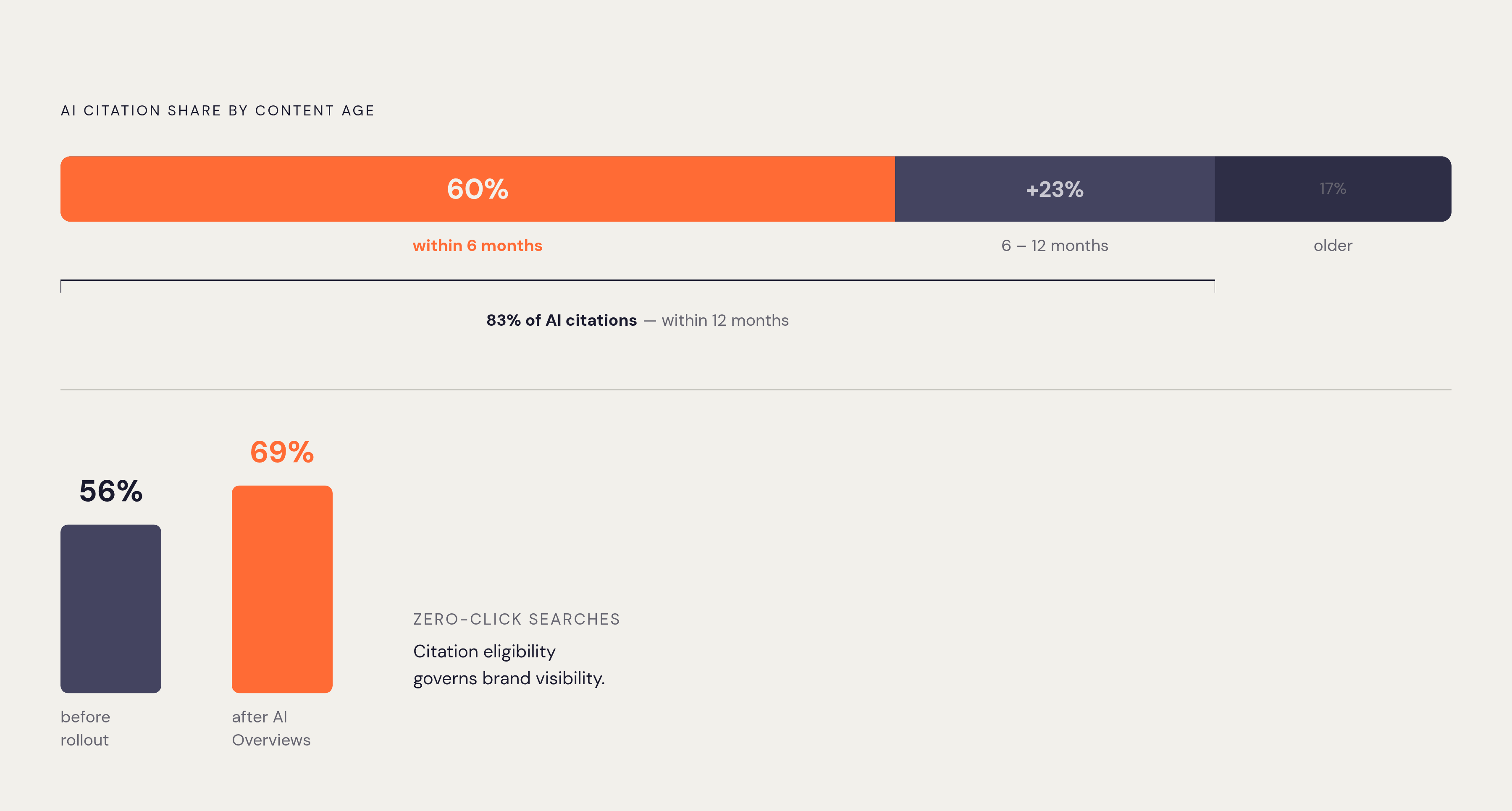
Freshness used to be a nice-to-have, something teams got to after the new content pipeline was handled. That's no longer defensible, and the data on search driven by AI systems makes the case bluntly. AirOps research found that for commercial and evaluation-stage search queries, 83% of AI citations came from pages updated within the past twelve months, and more than 60% came from pages refreshed within the last six.
A piece published eighteen months ago and never touched since is losing its eligibility for AI citation, regardless of how good it was on the day it went live. Quality has a shelf life now, in a way it didn't when Google's organic ranking was the only game being played, and teams still treating freshness as optional are optimizing for a search landscape that no longer exists.
Refresh work belongs on the calendar as its own category, with the same owner model as new content. A quarterly audit slot should prioritize refreshing high-performing existing pages over drafting a new piece on the same topic from scratch. A refresh brief is still a brief: what changed since publication, which statistics are now stale, what new angle deserves a paragraph. There's a distribution angle here too, easy to overlook: distributing content across a range of third-party publications, rather than only the brand's own site, increases AI citation rates by up to 325%. A refresh workflow that only touches the owned domain is leaving most of the opportunity on the table.
A workable rule of thumb is one refresh cycle for every two new pieces, which keeps the existing archive productive without swallowing the capacity of a small team. The stakes go beyond citation counts, too. Zero-click search grew from 56% to 69% in a single year following the rollout of AI Overviews, Similarweb data shows. A page can rank well and still send no one to the site, because the answer already appeared in the AI summary above it. Freshness now governs whether a brand shows up in that summary.
Measuring whether the workflow is working (the metrics small teams can act on)
Most lean teams track pageviews and social impressions and call that measurement. Those numbers say something about a piece's reach. They say almost nothing about whether the workflow producing that content is functioning, and that gap is why small teams end up guessing instead of diagnosing.
Process metrics close that gap. Brief-to-publish cycle time, tracked per content type, shows whether the workflow is getting faster or slower quarter over quarter. Review-stage pass rate (the percentage of drafts that clear Stage 1 without a structural rebuild) is a more honest diagnostic than it looks: a low pass rate almost always points to a weak brief, not a weak writer, and teams that blame the writer here are looking at the wrong stage. Calendar completion rate, the share of planned pieces that actually published on schedule, deserves close attention too. A completion rate under roughly three-quarters of planned output usually means the calendar was built on capacity that doesn't exist, not that the team underperformed.
On the outcome side, the relevant metrics have shifted along with the search landscape itself. AI citation frequency for a set of priority, category-relevant queries shows whether the brand actually shows up in AI-generated answers. AirOps' analysis of more than a billion citations found that 85% of brand mentions inside AI search results came from third-party pages, not the brand's own site. A workflow that only produces owned content is missing most of the surface where citations happen. Referral traffic from AI engines deserves its own line in a monthly report as well. Seer Interactive data put ChatGPT referral conversion at 15.9%, against 1.76% for organic search traffic. That gap is large enough that a small team tracking channel performance in GA4 should treat AI referral traffic as a distinct, high-value category rather than folding it into general referral numbers.
The loop closes when process metrics feed back into planning every month. If brief-to-publish time is stretching out, that's diagnosable straight from the data, and it's a planning fix, not a writing fix, a distinction that saves a lot of wasted retraining. For teams managing content across multiple brands or clients, testing AI visibility query by query by hand doesn't scale past a handful of accounts, which is exactly the reporting gap that per-client analytics and portfolio-level citation tracking exist to close, turning hours of manual checking into a report an account team can hand a client with evidence attached.
The compounding advantage of running the same structured workflow across every content type
Most small teams think about workflow one piece at a time: this blog post, this landing page, this week's social batch. That's the wrong unit of analysis, and it's the reason so many teams end up with a strong blog and a mediocre everything else. Consistency of process is what produces consistency of output, not the other way around, and that advantage becomes visible when the same brief template, the same two-stage review, and the same calendar structure run across every content type the team produces.
A team that runs one disciplined workflow for blog posts and improvises everything else ends up with a blog that reads coherently next to a social feed, an email program, and a landing page library that all sound like they came from different companies. That inconsistency is a structural problem. It's a structural problem, and it compounds the same way a missed review gate compounds: slowly, then all at once, until the brand's voice across channels no longer feels like one brand.
Running the identical structure everywhere (the same brief fields, the same named reviewer roles, the same freshness audit cadence) means every new content type the team takes on inherits a working system instead of requiring one to be invented from scratch. That's the actual payoff of building the workflow. Not that any single piece gets better. That the fifth piece, and the fiftieth, cost less to produce and carry more consistency than the first one ever did.
Sources
- Generative Engine Optimization Statistics (2026): 60+ Data Points on AI Citations, Brand Visibility, and Content Performance
Provided the statistics on zero-click search growth (56% to 69%) and the 325% AI citation rate increase from third-party distribution.
- Generative Engine Optimization: The Complete 2026 Guide | Similarweb
Provided the Similarweb data on zero-click search growth following the rollout of AI Overviews.
- 2026 Trends for Generative Engine Optimization and AI Visibility | Brandi AI Predictions
Provided the finding that brands publishing twelve pieces saw visibility gains many times faster than those publishing four.