AI-Assisted Research for Content Accuracy
Accurate sourcing now determines whether AI chatbots cite your content.

AI-assisted research doesn't just make writers faster. Done right, it makes writers more accurate, and accuracy has quietly become the thing that determines whether a brand shows up when someone asks ChatGPT or Perplexity a question instead of typing it into Google. That's the shift this piece is about: the discipline of verifying a claim before you publish it is no longer just an editorial virtue. It's a distribution mechanism.
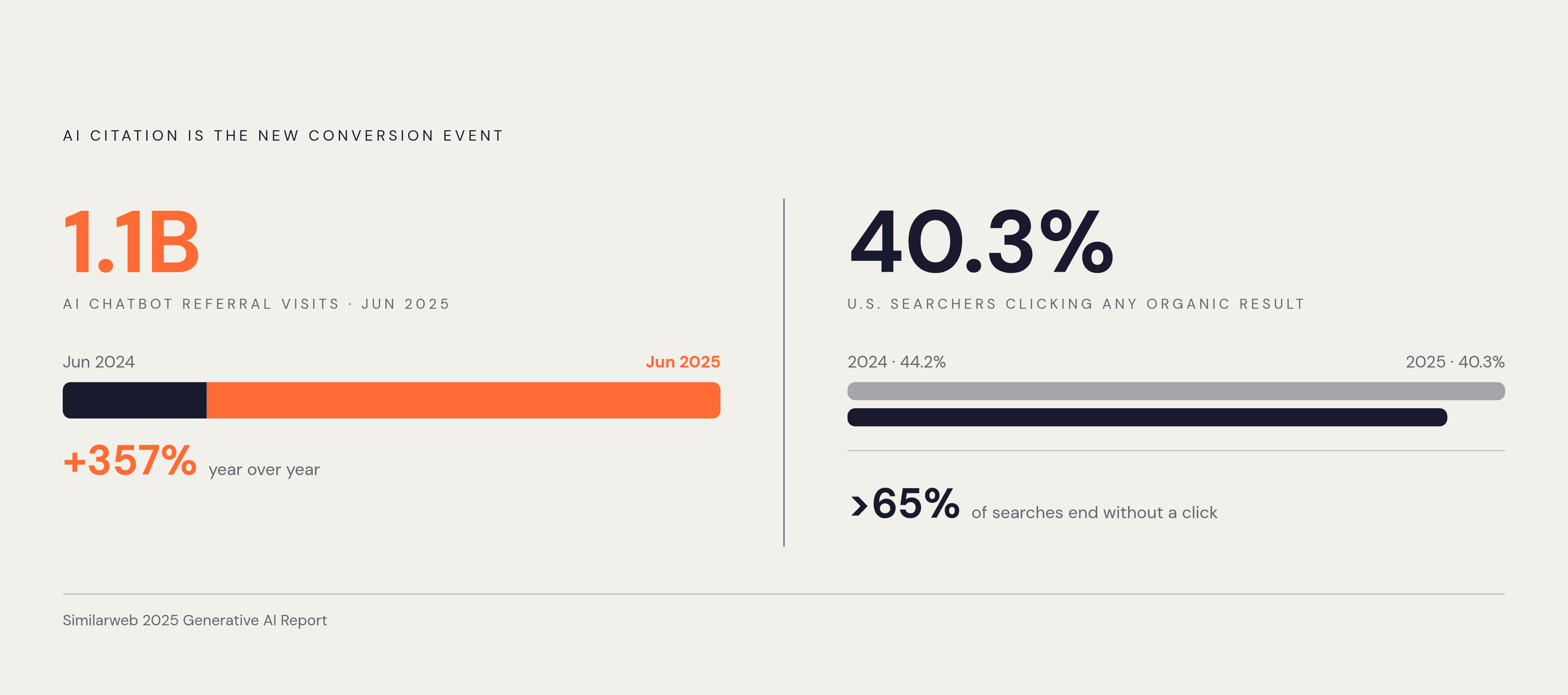
The numbers driving that shift are not subtle. Similarweb's 2025 Generative AI report clocked AI chatbot referral traffic at 1.1 billion visits in June 2025, up 357% year over year. Meanwhile, Search Engine Land reported that over 65% of Google searches now end without a click at all, with the share of U.S. searchers clicking any organic result falling from 44.2% to 40.3% in a single year. Similarweb's Generative AI Brand Visibility Index found that 35% of U.S. consumers now use AI at the product discovery stage, compared to 13.6% who still start with a traditional search bar. Forrester puts the number of B2B buyers who've adopted generative AI as a central research tool at 89%.
The shortlist gets built before the search bar ever opens. Being cited inside an AI-generated answer is the new conversion event, and LLMs are far stingier about who gets that citation than Google ever was with its ten blue links. Most models cite somewhere between two and seven domains per response. That's a brutally narrow surface, and it rewards brands that treat AI research as a discipline rather than a shortcut.
What it means for content to be cited by an AI answer engine
The industry has settled on two overlapping terms for this: GEO (Generative Engine Optimization) and AEO (Answer Engine Optimization). Both describe the same thing, optimizing content so it gets pulled into a synthesized AI answer rather than ranked as a link, and practitioners use them more or less interchangeably.
Understanding why requires understanding how these systems actually work. Most AI answer engines run on retrieval-augmented generation, or RAG, which happens in two stages. First, the system retrieves a set of candidate documents relevant to the query. Then a large language model synthesizes an answer from those documents, deciding which sources to cite and how prominently to feature them. Getting indexed in that first stage is necessary, but it's not sufficient. The model still has to judge your content readable, structurally clear, and trustworthy enough to actually cite in the answer it hands the user.
What does successful GEO look like once a model clears that bar? A few distinct outcomes: a citation with a source link, where the AI points directly to a URL as evidence; a brand mention with no link attached; a positive or neutral sentiment surrounding that mention; and share of voice, meaning the brand appears consistently across a range of related prompts rather than appearing once and disappearing.
None of this appears in Google Analytics. Measuring it requires an entirely different toolkit, which the later sections of this piece get into.
The old SEO playbook doesn't transfer cleanly, either. Ahrefs' study of 75,000 brands found that brand mentions correlate with AI visibility roughly three times more strongly than backlinks do (0.664 versus 0.218). And a separate Ahrefs/Brand Radar analysis of 15,000 prompts found only 12% overlap between AI citations and Google's top 10 results overall, dropping to just 8% overlap for ChatGPT specifically against Google and Bing. Ranking well on Google tells you almost nothing about whether an LLM will cite you.
What ties all of this together is that the criteria AI engines use to select sources are, at bottom, content quality and trustworthiness criteria. That's why research discipline turns out to be a GEO discipline whether or not anyone on the content team set out to do GEO at all.
How content with verifiable, structured claims earns AI citations at a higher rate
A KDD 2024 study out of Princeton, Georgia Tech, and IIT Delhi tested GEO techniques against 10,000 real queries and found some interventions boosted content visibility in AI-generated responses by as much as 40%. Adding statistics to content was among the most effective single tactics, improving visibility by roughly 33 to 41% depending on which metric the researchers measured, though quotation addition actually ranked highest on the paper's primary scoring metric (PAWC). Quotation addition ranked highest on the paper's primary scoring metric, making attribution of claims a particularly powerful lever.
But "adding statistics" carries a catch that's easy to skip past. The statistic has to be real. It has to trace back to an actual source, and it has to be checkable by anyone, including the model itself, in whatever retrieval pass it runs before generating an answer. A fabricated number doesn't carry the same trust signal as a sourced one, even if a human reader can't immediately tell the difference. Research has found that content combining quotes and statistics sees meaningfully higher visibility in AI assistants than content without them, a pattern that held consistently across the queries tested.
Where in the document that evidence sits matters too. Growth Memo's Kevin Indig found in an analysis that 44.2% of all LLM citations draw from the first 30% of a piece of content, the introduction. Bury your best-sourced claim in paragraph twelve and it may never get retrieved at all.
Length matters in a way that cuts against a lot of conventional SEO wisdom about scannable, bite-sized content. ConvertMate's GEO Benchmark 2026 found pages above 20,000 characters receiving several times more AI citations than short pages. And domain authority, the thing SEO practitioners have spent two decades chasing, turns out to matter less than expected here: the same ConvertMate benchmark found 83% of AI Overview citations come from pages that don't even appear in the organic top 10. Structured, accurate content earns citations on its own terms.
Keyword stuffing, meanwhile, performed below baseline in Princeton's benchmark. The content structure that gets cited by an LLM is not the content structure that was built to chase keyword density, and treating them as the same skill is probably the single most expensive mistake a content team can make right now.
The hallucination problem: what happens when AI research goes wrong and why it threatens brand credibility
Columbia University's Tow Center for Digital Journalism ran 1,600 queries across eight AI search engines and found more than 60% of responses contained factual errors. The error rate varied sharply by platform: The error rate varied sharply by platform, with some engines performing significantly worse than others.
These aren't abstract or academic errors. Kodec AI's study, which ran over 200 query cycles against Series B and later SaaS companies, found AI platforms returned incorrect pricing or feature information in 62% of simulated buyer queries. That's a prospective customer asking an AI engine what a product costs and getting a wrong answer, one attributed to the brand, one the brand never wrote and can't retract.
New brands face the sharpest version of this problem. A model can't reference an entity that doesn't exist anywhere in its training data, so when a brand is genuinely new or under-covered, the system fills that gap with whatever weak retrieval signal it can find, or invents something plausible-sounding to complete the answer. Absence creates a vacuum, and hallucination fills it.
Visibility itself is unstable on top of all this. AirOps' analysis of 45,000 citations in 2025 found only 30% of brands maintain consistent visibility from one AI answer to the next, and just 20% remain present across five consecutive runs of the identical query. A brand cited Monday can vanish from the same question Tuesday.
Newer model generations have made progress on reducing hallucinations, but performance still varies unevenly across tasks and contexts, and the tools built to detect hallucinations have grown a lot since 2023 without actually solving the underlying measurement problem: most of them track mention volume, not factual accuracy. Knowing a brand got mentioned 40 times last week tells you nothing about whether those 40 mentions were true.
All of which argues for something structural, not cosmetic. The fix isn't a better proofreading pass after a draft is done. It's a workflow that produces verifiable, source-grounded claims before anything goes near publication.
Most models cite somewhere between two and seven domains per response.
What a verification-first AI research workflow looks like in practice
AI tools are genuinely useful early in the research process, for surfacing candidate claims, suggesting angles, and pointing toward relevant sources fast. The discipline lives in what happens after that first pass, not in whether the tool gets used at all.
RAG offers a decent model for how a human research workflow should behave, too: every claim in a finished piece should trace back to an approved source, and any AI-generated line that can't be anchored to something citable should get treated as a hypothesis, not a fact, until someone checks it.
In practice that means a handful of concrete steps. Use the AI to generate a candidate set of claims, statistics, and sources first. Then check each one against the original source directly, not against the AI's summary of that source, since distortion tends to occur in summaries. Separate what a source actually says from what the AI inferred or extrapolated from it, because those are not the same thing even when the AI presents them with equal confidence. Flag any statistic that doesn't come with a named study, a year, and some indication of sample size or method. And treat a suspiciously precise number, a percentage nobody can find in the underlying source, as a likely fabrication rather than a small thing to wave through.
Skipping human review turns out to be a documented risk, not a hypothetical one. Adding an extra round of human review specifically to catch AI errors is a widely recommended adjustment, yet in practice many teams skip that review when they trust the tool. That gap is exactly where hallucinated claims slip through into published, attributable brand content.
Ownership matters here too. Marketing typically owns the ongoing tracking and optimization work. Legal needs escalation authority for any hallucination serious enough to cause real harm. PR, meanwhile, shapes the earned media strategy that eventually feeds back into what training data says about the brand in the first place, which is the subject of the next section.
The output of all this isn't just accurate copy. It's copy structured to get picked up: claims that are named, sourced, and positioned early in the piece, right where LLM retrieval tends to look first.
Where earned media, third-party placement, and distribution fit into a citation strategy
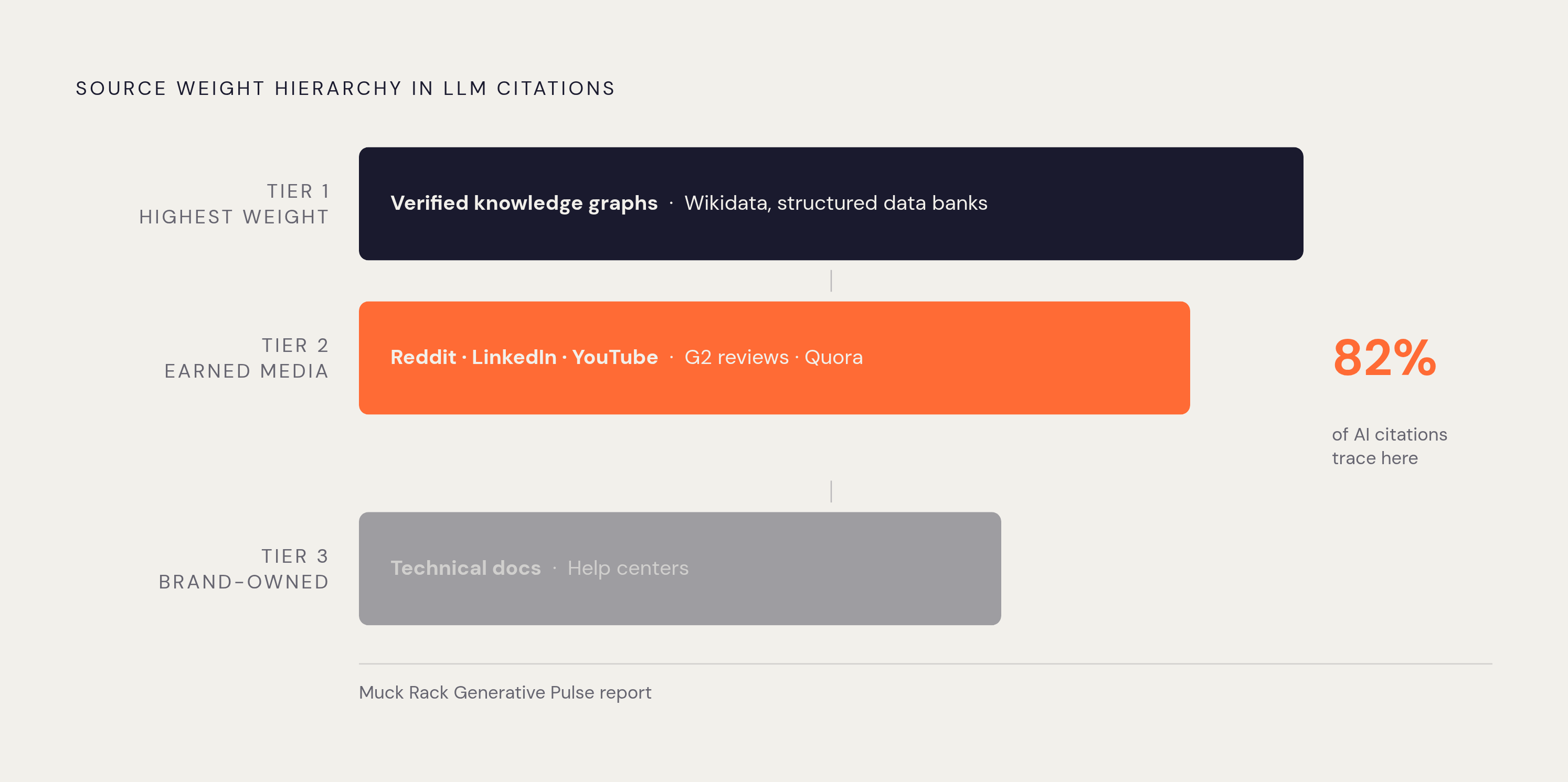
A brand's own website is a minority stakeholder in its own AI visibility. Muck Rack's Generative Pulse report found 82% of AI citations trace back to earned media, not owned content and not paid placement. That reframes the whole exercise: publishing well-sourced content on a company blog matters, but it's not where most of the citation surface area actually lives.
Distribution compounds that effect. Research from Similarweb's 2026 Generative AI Brand Visibility Index found that spreading content across a wide range of publications increased AI citations by up to 325%, with broader distribution consistently showing substantial citation lifts across follow-on analyses.
Press releases have become a meaningful citation source, and structured releases have grown as a share of overall AI citations. Format discipline applies to press content the same way it applies to a blog post: a structured, factual release travels further than a loosely written one.
Recency counts for a lot, too. Recency is a meaningful factor in citation likelihood, with freshly published content drawing a disproportionate share of AI citations in the period immediately after publication. Older content, even accurate older content, loses share over time simply by sitting still.
Placement should be targeted rather than scattershot. A brand's AI citations tend to concentrate in a relatively small number of media outlets, which means a focused press strategy is likely to outperform a scattershot one.
There's a rough hierarchy to how LLMs seem to weigh sources, often described as a "source stack." At the top sit verified data banks like Wikidata and knowledge-graph-style structured databases. Below that sits high-trust user content: Reddit threads, LinkedIn posts, YouTube, G2 reviews, Quora answers, the kind of content real users generate and other real users correct in public when it's wrong. Brand-owned assets, technical docs and help centers, sit a tier below that.
That middle tier is where accurate research pays off in a way that's easy to underestimate. A brand accurately and specifically discussed on Reddit or G2 has a bigger citation surface than one that only maintains its own site, precisely because those communities police bad claims. Vague or inaccurate assertions tend to get filtered out or corrected by other users before an LLM ever ingests them. Specific, attributable, checkable claims survive that filter and keep traveling.
How agencies managing multiple brands operationalize AI research accuracy at scale
Agencies face a version of this problem that's structurally worse than a single in-house team's. Speed pressure across a dozen client accounts makes verification shortcuts most tempting exactly when the stakes, each client's AI-visible brand claims, are highest.
SiriusDecisions data cited in Forbes found that 60 to 70% of B2B content goes unused, not because it's bad, but because teams can't find it, don't trust it, or can't tell which version is current. Multiply that across every client roster an agency manages and the problem doesn't just add up, it multiplies.
Then there's volatility. AI citation share swings 40 to 60% month to month as a matter of course, per the AirOps data referenced earlier, so a brand visible in one week's AI answers can be absent the next. For an agency, that rules out the one-time audit model entirely. Monitoring has to be ongoing, per client, not a quarterly checkup.
Multiple sources point to what's being called the 54% plan versus 23% measurement gap as the defining GEO maturity problem heading into 2026: most enterprise marketing teams now have some kind of GEO initiative underway, but most haven't figured out how to actually measure whether it's working. Closing that gap is where an agency earns its fee. GEO's ROI is structurally harder to prove than SEO's ever was, since a zero-click AI answer generates no referral session and shortlist influence happens before any touchpoint a dashboard would normally track. Repurposed SEO reporting tools simply don't capture it.
The research-accuracy discipline described earlier in this piece only matters to a client if someone can show them the number moving.
None of that works if the account team itself can't explain the underlying logic. An agency that can't articulate, in plain terms, why a sourced statistic in the first three paragraphs of a page earns more AI citations than the same statistic buried on page four, isn't going to be able to sell a client on paying for the discipline it takes to get there.
The GEO and AI visibility tools an agency or brand team can use to track whether accurate content is being cited
Monitoring citation share and monitoring citation accuracy are two different jobs, and a complete measurement stack has to cover both. Tracking how often a brand gets mentioned tells a team nothing about whether those mentions are correct.
Evertune measures AI visibility across multiple models at enterprise scale, pairing direct API access to base models with EverPanel, a demographically weighted panel drawing on over 150 million real user conversations, so it can compare training-level model behavior against actual real-world consumer experience. The company was founded by early team members from The Trade Desk, has raised a substantial amount in funding, is headquartered in New York City, and runs a team of more than 40 people.
Semrush's Enterprise AIO, also marketed as its AI Visibility Toolkit, tracks share of voice, brand mentions, and sentiment across AI search engines, and plugs into the broader SEO workflows teams already run.
Profound favors the AEO terminology and functions as a command-center tool for enterprise brands managing answer-engine visibility. Its own published guide on Answer Engine Optimization has reportedly been cited over 9,000 times across the range of LLMs Profound tracks, which is a fairly direct demonstration of the discipline working on itself.
Otterly targets a more accessible price point, converting existing SEO keyword lists into GEO-style prompts and tracking how brands perform against them, making it a reasonable entry point for teams not ready for an enterprise-scale platform.
Choosing among these tools matters less than choosing to measure at all. A brand that publishes accurate, well-sourced, clearly structured content but never checks whether that content actually gets cited is flying blind in exactly the channel where its buyers are already making decisions.
Sources
- Generative Engine Optimization: The Complete 2026 Guide | Similarweb
Provided the AI chatbot referral traffic figures (1.1 billion visits, 357% growth) and the organic click-rate decline statistics cited in the opening section.
- Generative Engine Optimization Statistics (2026): 60+ Data Points on AI Citations, Brand Visibility, and Content Performance
Supplied multiple statistics cited in the article, including the 65% zero-click search rate, 89% B2B AI adoption figure, 12%/8% AI-Google citation overlap, LLM citation position data, and brand visibility consistency figures.
- https://otterly.ai/agencies-ai-search-monitoring
Described Otterly as an entry-point GEO tracking tool for teams converting SEO keyword lists into AI-style prompts.