In-House Content Team vs Agency Tradeoffs
In-house teams offer brand depth agencies can't match, but agencies win on speed and cost upfront.
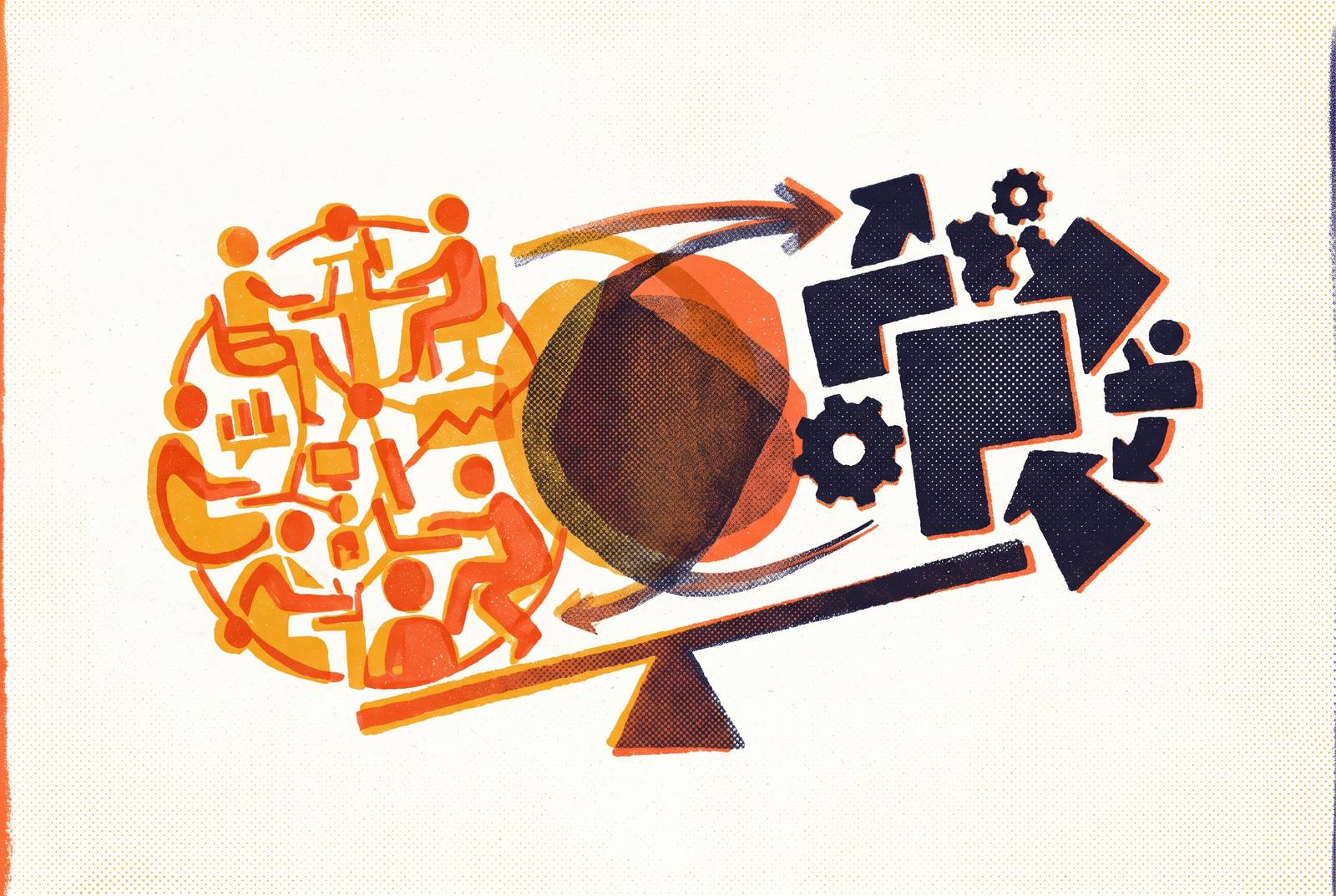
An in-house team and an agency control fundamentally different parts of the work, and confusing the two is where most of these decisions go wrong. An in-house team sits inside the company's nervous system: it hears sales calls, sits in on product meetings, knows what leadership argued about in last week's roadmap review. That access is the raw material for brand depth, and it's something no creative brief can fully transfer.
An agency offers a functioning process and specialists who already know how to work together, ready to start producing before an internal hire has finished onboarding paperwork. Think of it as renting a team that's already assembled and warmed up, instead of building one from scratch. That distinction matters most when speed is the constraint, which it often is.
Here's the part worth taking a stand on: neither model owns strategy by default, and most companies quietly assume otherwise. In-house teams get treated as automatically strategic because they sit close to the business, while agencies get treated as automatically tactical because they work from briefs. Both assumptions are wrong, and betting a content program's structure on either one is a mistake worth naming early. Strategic ownership is a choice someone makes on purpose, and that choice is where the real risk in this decision lives. The rest of this piece works through four places where the tradeoffs get concrete: speed, brand depth, cost, and that same question of ownership, examined more closely.
Speed: how long each model takes to produce anything at all
Agencies win on time-to-first-deliverable, and the margin is significant. A campaign can launch in weeks through an agency, while building an equivalent in-house team takes months, mostly because hiring is slow by nature. The average time to fill a single marketing role runs around 50 days, and that's for one person. Staffing a four-person content team from scratch, then getting that team functional, takes an estimated six to eight months at minimum.
What happens during that stretch? Content programs stall, competitors keep publishing, and any SEO momentum that was building just stops moving. None of this shows up as a line item anywhere, which is exactly why it gets underweighted in planning conversations. Yet it's a real cost that just doesn't appear on a spreadsheet.
Ramping up an agency takes time too. There's a stretch where it has to absorb brand voice, learn who signs off on what, and figure out the actual approval chain. Still, that ramp runs in weeks, not quarters, and that gap is the whole argument for going agency first.
Scale changes the math further. Analysis of DTC client accounts suggests ad creative performance drops off after two to three weeks of exposure, which means brands spending above a certain threshold need a steady, large volume of fresh assets every month just to hold flat. Building a solely in-house pipeline that keeps that pace without burning out a small team is hard to pull off in practice. Many growth-stage brands end up leaning on agency support or hybrid staffing here regardless of what they'd prefer on paper, because volume simply outstrips what a small internal team can produce.
AI tools are shifting this dimension too. Forrester's 2025 predictions put generative AI adoption at a majority share among external agencies, a share notably higher than what's reported inside in-house teams. That's a real gap on production speed right now, though it's the kind of gap that tends to close as tools get cheaper and easier to plug into existing workflows. If speed is today's bottleneck, agency work or AI-assisted production buys the runway needed to build internal capability properly, instead of rushing a hire just to fill a hole.
Brand depth: what in-house teams accumulate that agencies can't easily replicate
Flip the lens, and in-house pulls ahead, clearly. ANA's 2023 survey found 84% of respondents cited "better knowledge of brands" as a primary benefit of running an in-house agency, with 81% citing institutional knowledge specifically, trailing only cost efficiencies as a top-ranked advantage.
What does brand depth mean day to day? It goes past knowing the tone-of-voice guide by heart. It means knowing which product claim lands with which customer segment, which sales objection keeps resurfacing on calls, which topics leadership actually has opinions on versus which ones get a shrug and a "let's punt on that." Research offers a sharp illustration here: nearly all B2B marketers say they create thought leadership content, but only a small fraction report substantial or widespread participation from actual subject-matter experts inside the company. That gap between "we make thought leadership" and "our experts actually show up for it" is exactly where in-house teams have the edge, because they sit down the hall from the people who know the material.
Quality also moves differently over time depending on the model, and this is worth sitting with. In-house teams start with a learning curve, but they typically close the gap to agency-level polish within six to twelve months as brand knowledge deepens and compounds. Agencies tend to plateau earlier: professional, competent work from day one, but with a ceiling on brand-specific nuance, especially when the same team is juggling several other client accounts at once. One brings broad technique across many clients, while the other knows exactly which parts of the business run hot and which ones need careful handling.
Marketing Dive's coverage of ANA data found a majority of in-house respondents now report genuine strategic capability in brand strategy, creative, or media, a meaningful jump from earlier years. That's worth flagging on its own, separate from execution quality: in-house teams are increasingly trusted to act on their institutional memory, and to build on it over time.
None of this means agencies can't close the gap. Structured onboarding, embedded arrangements where an agency staffer effectively lives inside the client's Slack and standups, and long-term retainers can all replicate a version of institutional knowledge. It takes deliberate investment from both sides, and it rarely happens by accident. The brand-depth argument matters most for companies where the content itself is the product's edge, not just the pipe it travels through.
Cost structure: what you're actually paying for under each model
The monthly invoice comparison is the most misleading number in this entire decision. It's worth walking through slowly, because the surface math points the wrong direction.
Load up an in-house team properly, and the numbers get big fast. A baseline five-role setup, covering a marketing manager, designer, web developer, content writer, and social media manager, runs $280,000 to $420,000 a year in salary alone. Add benefits and employment overhead, and that's another 25 to 40% on top of every base salary. Recruiting fees typically add 15 to 20% of first-year salary per hire, on top of everything else. Then there's software: mid-size in-house teams can spend north of $50,000 a year just on the tooling stack, before anyone's written a single headline.
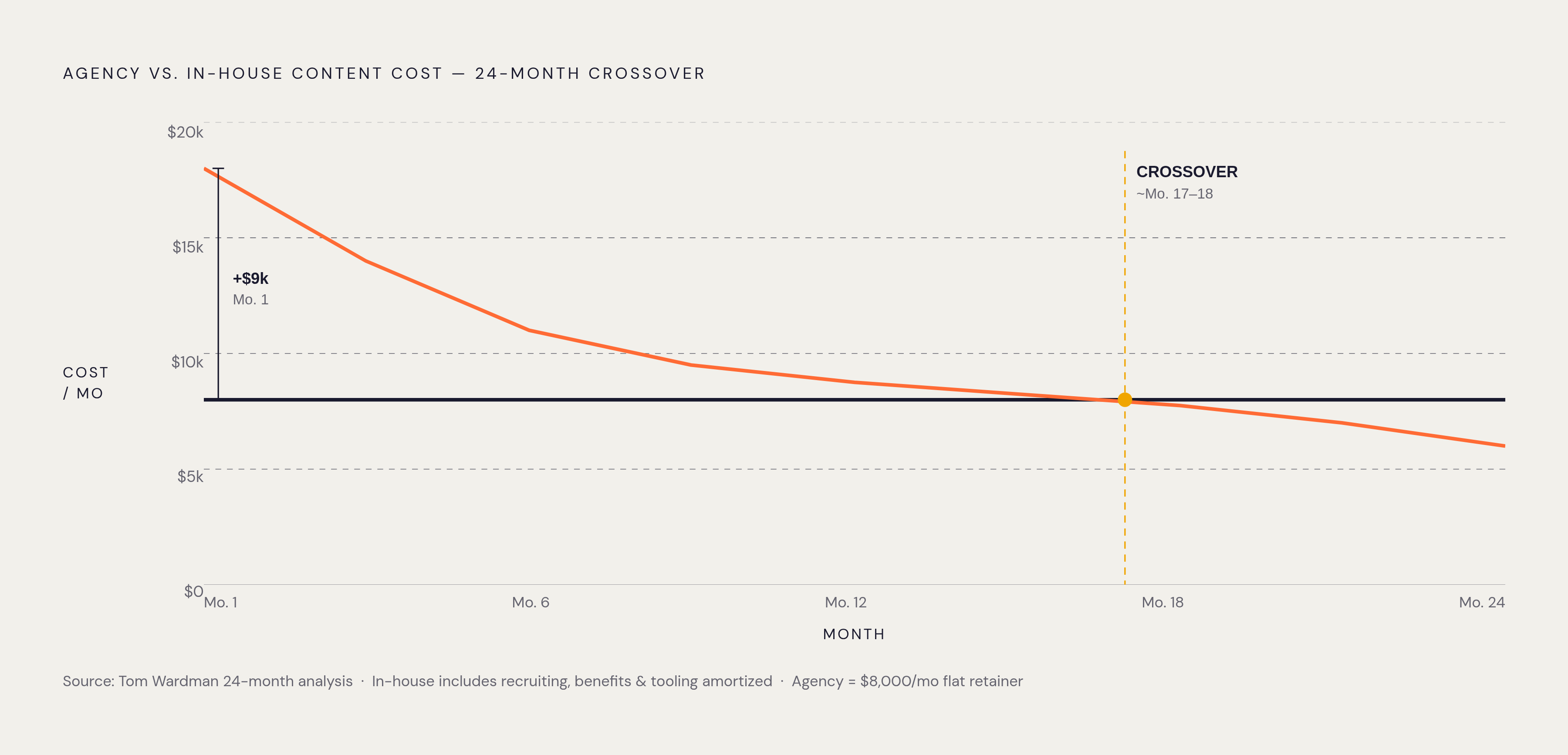
Agency retainers, by comparison, look almost tidy. Full-service content agency retainers generally run $5,000 to $20,000 a month, with year-long partnerships landing between $50,000 and $150,000 annually, according to industry sourcing. No recruiting fees, no duplicated tool licenses, no benefits math. An $8,000-a-month retainer starts producing usable content by week two, and its annual cost of roughly $96,000 compares favorably against the fully loaded cost of a single senior in-house hire, which typically runs $105,000 to $120,000 before that person has published a word.
But the picture flips over a longer horizon. Tom Wardman's 24-month analysis found in-house teams carry the highest upfront cash cost, but deliver the best results by the end of the window, because the investment compounds in a way a rented team's output doesn't. There's a volume-efficiency crossover worth knowing, too: in-house tends to get cheaper than freelance or agency support at roughly eight or more posts a month, while below four to six posts monthly, outside help is usually the cheaper route.
One more line item that never shows up on an invoice: agency turnover. Marketing agencies see high annual staff turnover, which means the team a client signs with in January can look materially different by the following January. That continuity loss is a real cost even though nobody bills for it directly.
So which is cheaper? The honest version of the question asks what each model costs over 18 to 24 months, given actual content volume and where the growth curve is headed, rather than what the invoice says in month one. Anyone comparing month-one numbers alone is comparing the wrong thing.
Strategic ownership: who controls the direction, and why it matters more than either model
Here's the failure mode that actually sinks content programs, and it has nothing to do with picking in-house over agency or the other way around: strategic ownership quietly slides to whoever happens to be producing the content, and nobody notices until the output has drifted somewhere nobody intended.
In-house teams carry their own version of this risk. Without outside friction, they can slide into creative ruts, build up blind spots, and drift from what the market actually wants, simply because there's no external voice forcing a gut check. A large share of in-house teams report rising workload pressure, and when a team is buried in execution, strategic thinking is usually the first thing to get skipped, because there's just no time left in the week.
Agencies carry a mirrored risk. They work from the brief they're given. If that brief is built on weak strategy, the agency delivers competent execution of a weak idea, and there's limited incentive for an outside partner to push back hard on the thinking behind the brief in the first place. Few vendors want to tell the client their premise is off, especially not the one being paid to execute it.
Strategic ownership, defined properly, means someone inside the company answers for the content strategy, the editorial direction, and what "working" actually looks like, independent of who's doing the producing. In a hybrid model that's functioning well, the internal team holds the strategy and the brand standards, while outside partners execute against a clearly defined brief. That's a structural distinction, not a question of who's more trustworthy.
Marketing Dive's coverage of ANA data shows a large majority of in-house respondents now report genuine strategic capability inside their function, which suggests companies are claiming this territory on purpose rather than defaulting to whichever team happens to hold the pen. Worth noting: AI tools don't resolve any of this. They speed up execution, sometimes dramatically, but someone still has to decide which direction to point it. The companies getting the most out of any model, hybrid or otherwise, are the ones treating strategy as something the company owns permanently and production as a resource it manages flexibly, swapping vendors and tools as needed without ever handing over the pen.
How to decide which model fits your situation right now
There's no universal answer here, and any framework claiming otherwise is selling something. The right model depends on where a company sits on four variables: speed, brand depth, cost tolerance, and strategic clarity. Different companies land in different spots on that map, and that's fine.
Lean agency, or agency-augmented, when the content program is new and time-to-market is the binding constraint. Lean that way too when there's a skill gap that would take a full hiring cycle (that 50-day average per role, remember) to close, or when volume demands outpace what a small internal team could ever sustain without breaking. A notable share of marketers who outsource cite a lack of in-house skills as the primary driver, and that's a legitimate, sensible reason to bring in outside help. It's a resourcing decision, not a failure.
Building or deepening in-house capability makes sense when content is the actual competitive edge rather than just the delivery mechanism, when brand depth and expert-driven thought leadership are the real product, and when volume has crossed the point where in-house gets cheaper per unit. It's also the right lean when strategic ownership feels fuzzy or split across too many desks, since bringing it inside forces the clarity that a scattered arrangement never will.
For companies designing the hybrid deliberately instead of backing into it by accident, a few rules hold up. Keep strategy, editorial standards, and audience knowledge inside the building, and route specialist execution, surge capacity, and skill-gap coverage to outside partners. Define the brief handoff explicitly, because the quality of that interface, the thing connecting internal knowledge to external execution, ends up determining the quality of everything downstream. AI-powered content tools built around strategy-first workflows can act as a useful middle layer here too, giving internal teams agency-level output speed without full agency dependency. Letterstory, an end-to-end content marketing platform, is one option built for teams that want to keep strategy in-house while automating production.
ANA's own forecasting suggests in-house penetration will eventually plateau somewhere between 85% and 90%, meaning nearly every large marketing organization will run some internal capability going forward. The open question was never really whether that internal core exists; it's what gets built around it, and how deliberately. Before changing anything, audit current output against the four dimensions covered here (speed, brand depth, cost per unit, and strategic ownership) and find out which one is actually the constraint. Odds are it's not the one getting the most attention in the budget meeting.