Content Strategy for B2B SaaS Companies
Align content to the subscription lifecycle, not just volume, to win B2B deals.

B2B SaaS content strategy fails for a structural reason, not a production one: most teams treat content as a volume problem when it's actually an alignment problem, matching audience stage, format, and conversion goal before anyone opens a doc. The companies that get this right map content to the entire subscription lifecycle, from a prospect's first search to a renewal three years later; the ones that don't just publish into the void and call it a content calendar. This piece walks through why the subscription model changes the math, how buyers actually behave, and what a lifecycle framework looks like when it's built to hold weight rather than just fill a spreadsheet.
The economics that make content a different kind of investment for SaaS
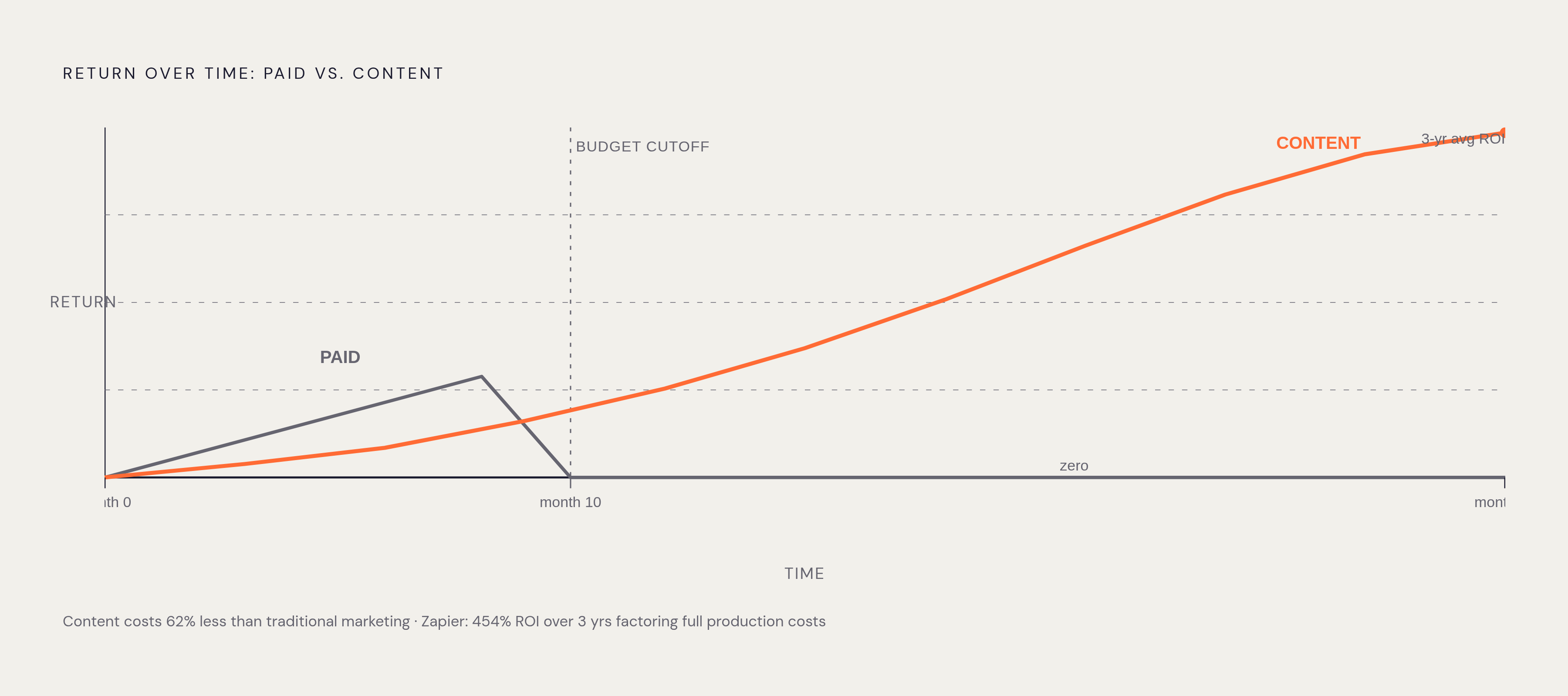
Start with the number finance actually cares about: content marketing costs SaaS businesses 62% less than traditional marketing, according to DemandMetric. That's the efficiency argument, and it's fine as far as it goes. But efficiency is the least interesting part of this story, because it doesn't explain why content should be structured around lifecycle stages instead of just producing more of it.
The real case is compounding, and the numbers back that up specifically. Sustained content programs post a three-year average ROI of 844%. Zapier's own content program, factoring full production costs against a three-year customer lifetime value multiplier, returned 454%. Paid acquisition stops the moment the budget does. A blog post published in year one can still be pulling qualified traffic in year three, quietly working while the team that wrote it has moved on to three other projects.
That compounding behavior is why the spend isn't trivial. SaaS companies spend between $342,000 and $1,090,000 annually on content marketing, per 0101 Marketing, and median marketing spend across B2B SaaS runs 8% to 11% of ARR, with early-growth companies often pushing 15% to 25% or more. Money is moving toward content at a faster clip than it used to. The open question is whether it's moving toward a plan or just toward more output, and that's a distinction most budget memos don't bother to make.
Here's the part that should change how leadership reads the line item: if returns compound over three years, judging a content program on a quarterly dashboard is like judging a tree by how much shade it throws in its first week. The framework has to survive 12 to 18 months of iteration, not get optimized sprint by sprint the way a paid campaign does. Treating content as a compounding asset with a longer payback window than paid media shifts the planning conversation toward the shape of the thing being built over time, rather than what published this month.
How B2B SaaS buyers actually move through a purchase decision
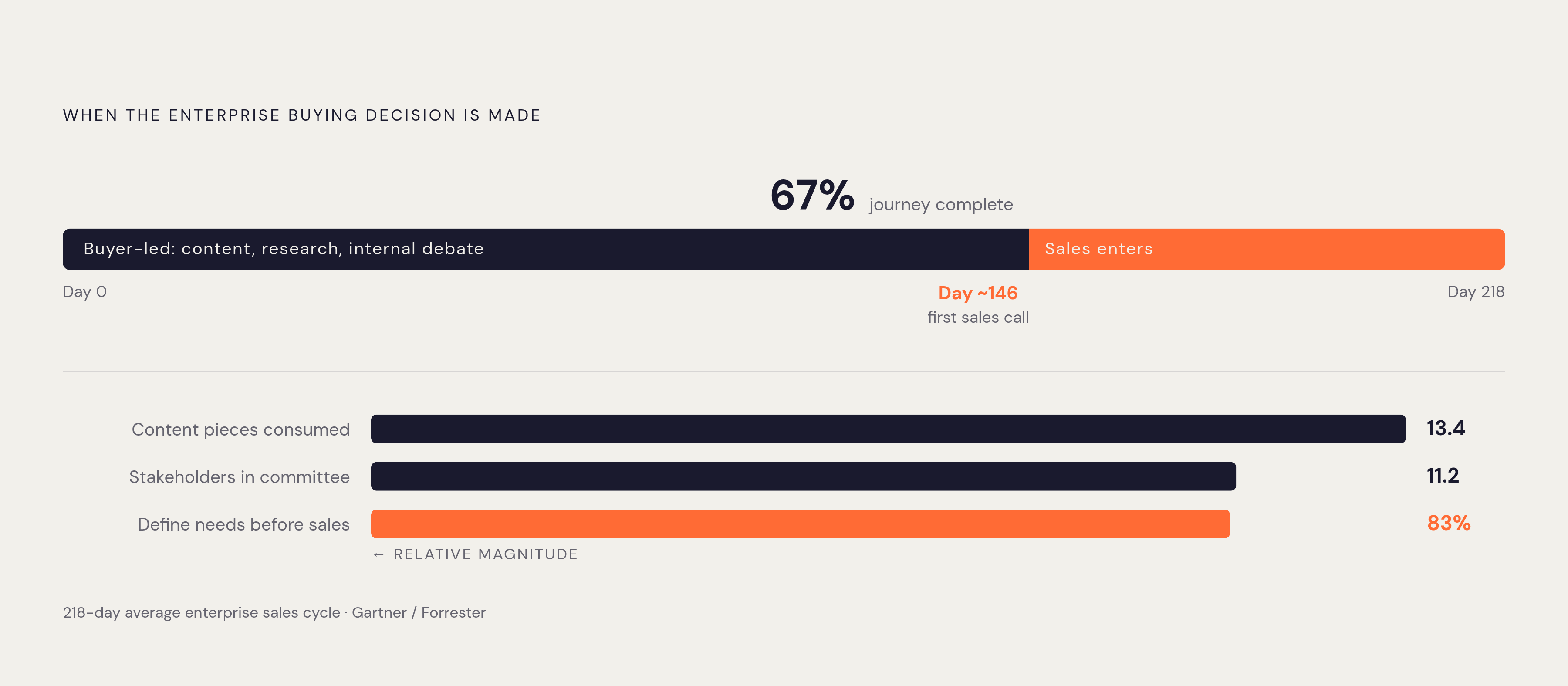
Ninety percent of B2B buyers start research with an online search, and 83% define their purchase requirements before a sales rep ever gets a call. That alone should reorganize how a marketing team spends its time: the sales conversation is mostly a formality bolted onto a decision that's already been made somewhere else.
The content load has gotten heavier too. Buyers now consume an average of 13.4 pieces of content before reaching out to sales, up from 11.6 in 2024, and 67% of the buying journey wraps up before a vendor conversation starts. Content now carries most of the actual decision weight, which means a sales team that treats the first call as the opening pitch is several steps behind.
And here's the uncomfortable part for anyone convinced a great discovery call can rescue a deal: research consistently finds that the vendor who wins was already on the buyer's shortlist at the start of the process. Being present during research is the entry ticket. Miss the shortlist and there's no call clever enough to buy the seat back.
Complicating this further is who's actually in the room. Buying committees for deals over a certain threshold now average 11.2 stakeholders, up from fewer in 2024, according to Forrester and 6sense's 2026 research, and enterprise sales cycles stretch to 218 days. Each of those 11 people worries about something different: the engineer wants to know if the API rate limits will choke the pipeline, the CFO wants a payback period, the VP wants to know if this makes them look sharp or exposed at the next board meeting. Write a single content thread for one persona, and the other ten are left to fend for themselves, which is a strange way to try to close a deal that size.
Peer influence sits on top of all this. Research finds a majority of B2B buyers cite peer recommendations as their single most influential information source. Content strategy has to map to a committee's decision process rather than one buyer's linear funnel; that distinction sounds subtle, but it's the difference between writing for a person and writing for a room full of people who don't fully trust each other's judgment yet.
The subscription lifecycle framework: mapping content to every stage from acquisition to retention
If format follows from goal, and goal changes by stage, the framework only works once someone defines the stages before the content team starts drafting. Four stages do the job: awareness, consideration, decision, and retention. Each one does a different kind of work, and treating them interchangeably is the single most common failure mode in this entire discipline.
Awareness is about being found and trusted before a buyer has consciously decided to talk to anyone. Long-form SEO content, thought leadership, FAQ pages, and proprietary research live here. What separates functional awareness content from decorative awareness content is precision: does it answer the exact question a buyer is typing into a search bar the moment they realize they have a problem, or does it just gesture vaguely at the topic and hope for the best? AI search has raised the bar considerably here (more on that below); being topically relevant isn't enough anymore. The content has to be authoritative enough to survive an AI Overview summarizing it out of existence before a human ever sees it.
Consideration is where the buying committee does its internal lobbying, and the content's job is to arm each stakeholder with what they need to advocate to the others. Webinars, comparison guides, demos, and category explainers belong here; Webinars are consistently rated among the best formats for generating high-quality leads. Interactive tools like calculators and self-assessments matter too, with buyers increasingly expecting them as part of the evaluation process. Consideration content has to talk to the practitioner, the finance lead, and the risk-averse VP simultaneously, which is a hard writing problem, not a formatting one, and it's where a lot of teams quietly give up and just make another PDF.
Decision content exists to remove the last objection standing between a prospect and a signature. Case studies with real numbers, ROI calculators, security and compliance documentation, and reference customer programs sit here. Case studies convert better than almost anything else at this stage, which makes it strange that they're the format most SaaS companies fund like an afterthought. The next section digs into why.
Retention and expansion is the stage most SaaS content strategies skip entirely, and it's also where churn actually gets decided, not in the exit interview but months before it. Onboarding guides, product-use tutorials, customer newsletters, and community programming live here, and their job is to shrink time-to-value and surface expansion opportunities before a renewal conversation even starts. There's a second job hiding inside retention content: it produces the reviews, testimonials, and case study material that feed next year's awareness stage. The lifecycle isn't a straight line, it's a loop, and retention is the part of the loop that restocks the shelves for the next batch of buyers.
None of this works as four separate buckets sitting in four separate folders. Awareness content shapes who makes the shortlist. Consideration content arms the internal champion who has to sell the deal to their own boss. Decision content clears the final friction, and retention content manufactures the proof that starts the whole cycle over again. Break any one link and the chain stops pulling weight, no matter how strong the other three are.
Which formats earn their place at each stage and why case studies are chronically underinvested
Video wins most effectiveness surveys, and for reasons that hold up: it delivers ROI 49% faster than text content, and a majority of B2B marketers planned to increase short-form video investment in 2025. But video has a catch that rarely gets mentioned: it demands production discipline most SaaS teams underestimate until they're three months into a project with no distribution plan. Without a real workflow behind it, video becomes expensive awareness content with no clear path to a conversion.
Case studies deserve the longest look here, mostly because they're the format everyone praises and almost nobody properly funds. Mixology Digital finds 42% of B2B buyers name case studies and success stories as their single most influential content type. And yet most SaaS companies either have too few of them or write them vaguely enough that they could apply to any vendor in the category. A case study that actually earns its place has specific metrics, names the customer wherever legally possible, follows a clean before-and-after structure, and frames the original problem in language that mirrors what a prospective buyer is dealing with right now, not what a happy customer said eighteen months ago. Video case studies, which combine the two highest-performing formats into one asset, are probably the highest-ceiling investment available at the decision stage. They're also the one most consistently skipped when the annual content budget gets drawn up, which is the kind of contradiction worth sitting with for a second.
Proprietary research earns a different kind of return: it compounds the way the first section's ROI numbers compound. Original data draws more backlinks than opinion content, gives sales reps talking points competitors can't just copy and paste, and positions a company as a category authority in a way that matters both for search rankings and for how AI systems decide what to cite. The 2025 Edelman-LinkedIn B2B Thought Leadership Impact Report found a strong majority of B2B buyers favor genuine thought leadership over promotional content when evaluating a vendor, a fairly direct rebuke of the "just publish more product pages" school of strategy.
Gating deserves a practical answer, not an ideological one. Research consistently shows buyers will only engage with gated content if it's highly relevant to them, but they will accept a gate if the content delivers real value in return. The workable rule: gate what took real production investment and is tied to a specific stage, and leave awareness content ungated so it can do its actual job of showing up in search in the first place. Format decisions should follow the question "what does this buyer need right now to move forward," never "what's trending on LinkedIn this quarter."
How AI search is redrawing the organic traffic landscape for B2B SaaS
Here's the disruption nobody's content calendar accounted for two years ago: A significant share of B2B websites saw meaningful organic traffic losses in 2025, as AI Overviews started resolving search queries directly on the results page instead of sending a click to anyone's website, as widely reported across industry sources. That's a meaningful chunk of the funnel getting quietly rerouted before it ever reaches a company's domain, and most teams found out the hard way, by watching a traffic graph fall off and assuming it was a tracking bug.
This isn't confined to top-of-funnel informational queries anymore, which is the assumption a lot of content teams are still operating under, months after it stopped being true. As of 2026, AI Overviews have expanded to cover a broad and growing share of Google queries, with coverage having expanded substantially since early 2025. Within B2B technology specifically, coverage is reported to be especially high, touching the majority of queries in the category. Commercial-intent queries, the ones closer to an actual purchase, are increasingly covered too. So the comfortable idea that AI answers only touch "what is X" searches while the money-intent searches stay untouched doesn't hold up.
The traffic that does arrive via AI referral is small but growing fast, a small but fast-growing share of total B2B SaaS traffic compared to standard organic search, and that referral share has grown rapidly in a short period. The visitors who arrive that way are unusually engaged too, suggesting they arrive pre-qualified in a way a random organic click doesn't.
So what actually changes here? Generic, thin awareness content loses its function almost entirely, because an AI system will just answer the question before anyone clicks through to read the full post. What survives shares the same DNA as content that earns backlinks in the first place: original data, real subject-matter depth, clear sourcing. Proprietary research and detailed original case studies are much harder for an AI system to summarize away cleanly than a generic "10 tips" post, because there's no equivalent original source sitting behind them to substitute in. Chasing whatever the algorithm rewards this month tends to produce a team rewriting the same blog post four times in a year for no reason. The steadier approach is producing work substantial enough that it becomes the thing AI systems point back to, which loops directly to the lifecycle framework: awareness content now has to earn authority, not just occupy a keyword.
Building the content operation that can execute a lifecycle strategy consistently
None of the preceding sections matter if there's no team capable of executing them consistently, and this is where a lot of otherwise sound strategies quietly fall apart, usually around month four. Gartner's benchmark for mature B2B marketing teams puts content roles at 20% of total marketing headcount, with marketing operations at another 15%. That overlap isn't incidental. SaaS content that drifts from actual product positioning is exactly the kind of content that breaks down at the decision stage, when a prospect reads a case study or comparison page and it doesn't match what the sales engineer just showed them on a demo call twenty minutes earlier.
Most early-stage SaaS teams sit well under that benchmark, which is exactly where the build-versus-outsource question shows up. The Content Marketing Institute finds 57% of top B2B tech companies outsource content marketing in some form, but the number itself isn't the useful part. What gets outsourced is. Strategy and audience definition don't survive outsourcing well; losing that ownership tends to fragment the lifecycle coherence the whole framework depends on. Production work, writing, editing, video, design, scales externally just fine without losing strategic control, provided someone internal still owns the stage-by-stage map and isn't afraid to reject a draft that technically hits the brief but misses the point.
The model that reliably breaks is handing the strategic layer to an outside partner who doesn't understand the product deeply enough to know which objections actually kill deals or which use cases actually drive expansion revenue. Outsourcing that particular layer, the one that requires actually knowing the product rather than just knowing how to write about products in general, is where the risk concentrates.
The tension that kills most content programs is velocity versus coherence: the pull to publish more, faster, because a content calendar with gaps in it feels like failure, even when a slower cadence tied to the right stage would outperform it comfortably. Publishing frequency, on its own, correlates with almost nothing that matters. A workflow that starts every piece of content with "what stage is this buyer at, and what does it need to do for them" before anyone picks a format or a headline is the real defense against sliding back into volume for its own sake. The lifecycle framework works best as a live question rather than a document sitting in a shared drive collecting dust between quarterly reviews. It has to get asked, out loud, before the first word gets typed, every time, no exceptions for the piece that's "just a quick blog post."