Content Pillars vs Topic Clusters for SEO
Understanding the structural difference shapes better SEO strategy.

Content pillars and topic clusters get treated like synonyms, and that's the first mistake worth fixing. A pillar is the hub, the broad territory a brand claims. A cluster is the set of spokes built around it, and mixing the two up leads to trouble: a "cluster" with no real center, or one long article mistaken for a full strategy.
One more mix-up to clear before going further. "Content pillar" also shows up in social media strategy, where it means a recurring theme a brand posts about, things like "behind the scenes" or "customer stories." That's a legitimate use of the term, but it has nothing to do with SEO architecture, and confusing the two in a planning meeting wastes actual time. Set it aside. Everything below is the SEO version: pillar pages, cluster pages, and the links holding them together.
What a content pillar actually is in an SEO context
A pillar page is a broad resource that covers a whole topic well enough to work as the front door for everything else a site has written about it. It's wide in scope, treated with real authority, and organized so a reader, or a crawler, can see the whole shape of the subject in one place.
A long blog post has different priorities than a pillar page, and so does a landing page trying to sell something, or a category archive that just lists other posts with no framing of its own. A pillar page's job is orientation, and that shows up two ways. First, keyword targeting: pillar pages chase broad, high-volume terms, the head term for the whole subject, rather than the narrow long-tail questions cluster pages answer. Second, and this is the detail that trips people up most: a pillar page can link outward to pages that aren't part of its own cluster. A content silo's hub page links only inward, to its own subtopic pages, keeping the structure as a closed loop. Hold onto that one structural difference, because it comes back later when the discussion turns to why silos and clusters aren't interchangeable despite looking similar on a sitemap.
What a topic cluster actually is, and how it differs from a content silo
A topic cluster is the set of interlinked pages built around that pillar, where each page picks one specific subtopic and goes deep on it. The pillar covers "content marketing" broadly; a cluster page covers "how to write a content brief" in detail. Together they cover the full territory: the pillar wide, the cluster pages narrow.
Keyword targeting runs in reverse here compared to the pillar. Cluster pages go after specific, long-tail phrases, the kind of granular question a searcher types when they already know roughly what they want, and each cluster page should own its subtopic outright rather than fight the pillar, or each other, for the same query.
This is where the silo comparison earns its keep. Both a silo and a cluster group related content together, but a silo's main page links only within itself, a closed loop, while a topic cluster's pillar page links outward when it makes sense to. That's a meaningful, practical difference when deciding how to wire up a site's navigation. An early, widely cited example paired a pillar on "Content Marketing" with roughly a dozen spoke articles: content strategy, buyer personas, blogging, content planning, each one narrow, each one linked back to the hub. That example still holds up as one of the clearest illustrations of what a cluster looks like once it's actually built, rather than described in the abstract. Worth repeating: a cluster is the posts plus the linking structure connecting them, together, as one unit. Delete the links and what's left is just a pile of disconnected pages.
Where the model came from and why Google's evolution made it necessary
The topic cluster methodology was formally documented in April 2017, building on earlier internal research from 2015 that tracked how internal linking pulls authority together across a site rather than scattering it across disconnected pages. That earlier work, often summarized as "topics over keywords," is the direct ancestor of everything in this piece.
Why did this need inventing at all? Google stopped rewarding pages that simply matched a keyword and started evaluating how thoroughly a site covers the topic a searcher actually cares about. A scattered pile of blog posts, each chasing a slightly different keyword variant with no connective tissue between them, stopped performing the way it used to. Google's evaluation framework increasingly rewards demonstrated depth on a subject over keyword density stuffed into a paragraph. The June 2025 core update pushed further in the same direction, reinforcing topical authority specifically: sites covering a subject thoroughly, consistently, and credibly outperformed sites leaning on older domain-level signals alone.
Here's the position worth stating plainly: the pillar-and-cluster structure works because it mirrors how Google evaluates content. Give Google the pillar for breadth and the cluster for depth, at the same time, and the site ends up organized the way any genuinely knowledgeable source would organize it anyway, algorithm or no algorithm. This is what good reference material looks like, regardless of the ranking benefits it happens to produce.
How the hub-and-spoke linking structure actually works
The mechanism is bidirectional linking, and "bidirectional" is doing real work in that sentence. Cluster pages link back to the pillar, and the pillar links out to every cluster page in turn, and that two-way structure signals full coverage far more than the raw count of pages published ever could.
So what are the links actually doing, mechanically? They pass authority between pillar and cluster pages. Anchor text tells a crawler how each page relates to the others, which means generic anchor text ("click here," "read more") weakens a signal that specific, descriptive anchor text would strengthen instead. The whole structure pulls together what would otherwise look like scattered, unrelated posts into one recognizable topical unit inside Google's index.
Picture a pillar page on "SEO Strategy," with cluster articles on topical authority, keyword research, technical SEO, link building, and E-E-A-T, each one linked back to the pillar and linked from it. That structure hands Google a coherent map of what the site actually knows about SEO, rather than five disconnected posts that happen to share a category tag. Add an FAQ page and a case study into that same linked structure, and the E-E-A-T signal measurably strengthens beyond what any single page could send alone.
Here's the part that surprises people who assume more content always wins: three deeply developed clusters, each with many interconnected articles covering its domain thoroughly, tend to beat ten shallow ones, because focus compounds and breadth without depth just dilutes coverage. That cuts against almost every content calendar built on volume targets. And the single most common way this goes wrong: cluster pages targeting near-identical keywords, cannibalizing each other instead of splitting the work. Keyword mapping across the whole cluster is the discipline that keeps the architecture functioning instead of competing with itself.
What the performance evidence shows about clustered content vs. standalone posts
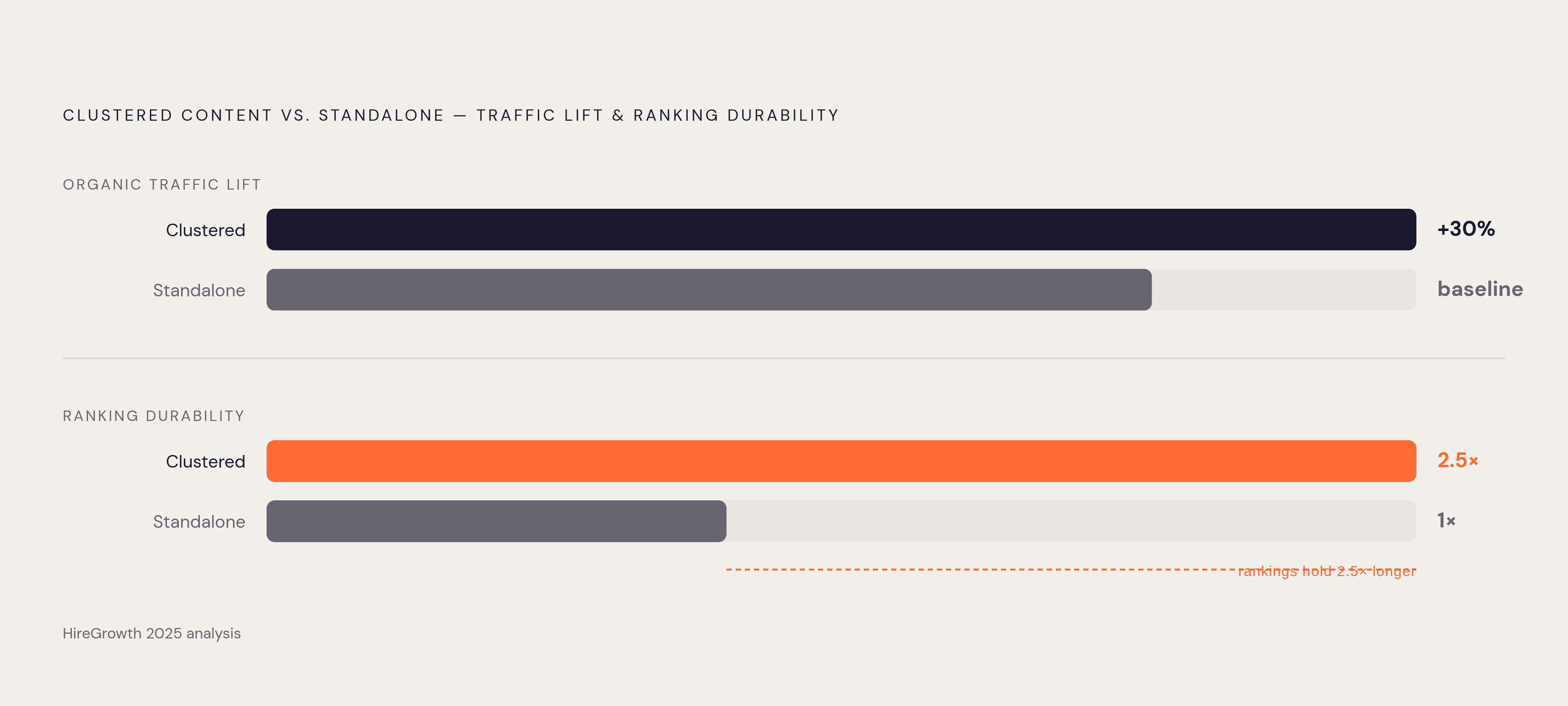
According to a 2025 analysis from HireGrowth, content organized into clusters drove roughly 30% more organic traffic than standalone pieces, and held its rankings about 2.5 times longer. That second number matters more than the first. A traffic bump is nice, but a ranking that survives 2.5 times longer than a standalone post's points to something structural.
Separately, one 2025 analysis found sites using topic clusters saw organic traffic rise by roughly 38% over six months, a number that lines up directionally with the HireGrowth finding, even if the exact mechanism (deeper crawlability, wider keyword coverage, stronger internal authority flow) matters more than the headline figure itself.
Why does durability matter more than the initial lift? Because chasing individual keywords produces results with a short half-life, and a competitor tweaking a title tag can erase a ranking overnight. Structured topical coverage rests on a whole interconnected structure rather than one page's optimization, which is why it holds up longer. Practitioner surveys back this up qualitatively too: roughly a quarter of marketers point to the content pillar strategy as the single most effective method for improving search rankings, a number worth noting because it's coming from people doing the work, not vendors selling the tool.
One caveat the data doesn't let anyone skip: results vary a lot with execution quality. A cluster with cannibalizing pages, thin coverage, or missing internal links won't produce these numbers. The figures above describe well-built implementations, and grouping some posts together and calling it a cluster is a different exercise entirely. That distinction gets lost constantly, usually by whoever is pitching the client.
Why this architecture now serves AI search as well as traditional SEO
Search behavior has shifted underneath all of this. Capgemini reported in 2025 that 58% of users have already replaced traditional search with AI-driven tools for product and service discovery, and Ahrefs found in the same year that 63% of websites report traffic arriving from AI search. This is already showing up in analytics dashboards, well past the point of being some hypothetical future channel. AI referral traffic surged 527% between January and May 2025, a speed of change that means architecture decisions made now will shape AI visibility for years, not months.
Here's the mechanism worth understanding: Google's AI Overviews and AI Mode appear to draw on content across multiple related subtopics when responding to a single search. A topic cluster is built exactly for this. Each cluster page can answer a different branch of that fan-out, because each one already owns a distinct subtopic instead of duplicating its neighbors.
Large language models don't read pages in isolation either. They learn from how content connects to itself and to the rest of the web, so a coherent, well-linked cluster teaches a model what a brand is actually authoritative about in a way five disconnected posts can't. Research from Position Digital in 2026 found branded web mentions correlate with AI Overview appearances at 0.664, notably stronger than the correlation for backlinks, which sat at 0.218. The trust signal that matters most for AI visibility looks increasingly like consistent, visible topical presence across the web, alongside the count of links pointing at a domain. A separate 2025 SEMrush content gap study found brands that filled competitor content gaps saw 38% higher engagement and 2.4 times more AI citations, which means cluster completeness is directly measurable in citation outcomes.
Put those together and the implication is straightforward: a team building complete topic clusters for search rankings is, at the same time, building the exact asset that earns AI citations. Two apparent workstreams turn out to be the same architecture, read by two different kinds of reader.
How to decide which pillars to build and how to scope each cluster
Picking a pillar is a strategic call, and here's the position worth taking: expertise should beat volume every time. The pillar should map to territory where a brand has genuine expertise and a real claim to being the definitive source, weighed against whatever topic shows the highest search volume on a keyword tool's dashboard. Volume without credibility is how a site ends up ranking for a week and then vanishing once Google notices the coverage is thin. Chasing volume first is, frankly, the more common mistake, and it's the one that looks smart on a spreadsheet before it fails in the index.
Scoping the cluster starts by listing every subtopic a reader needs to understand to fully grasp the pillar topic. Each of those becomes a candidate cluster page, and each one needs to be distinct enough to own its own query without stepping on its neighbors. That's the cannibalization test in practice: if two candidate pages would target near-identical search intent, merge them or cut one before a single word gets written. Fixing that after publication is far more painful than catching it on a spreadsheet.
Before building anything new, audit what already exists. Most sites have scattered old posts sitting around that could get folded into a new cluster's structure rather than replaced outright, which means the first move in a cluster project is often reorganization, not new drafts. It's also worth prioritizing subjects where a competitor's coverage is thin or missing entirely; filling that kind of gap inside a properly structured cluster tends to produce faster authority gains than trying to outrank a competitor on a topic they've already saturated. And resist the urge to claim five territories at once. One well-executed cluster, pillar plus a full set of interconnected supporting articles, beats three half-finished ones every time.
The production and workflow reality of building clusters at scale
Here's the part nobody puts on the strategy slide: a single cluster done properly needs a pillar page plus a real set of supporting articles, each one keyword-mapped and internally linked to the others. Pay an agency per deliverable for that volume and the cost curve gets ugly fast, along with the timeline.
There's a second problem hiding behind the first: consistency, which is the problem Letterstory was built to solve. Cluster content written by different freelancers over several months tends to lose the editorial coherence that makes the whole structure legible to a search engine in the first place. Tone drifts, terminology drifts, internal linking conventions get applied differently from one writer to the next, and that quietly undermines the exact signal the cluster is supposed to send.
The fix is sequencing. The keyword map, the linking plan, and the brief structure for every article in the cluster need deciding before a single draft gets written. Retrofitting structure onto content that's already finished is how the cannibalization problems described earlier actually happen in practice.
The tradeoff comes down to something fairly plain: AI-assisted production, paired with real editorial oversight, handles both the cost problem and the consistency problem at once, with speed that avoids the per-piece agency markup and consistency enforced through templates and shared brand context rather than left to whichever freelancer happened to be free that week. In practice, that looks like a strategy-first content platform where the cluster architecture, internal linking, keyword targeting, and content scope get built directly into the brief and the production workflow, handled by the system with minimal reinvention on every article. The payoff compounds: a cluster built correctly in month one keeps gathering authority, rankings, and AI citations for years afterward. Standalone content, built one disconnected post at a time, has a much harder time matching that return.
The common mistakes that turn a promising cluster into a cannibalization problem
The single most common failure, worth repeating because it shows up constantly, is cluster pages targeting near-identical search intent. Google's crawler can't tell which page deserves to rank, and the practical result is that neither one does.
A second failure sits at the pillar level: pillar pages so vague they could belong to any brand in the category. A pillar page that could get swapped onto a competitor's site with a find-and-replace on the logo has length, but it lacks the depth that would make it genuinely thorough. Thorough and vague pull in different directions, and only one of them earns trust.
One-directional linking is a quieter failure, but it cuts the mechanism in half: cluster pages that link up to the pillar while the pillar never links back down. Since bidirectional linking is what makes the whole structure legible, breaking one direction of it meaningfully weakens the signal the structure sends. Building a new cluster without auditing old content first is another common one, since duplicate posts left over from before the cluster existed keep splitting authority even after the shiny new structure goes live on top of them. Treating cluster size as the metric to chase, more articles equals more authority, misses the point entirely: coverage completeness and keyword distinctness are the actual quality signals, and neither one has anything to do with a raw page count.
Last on the list: orphaned cluster pages, articles written to fill a gap in the plan but never actually linked into the structure. They sit on the site, technically published, contributing nothing to the topical authority signal because nothing points to them and they point nowhere. The fix for nearly all of these problems is the same: a keyword map built before production starts, checked against existing content, with the linking structure specified directly in the brief. These are process failures, and process failures are the fixable kind.
What a working pillar-and-cluster architecture looks like when it comes together
Picture the finished shape: one pillar page claiming the broad territory, a keyword-mapped set of cluster articles each owning a distinct subtopic, bidirectional links connecting every node back to the hub and out to each other, a structure that gets stronger with each new piece instead of more crowded.
Return to the "SEO Strategy" example from earlier: the pillar defines the entity, and clusters on topical authority, keyword research, technical SEO, link building, and E-E-A-T each answer a distinct question while reinforcing the pillar's own authority signal. Each layer earns its keep on its own terms. That's the whole point of the architecture.
The same structure built for traditional rankings turns out to be well suited to earning AI citations as well, since the cluster teaches both a search engine and a language model what a brand is actually the definitive source on. So how would anyone check whether their own architecture is actually working, rather than just looking tidy on a sitemap? The pillar ranks for the broad term, individual cluster pages rank for their specific subtopics, and the site starts turning up in AI-generated answers on the subject. Internal analytics show readers clicking from one cluster page to another, building a path deeper into the site rather than a single visit that ends there.
Content pillars and topic clusters function as two layers of one structure, complementary parts of a single system to build together. The gap between a site that understands that and one that doesn't shows up exactly where it should: in the rankings that last, and the ones that don't.