Editorial Calendar Planning for Enterprise Marketing Teams
Most enterprise calendars track publishing dates.

Enterprise editorial calendars fail for a boring reason: most only track one or two of the seven things a large marketing org actually needs to coordinate at once. Everyone assumes the tool is broken, so they buy a new one, migrate the spreadsheet, rename some columns, and six months later they're missing the same deadlines with a fresh coat of paint on top. The actual fix is a calendar built to hold strategy, production, approvals, distribution, audience stage, measurement, and repurposing simultaneously, because a large marketing team runs all seven whether the calendar admits it or not.
Only 28% of enterprise marketers describe their content strategy as extremely or very effective, per the Content Marketing Institute's 2025 enterprise research. That points to a planning-infrastructure problem more than a talent one, and it starts with a distinction most teams never draw: a calendar tells you when something publishes; a workflow tells you how it gets ready to publish. Conflate the two, and the result can schedule content but can't produce it on time, at quality, with anyone able to say why a given entry exists in the first place.
Scale doesn't mean more content so much as more hands on each piece of content, more channels demanding different cuts of the same asset, and more stakeholders convinced their review is the one that matters. Coordination surface grows faster than volume does. Most calendar tools were never built to hold that surface, and vendors rarely mention it in a demo, because "handles seven workstreams" is a harder sell than "has a calendar view."
Here's what surprises people: even at companies large enough to call themselves enterprise, the content team itself often stays small. Per CMI's 2025 B2B benchmarks, 54% of B2B marketers with a dedicated content team report just two to five people on it. "Enterprise scale" usually means a small team wedged between a dozen departments, each holding informal veto power over what ships, rather than an army of writers cranking out copy.
Above a certain size, the org chart does split, and this is where the real trouble starts. A VP of Content or Chief Content Officer sits at the top, with managers running editorial, SEO, brand, social, and lifecycle, each overseeing a handful of individual contributors. Inside that structure, three roles get blurred constantly: the content strategist, who owns the topic map and brief quality; the managing editor, who owns editorial standards; and the content ops lead, who owns tooling, workflow, and measurement. Ask who owns all three on a given team. If the honest answer is "one person does," that's a bottleneck wearing three name tags, and eventually all three jobs get done at a fraction of full capacity each.
Meanwhile the volume math has turned genuinely strange. A 2025 survey by 10fold found 91% of marketers increasing content output. Budget didn't keep pace: 75% of those teams saw increases of only 1 to 10%. So the calendar is tracking three to five times more entries, made by roughly the same people, with slightly more money and the exact same number of hours in a day. Something gives, and it's usually consistency, the thing enterprise buyers actually claim to want.
Specialization is the natural response to that squeeze, splitting work by channel or function so each person owns a narrower lane. It works, mostly, but every specialist added is another workstream the calendar has to represent. Meanwhile, 33% of B2B marketers, per CMI's 2025 benchmarks, say they struggle just to get time with subject matter experts. That's a coordination failure hiding inside a staffing statistic, and no software fixes it by itself; a calendar can make the gap visible, but a human still has to decide who closes it.
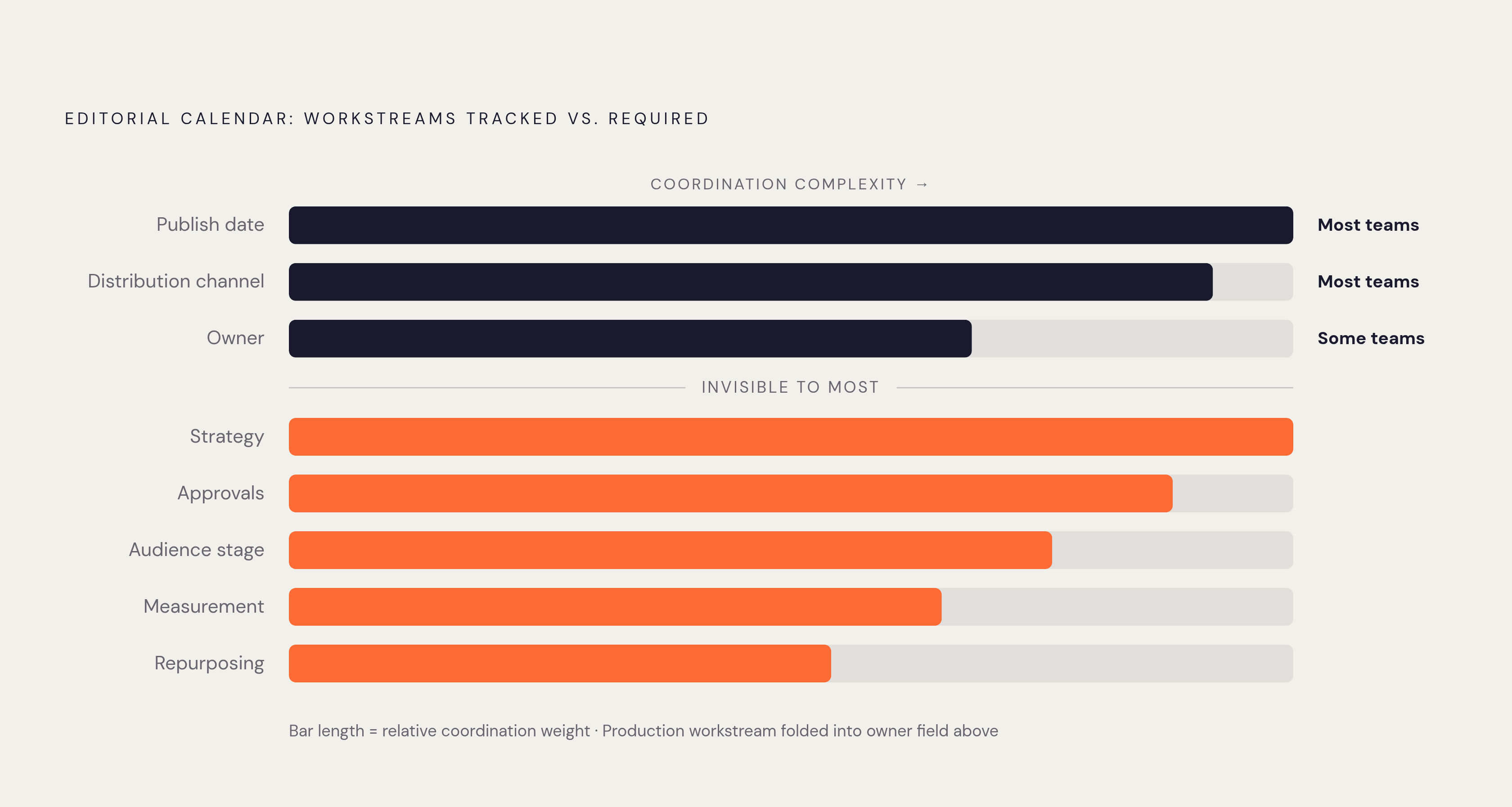
The fields every enterprise editorial calendar entry must carry
Ask ten content marketers what fields a calendar needs, and most converge on the same short list: topic, content type, purpose, promotional channels, owner, publish date, status, headline, live link, document link. Call that the floor. Past a five-person team, it stops being sufficient for a plain reason: none of those fields tell a new hire what to actually do if they inherit the entry cold.
The fix, and the part most calendars skip, is treating each entry less like a row and more like a small hub. Put the brief and talking points inside the entry itself. Add research notes and source links. Add a draft checklist that shows what stage a piece is really in, not the word "in progress," which could mean anything from "outline exists" to "legal has had it for three weeks and gone quiet." Add the repurposing plan before the piece even exists: what it feeds downstream, what gets cut from it later. Add the published link and wherever performance actually gets logged. Do that, and the entry becomes the operational record for the asset instead of a scheduling slot with a due date stapled to it.
Content type is worth a hard look here, because most default templates are quietly wrong. CMI's 2025 research on B2B teams found the most-used formats are short articles and posts (94%), video (84%), and case studies or customer stories (78%). A calendar whose template only has fields tuned for blog posts is structuring itself around a fraction of what teams actually ship. Channels tell the same story: in-person events (52%), webinars (51%), email (42%), and website blogs (41%) all rated as effective B2B distribution channels in 2025. A calendar without a real channel-assignment field is ignoring the last, and arguably hardest, mile of the whole process: getting the finished thing in front of someone who cares.
Meanwhile, "status" deserves better than the single word "draft," full stop. A useful status field is a taxonomy: briefed, drafted, in review, approved, scheduled, live, performance-logged. Anything less collapses seven distinct states into one vague blob, and vague blobs are where deadlines quietly go to die.
How governance and approval processes become the calendar's load-bearing structure
CMI's 2025 enterprise research (n=310) found 47% of enterprise marketers cite managing content workflow and approval as an active challenge. Nearly half the industry naming the same problem specifically means it's not a symptom of badly run teams; it's structural to how approvals get handled almost everywhere, including at companies that would never describe themselves as disorganized.
The failure mode is close to universal in shape: an approval step with no deadline attached becomes a graveyard. Something goes to legal, or brand, or a VP for sign-off, and it sits there, because "waiting to hear back" isn't a status with a clock on it. The fix is blunt on purpose. Give every review submission a real response deadline, and give every reviewer exactly three options once that deadline hits: respond, delegate to a named backup, or decline and redirect explicitly. There is no fourth option where the piece floats in an inbox until someone remembers it exists.
A RACI matrix, documenting who's Responsible, Accountable, Consulted, and Informed for every content type and channel, is what makes any of that enforceable. Skip it, and approvals default to whoever answers Slack first, a lottery with a Slack notification standing in for the lottery ball.
For regulated content, the audit trail has to live inside the calendar's workflow itself, not get reconstructed after the fact from an email thread when a compliance officer asks who approved what and when. Legal and compliance review needs to be a tracked stage with a timestamp, same as any other step, not a side conversation that happens to exist somewhere in someone's inbox archive.
There's a quieter failure worth naming: quality drift. A team can start with genuinely high editorial standards and still watch quality slide as headcount grows, not because new hires write worse, but because the mechanism for transmitting standards doesn't scale the way headcount does. A style guide that lives in one editor's head, or one nobody's touched in two years, is institutional memory wearing a disguise, and it evaporates the day that editor takes a new job. Functional governance looks like an operating model instead: named owners, defined service levels, archive rules, escalation paths, refresh cycles someone can actually measure, and a brand voice that holds steady whether the asset ships in three markets or one.
Connecting the calendar to strategy: audience stages, campaign arcs, and content gaps
CMI's 2025 enterprise research found that among marketers rating their own success as extremely or very high, 81% credit understanding their audience as the reason. The best-run teams tend to have someone functioning as an audience manager, mapping what questions the audience needs answered at each stage of the journey and checking that content exists to answer them.
Here's the test worth applying to any calendar in front of you: does every entry get tagged to a funnel stage or a piece of audience intent? If the honest answer is no, that calendar is scheduling content without deploying it, and those are different verbs for a reason worth sitting with.
Campaign content and evergreen content need to live in the same calendar under different rules, and conflating them is its own quiet failure. Campaign content ties to a launch window or business narrative; it needs a hard deadline and an escalation path for when that deadline slips, because it will. Evergreen content has no launch window at all; it needs a refresh cycle and a performance trigger that pulls it back into review when it starts underperforming, rather than a publish date that gets set once and ignored forever after.
Once entries carry stage tags, the calendar starts revealing gaps on its own. Look across a quarter's worth of tagged entries, and it becomes obvious fast where the team has overbuilt (top-of-funnel blog posts, almost always) and where it's neglected (late-stage comparison pieces, customer stories, the stuff that actually helps someone sign). That's a genuinely useful diagnostic, and it only works if the tagging happened in the first place, which is precisely the step most teams skip under deadline pressure.
The same logic extends to pillar content. A long-form guide or research report should generate a visible cluster of derivative entries right in the calendar: shorter posts, social cuts, email excerpts, all linked back to the anchor asset. Build that cluster before production starts, and the repurposing plan is visible from day one, instead of retrofitted three weeks after the guide ships when someone remembers it should probably become a LinkedIn carousel.
CMI's 2025 data puts 61% of enterprise marketers at "moderately effective" on content strategy, which is the mushy middle where most of the industry actually sits. That gap between moderate and effective is exactly where a calendar does work nobody notices it's doing, simply by forcing strategy to show up in the plan instead of living in a separate deck nobody reopens after the kickoff meeting.
What measurement integration looks like when it's built into the calendar rather than bolted on
CMI's 2025 research found 48% of enterprise marketers agree their organization measures content performance effectively. Flip that: slightly more than half do not, which makes measurement failure closer to the norm than the exception in enterprise content marketing, not some embarrassing outlier a team can blame on one bad quarter.
Two numbers explain most of that gap. Sixty-six percent of enterprise marketers report difficulty tracking customer journeys, and 63% struggle to attribute ROI to content. Both read as structural problems wearing an analytics costume: if a calendar entry never records, at creation, what outcome the piece was supposed to drive, there's nothing later for any dashboard to measure against. You can't grade a test that never stated its questions, and no amount of downstream analytics software fixes a question that was never written down.
Fixing it means building a few things directly into the entry, not into a separate reporting tool three systems removed. Every entry declares a goal at creation: traffic, pipeline, engagement, retention, pick one and write it down. A performance review stage gets built into the workflow itself, triggered automatically at a set interval after publish, say 30 or 90 days out, so someone actually looks at the thing again instead of assuming it's fine because nobody complained. Evergreen entries get a refresh trigger: performance drops below a set threshold, and the piece re-enters production rather than sitting there quietly decaying like milk at the back of the fridge. At the campaign level, the calendar should roll individual outcomes up into a campaign view, so a launch's performance isn't reconstructed by hand from a dozen spreadsheets after the fact.
Strung together, that's a closed loop: strategy sets the goal at the entry level, production executes against it, governance checks quality along the way, measurement confirms or corrects the outcome, and the resulting insight feeds the next planning cycle instead of evaporating into a quarterly report nobody rereads.
AI is changing what's realistic to expect from that loop, and the adoption curve backs that up. CMI's 2025 data shows 75% of enterprise marketers now report using AI, up from 58% the year before. Analytics summarization, spotting performance patterns, flagging content gaps: these are exactly the tasks that benefit from a structured calendar to run against, because AI pointed at a messy, ungoverned calendar just produces messy, ungoverned output faster. Speed isn't the bottleneck if the underlying system has no structure to accelerate.
How to evaluate tools against the seven-workstream standard
Wrong question for a vendor demo: does it have a calendar view. Every tool has a calendar view; that's table stakes, not a feature. The question worth asking is how many of the seven workstreams the tool natively supports, and where the vendor's answer turns into "well, you'd integrate that with X." Every one of those workarounds is a future failure point waiting for whoever configured it to leave the company, at which point nobody remembers why the integration exists or what breaks if it stops.
Purpose-built marketing platforms earn their cost when content is a primary acquisition channel. General project management tools can work too, but they need more manual setup to encode editorial-specific logic, approval chains, content-type taxonomies, the stuff that doesn't come standard in software built for construction schedules or engineering sprints.
Worth knowing a few tools by their actual strengths rather than their marketing copy. Wrike handles complex, multi-layered approval chains well, with native proofing across multiple file formats and multi-stage review built in; it's used by organizations across a wide range of industries and was named a Leader in the 2025 Gartner Magic Quadrant, which makes it a solid fit where governance and creative review, more than scheduling, are the hard part. monday.com has received analyst recognition for its work management platform, and in marketing work management specifically; its flexibility means editorial workflows get built on top of general project infrastructure rather than shipped pre-configured, which is a strength right up until someone has to build that schema from scratch. Asana lets one piece of content appear in multiple projects at once, a blog calendar and a product launch plan, say, without duplicating it, which directly addresses the cross-workstream visibility problem that trips up most calendars; its AI features support task summarization and workflow automation across the content lifecycle. Hootsuite makes the most sense where social distribution effectively is the content strategy, with scheduling, approval, and analytics unified across networks and enterprise-grade governance controls built in. And where AI-native writing pairs with strategy-first workflow design, some newer platforms let the calendar function as the actual input to production, rather than a document sitting next to production hoping to stay relevant.
None of that matters if the setup doesn't match the need. A tool that technically supports all seven workstreams but ships configured for two of them (scheduling and status, usually) reproduces the exact failure it was bought to fix, just with better UI wrapped around it. Someone still has to build the schema; the software doesn't know your RACI matrix on install.
Worth checking, too: CMI's 2025 data shows 62% of enterprise marketers now have formal AI usage guidelines in place, up from 36% the year before. Any tool evaluation should ask how the platform handles AI governance, not only what its AI features generate.
Underneath all of it sits a role, not a feature: the content ops manager, who owns tool configuration, workflow logic, and reporting across the whole function. Without that person, even a well-chosen, well-configured tool drifts back toward a two-workstream calendar within a year, simply because nobody's job is to notice the drift happening in real time.
Building toward the system: how to move an existing enterprise calendar from scheduling tool to operating infrastructure
CMI's 2025 data shows 39% of enterprise marketers expect content budgets to increase this year. That's good news until you sit with the implication: new budget landing on top of a broken coordination system just funds the dysfunction at higher volume. More money doesn't fix a calendar tracking two of seven workstreams; it buys more content for that same broken calendar to lose track of, faster.
Start with an honest audit, and it needs to be genuinely honest, not the version presented at the next all-hands. Count how many of the seven workstreams the current calendar actually surfaces, and say out loud which ones are invisible. Most teams land at two or three: publish date and channel, maybe a rough owner field, and that's the whole system.
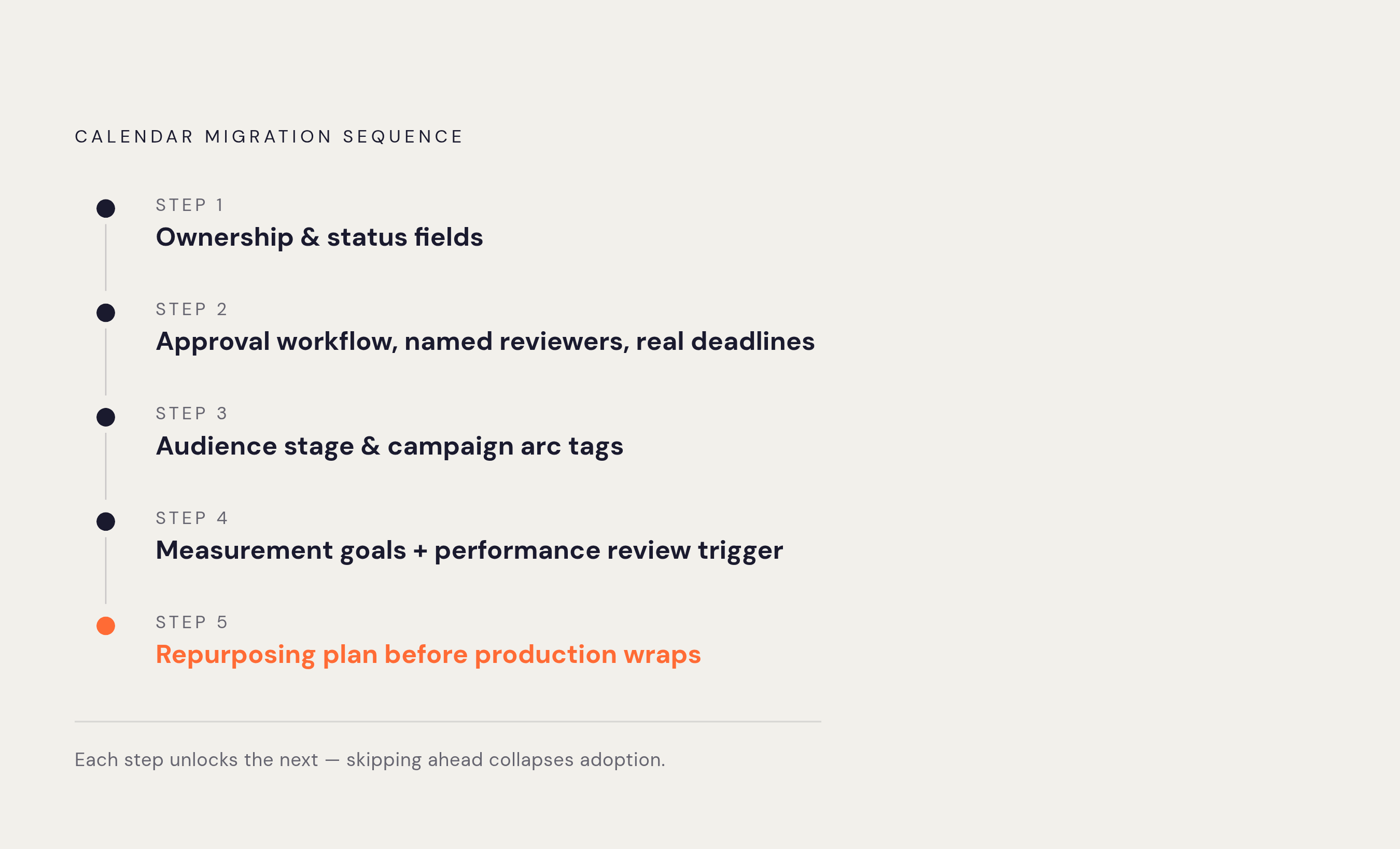
From there, sequence matters, because adding all seven at once collapses adoption entirely; nobody fills out fifteen new fields on faith alone. Ownership and status fields come first, since most teams are missing even these and running on memory and Slack threads instead. Second, build the actual approval workflow into the calendar: named reviewers, real deadline fields, no parallel email chain running alongside the "official" system pretending to be the real one. Third, layer in audience stage and campaign arc tags, so strategy becomes visible in the plan view instead of a concept everyone nods along to in meetings and nobody applies afterward. Fourth, add measurement fields at entry creation, and schedule performance review as a recurring workflow step rather than a task someone means to get to eventually. Fifth, build the repurposing plan into every long-form entry, so downstream assets are visible before production even wraps.
None of it works as tooling without governance attached. Switching platforms before RACI, approval SLAs, and editorial standards are documented just produces the same dysfunction in a shinier interface, which is an expensive way to relearn a lesson the team already paid for once. Someone has to own the schema going forward: enforcing the fields, auditing calendar health on a recurring basis, treating that as an actual job function rather than a setting configured once during onboarding and forgotten.
What a mature version of this looks like in practice: strategy is visible right there in the plan view, not filed somewhere else nobody opens. Every asset has a named owner and a clear next step. Approvals move because deadlines are enforced, not because someone happened to check their inbox that afternoon. Performance data flows back into the next planning cycle instead of sitting in a report nobody opens twice. And the calendar holds all of this in one place, rather than splitting it across four competing spreadsheets, each telling a slightly different, slightly wrong version of the same story.