Updating Old Blog Posts to Recover Lost Rankings
Refreshing old posts recovers lost search traffic faster than publishing new ones.
Content decay is the gradual, predictable loss of organic traffic, rankings, and impressions a page experiences simply because it has aged on the internet. A sudden, sharp drop in a single week almost always points to a technical problem or a penalty, while a slow bleed over months is the fingerprint of decay itself.
Four things drive it, and none of them are mysterious once you name them. The query itself survives, but what people typing it actually want changes underneath it. A "GA4 events" tutorial written in 2021 answered a real question at the time, but by 2026 the searchers typing that phrase are mostly looking for migration guides, not setup basics. Outdated information is the second driver, plain and simple: pricing changes, statistics age out, tool names get rebranded, regulations shift, and both Google's crawlers and human readers notice the staleness. Third, competitive pressure never lets up. Rivals publish newer, more thorough treatments of the same topic, and Google reshuffles the rankings to reflect it. Fourth, AI-powered SERP features now intercept clicks before a searcher ever scrolls down to organic results, a pattern documented in Ten Speed's analysis of decay causes.
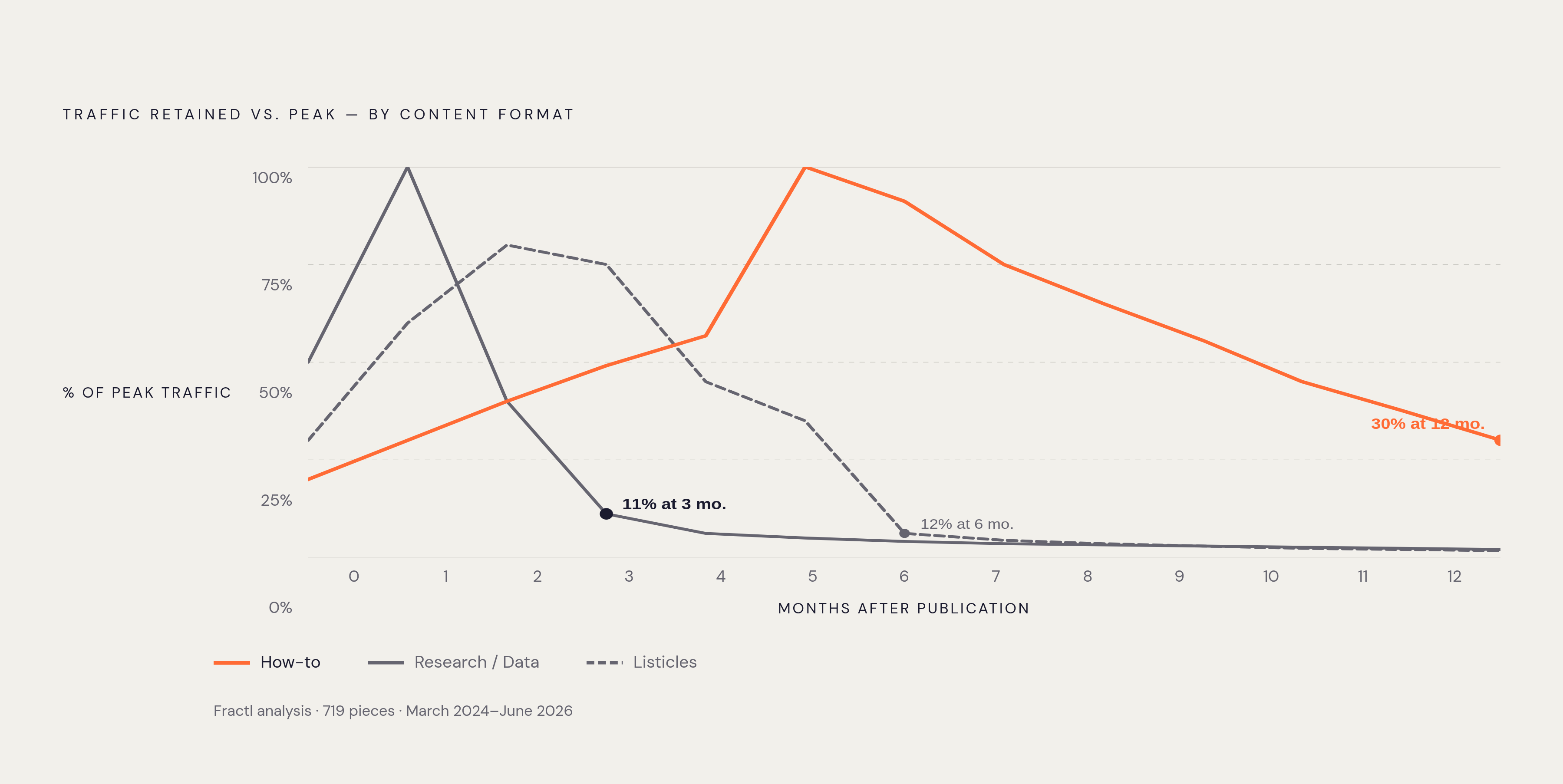
How fast decay actually bites depends heavily on content type. Fractl's analysis of 719 pieces across three client portfolios, using GA4 data from March 2024 through June 2026, found that research and data pieces peak in a median of just one month and then shed 89% of their traffic within three months Fractl 2024–2026. How-to content behaves completely differently: it peaks around five months out and still holds roughly 30% of its peak traffic a year later, making it the most durable format tracked in that study Fractl 2024–2026 Ahrefs Content Refresh Statistics for 2026: Traffic Gains, SEO Impact, Conte…. Listicles are in between, retaining about 12% of peak traffic at the six-month mark Fractl 2024–2026.
None of this happens in dramatic leaps. Algorithm updates then compound the damage for pages that were never even the target. The December 2025 Core Update produced visibility swings of 20 to 70% across affected sites, according to SISTRIX, and that swing catches bystanders too: a page doesn't need to be penalized directly to lose ground when competitors around it rise. Decay, in other words, is structural. It's baked into how search engines and content markets behave over time, not a symptom of bad writing, and that's precisely why it calls for a systematic response rather than occasional guesswork. Industry baseline: content decays at an average of 1.21% per week (small enough to ignore week to week, large enough to devastate a page over a year).
Why refreshing existing posts outperforms publishing new ones
An old blog post already carries assets a brand-new draft simply doesn't have: an indexed URL, backlinks earned over months or years, domain history, and topic demand that's already been market-tested by real searchers. Publishing something new means starting all of that from zero.
The efficiency case appears clearly in the data. Refreshing old posts can lift traffic by 106%, per HubSpot's historical content optimization study, cited in a compilation of SEO statistics by SearchAtlas. Practitioners back this up with their own reporting. The Orbit Media Studios 2024 Annual Blogger Survey, cited by Siege Media, found that bloggers who update older posts are 2.5 times more likely to report strong results than those who don't bother, and 74% of bloggers now treat updating old content as a standard part of their workflow. On the business side, 51% of companies say updating old content actually outperforms creating new content, according to a report from Knowledge Enthusiast.
The clearest illustration of scale comes from Workshop Digital's 2.5-year performance study, running from 2024 through mid-2026 Workshop Digital 2024–2026. Comparable pages that were left untouched declined 9.1% over the same stretch that refreshed pages improved, a gap the study's authors flagged as one of the more surprising findings in the entire analysis Workshop Digital 2024–2026. Orbit Media's own case study from 2025 tells a similarly sharp story: an article that had pulled in search visitors for six straight years finally saw its rankings collapse, and after a rewrite, quarterly traffic rose 700% while engagement rate climbed 180%.
None of this means every aging post deserves a rewrite. Refreshing the wrong post wastes the same hours a bad new post would waste, just with extra steps. The real question, and the one the rest of this piece works through, is how to tell which posts are worth that investment before committing to it. Content updates with maintained original URLs improve rankings on average 83% faster than new publications on new URLs, per an Ahrefs 2025 analysis cited by Brixon Group Ahrefs / Brixon Group.
How Google evaluates freshness for a refresh
Freshness hasn't always mattered to Google's ranking systems, and tracing how it got baked in explains why a refresh done right actually works. By 2011, the Freshness Algorithm formally made recency a distinct ranking dimension, affecting up to 35% of all search queries at launch, though only 6 to 10% of queries saw a noticeable, visible impact Content Refresh Guide 2026: Boost SEO Rankings & AI Visibility.
That history matters because freshness has only grown more central since. It now sits as the 6th largest Google ranking factor, carrying roughly 6% weight, up from a figure close to zero in earlier algorithm analyses, according to First Page Sage's study cited by The Stacc. The Query Deserves Freshness logic still governs which kinds of searches get a freshness boost in the first place: breaking news, recurring annual events, trending topics, and "best of" recommendation queries, and that last category covers a huge share of everyday blog content. There is a critical distinction in what Google actually measures.
Google's evaluation focuses on information gain, meaning genuinely new and useful content, not merely a changed timestamp. Swapping out a publish date or replacing one adjective creates the appearance of freshness without adding anything of substance, and Google's systems are specifically trained to tell the difference. A refresh that only touches the surface, in other words, risks doing nothing at all. It has to earn its freshness signal through real, substantive change, or it isn't a refresh so much as cosmetic maintenance. Understanding how deeply baked freshness is into Google's architecture requires a brief historical arc, offered here not as trivia but as context. The Caffeine update, announced in August 2009 and deployed in June 2010, enabled near-real-time recrawling instead of weeks-long cycles.
How fast decay actually bites depends heavily on content type.
AI Overviews and chat platforms have raised the stakes for stale content in 2026
AI Overviews now show up in roughly 30% of Google queries, and Ahrefs' analysis of 17 million AI citations found they prefer to cite content that's 25.7% fresher than what shows up in traditional organic results for the same query. ChatGPT skews even further toward recency: the URLs it cites run 393 to 458 days newer, on average, than the pages ranking organically for the same searches. Perplexity shows a similar pattern, drawing roughly half its citations from content published in the current year, and Ahrefs' 2025 data, cited by Slate HQ, found that 65% of all AI bot crawl activity targets pages published within the past 12 months.
This has produced visibility decay, a genuinely new kind of harm. Ranking well is no longer the same thing as being seen.
E-E-A-T, the Experience, Expertise, Authoritativeness, and Trustworthiness framework, now functions less like a quality bonus and more like a hard gate for AI citation. Content that doesn't clear that threshold doesn't get considered for citation at all, regardless of where it ranks organically.
Not every format suffers equally, though. Complex, multi-step processes, especially ones with screenshots and troubleshooting sections, tend to hold their traffic: an AI system can summarize the gist, but users still click through for the full walkthrough. Comparison pieces, decision-support content, and pages that earn their own citations tend to hold up or even grow. Simple factual answers are the most exposed of all; Contently's analysis found the losses concentrate specifically on pages built to answer a single-sentence question. Monitoring now has to track whether a post shows up inside AI answers, not just where it lands in traditional results, and that means structuring content with clear definitions, explicit step sequences, and FAQ sections built to stay eligible for citation. AI Overviews can reduce click-through rates to traditional organic results by 30 to 60% for queries where they appear, representing a new category of harm, "visibility decay," in which a page can hold its ranking position and still lose meaningful traffic Content Refresh Statistics for 2026: Traffic Gains, SEO Impact, Conte…. Certain content types hold traffic despite AI Overviews.
Identifying which posts are worth refreshing before touching anything
Confirm the problem before reaching for a fix. Seasonality, a tracking or tagging change, a site-wide algorithm event, or just a slow month can all produce a graph that looks like decline without actually being it. If the whole site lost traffic at the same time, that's a site-level problem to diagnose first.
Once decay is confirmed at the page level, triage splits into four decisions, since not every old post deserves a refresh. Some posts deserve a refresh outright, since the topic still matters, the URL carries history worth keeping, and the post can realistically be made better than the current top-ranking competitors. Others are better merged: two middling posts covering overlapping ground should get consolidated into one stronger hub page, with the weaker URL 301-redirected into it, since keyword cannibalization quietly hurts both pages at once Content Refresh Statistics for 2026: Traffic Gains, SEO Impact, Conte…. Some posts should simply be redirected, particularly when the topic no longer aligns with where the business is heading; preserving the link equity through a redirect beats letting the URL decay in place. And some posts are best left alone entirely, still doing quiet work for a niche audience or supporting the site's internal linking structure without needing any attention.
Among posts flagged for an actual refresh, certain characteristics predict the best return. Look for a steady, consistent downward slope in impressions and clicks across a six-month window, according to Collaborative Haus Marketing's framing of decay patterns. Posts that already carry a strong backlink profile deserve priority too, since existing authority makes recovery both faster and more durable, per Page Optimizer Pro's analysis. Watch closely for posts with high impressions paired with a low click-through rate: Google is already showing the page to plenty of searchers, they're just not choosing it, and that's almost always a title tag or meta description problem rather than a content depth problem.
Google Search Console is the primary tool for this stage. Comparing equivalent time periods for impressions, average position, clicks, and landing page performance reveals the pattern quickly, and it also reveals keywords the page ranks for unintentionally, which an update can then target on purpose. Before changing anything on the page itself, export every query the page currently ranks for over the past 16 months. Both Orbit Media and Elevation B2B flag this step as non-negotiable, because it's entirely possible to accidentally de-optimize rankings the page holds without anyone realizing they were there in the first place. Posts ranking in positions 11–30 (page two or three of Google) are already within reach of page one and often need targeted improvements rather than full rewrites.
Diagnosing why a specific post declined before writing a single word
Misdiagnosis is the single most expensive mistake in this whole process. A post that lost rankings because of outdated statistics needs a different fix than a post that lost because three competitors published comprehensive guides with original research, and misdiagnosing wastes the effort.
Start with a live SERP check, run in an incognito window on the primary target query, and actually study the top five to ten results as they exist right now. A listicle, a step-by-step guide, a comparison table, or an FAQ-first layout dominates? What subtopics do those results cover that the declining post skips entirely? What "People Also Ask" questions have surfaced since the post's original publish date? Intent mismatch is the most expensive form of decay precisely because it demands structural change, not another paragraph bolted onto the existing outline.
Search Console query data, pulled for the last three to twelve months on that specific URL, tells its own diagnostic story. Steady impressions paired with falling clicks usually points to a title or meta description that no longer matches current intent. Both impressions and clicks falling together signals either straightforward content decay or a competitor that's displaced the post outright. A slipping average position on the primary target queries suggests competitors have simply out-relevanced or out-depth the post. And ranking for fewer relevant queries than before means the topic coverage now has real gaps relative to what the SERP currently rewards.
GA4 fills in engagement time, scroll behavior, and conversion data after the click. A post that still converts well for the people who reach it deserves different prioritization than one that loses nearly everyone within seconds. And before assuming the problem sits in the content at all, rule out technical causes: site migrations, broken redirects, crawl errors, and slow page speed can all drag down a page that's editorially sound.
The output of this whole diagnostic stage should be a specific brief: exactly what changed in the SERP, which existing queries need protecting, and what the post needs to do differently.
What to change when you refresh a post
Some posts need only light touches. Others need a structural rewrite. The diagnosis from the previous stage determines which, and defaulting to one approach regardless of what the data says defeats the entire point of diagnosing first.
Updating for accuracy starts with the obvious: replace stale statistics with current figures, since a "best tools for 2024" post reads as visibly outdated in 2026, and Google's crawlers register that staleness just as readily as a human reader would. Remove or correct anything no longer true, discontinued products, changed regulations, retired best practices, and add in whatever new developments or tools have emerged since the original publish date. All of this only counts if it constitutes substantive freshness (new useful information) rather than cosmetic freshness (a date change only); Google's systems detect the difference, and only the former earns a ranking signal.
If the SERP has shifted format, for example from long-form to step-by-step, restructure the post to match the dominant format (this is the fix for intent decay, not just a paragraph addition). Expand coverage of subtopics that now appear in competing top-ranked pages and in "People Also Ask" results.
On-page signals round out the work. Revise the title tag and meta description first if impressions are high but click-through is weak; this is often the fastest win available in the entire refresh. Review the heading structure to make sure it covers the subtopics the current SERP surfaces, and add or update internal links, since a site tends to grow new pages around an old post over time, creating linking opportunities that simply didn't exist when the post first went live, a pattern Stackmatix flags as a common and easily fixable decay contributor. Fix or replace any broken external links while in there.
Finally, structure the piece to stay eligible for AI citation: clear definitions, explicit step sequences, and FAQ sections give AI Overviews and chat platforms something concrete to pull from, rather than leaving the post's best material buried in paragraph form where a crawler has to guess at it Ahrefs. Updating for AI citation eligibility is part of what to actually change when you refresh a post.
Sources
- How to Update Content for SEO: The Trick to Updating Old Blog Posts
Provided the 2025 Orbit Media case study showing 700% traffic increase and 180% engagement rate lift after refreshing a declining article, and flagged the step of exporting all existing queries before editing.
- How to Update Old Blog Posts for SEO: A Complete Guide
Cited for the finding that existing backlink authority makes content recovery faster and more durable when prioritizing posts for refresh.
- Content Refresh Strategy: When and How to Update Old Content for SEO
Identified the common and easily fixable decay contributor of unlinked new pages that grew around an old post after its original publish date.
- The conference for marketers ready to win in 2026
Provided the finding that content updates on maintained URLs improve rankings 83% faster than new publications, and the data on AI citation preferences for fresher content including the 17 million citation analysis.
- Content Refresh Statistics for 2026: Traffic Gains, SEO Impact, Content Decay, Audit Frequency, AI Freshness Preferences, and ROI
Supplied statistics on AI Overview click-through rate reductions of 30–60% and supported data points on content decay patterns and keyword cannibalization.
- Content Refresh Analysis: 2.5 Years of SEO Performance Data
Provided the 2.5-year performance study showing untouched pages declined 9.1% while refreshed pages improved over the same period.
- Content Decay: Why Older Blogs Lose Rankings | cHaus Marketing
Provided the framing of decay patterns as a steady, consistent downward slope in impressions and clicks over a six-month window.
- Content Refresh Strategy 2026: How to Win Visibility in AI Search | Ten Speed
Cited for documenting AI-powered SERP features intercepting clicks as one of the four drivers of content decay.