Fact-Checking Process for Marketing Content
A structured fact-checking system catches AI's predictable errors before publication.
Fact-Checking Process for Marketing Content. Marketing content, especially AI-assisted content, carries specific, predictable failure modes that a structured fact-checking process can catch before publication, and the article lays out that process as a practical, repeatable system any content team can adopt.
Why marketing content has a fact problem that AI has made structurally worse
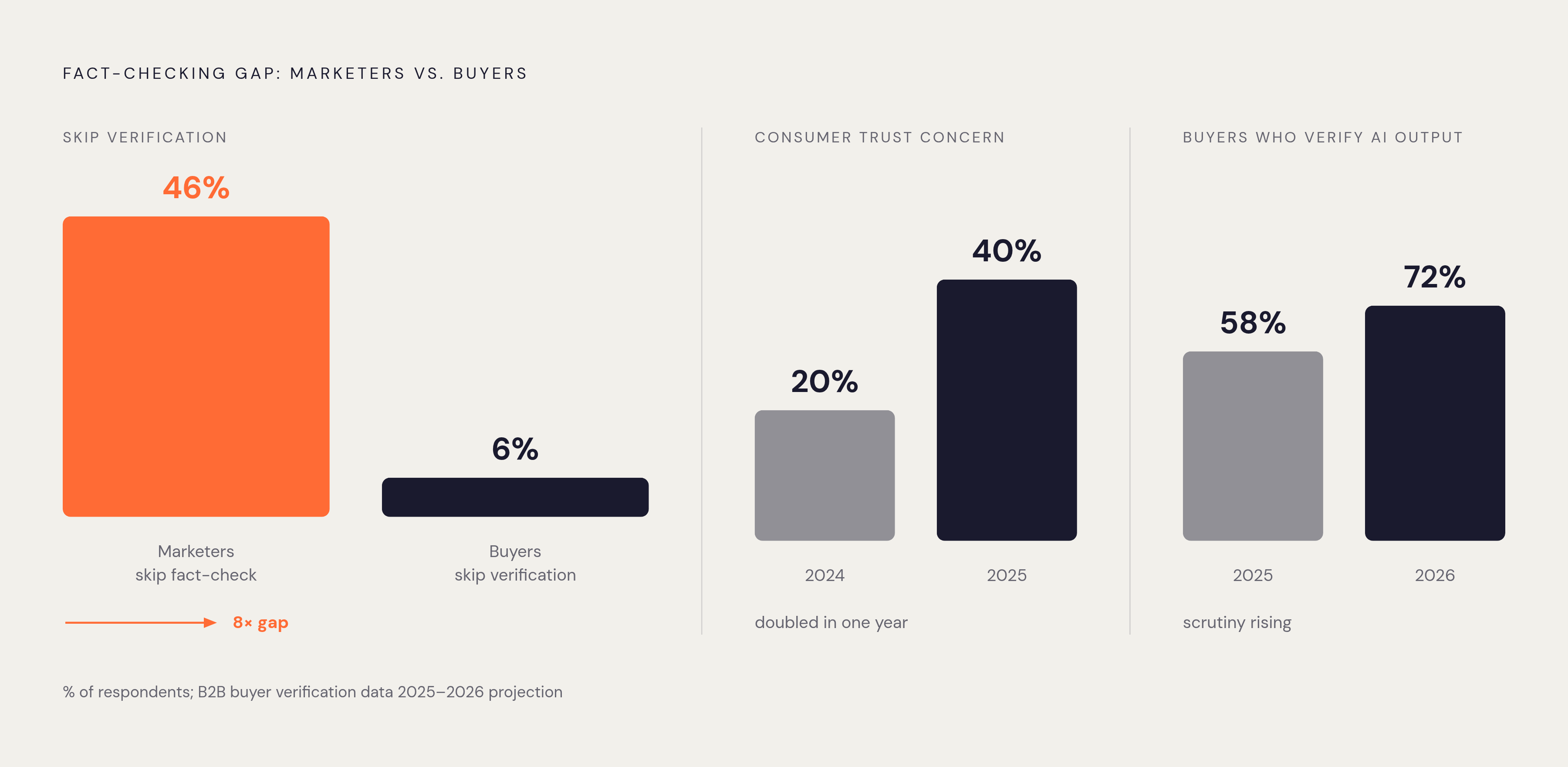
The defining dynamic in 2026 is that marketers skip fact-checking AI-generated content far more often than their own buyers do, with roughly 46% of marketers skipping it entirely versus about 6% of B2B buyers who never verify what they read. Consumers have noticed, too. The share who say heavy AI use in a brand's content would lower their trust in that brand doubled in a single year, from 20% to 40%.
AI produces fabrications in the same confident tone it uses for facts, and most readers and editors read for flow, not for truth. A fabrication doesn't stumble. It doesn't hedge. It reads like every other well-formed sentence around it. It survives editorial review so often for this reason.
Consider the kind of thing that almost went out under a real client's name: an AI tool invented a Gallup statistic claiming that 74% of employees feel disengaged when managers don't use data Gallup (cited as fabricated). The number was clean, the phrasing sounded like something Gallup would publish, and the citation had the right shape Gallup (cited as fabricated). The number was fabricated. It got caught before publication, but only because someone happened to look closely at a sentence that had no obvious reason to be doubted Gallup (cited as fabricated). That's the entire problem in one example: the fabrication was indistinguishable in tone from a fact, and tone is what most reviews actually check. Buyers are getting more skeptical, not less: per TrustRadius 2026, the share checking AI outputs rose from 58% in 2025 to 72% in 2026.
The four failure modes that appear most often in AI-generated marketing content
The more common and more corrosive failures are directional distortions: a real source gets cited with the wrong number attached, a real person gets a title they never held, a real study gets summarized in a way that quietly changes what it found. These are harder to catch than outright invention because half of the claim checks out. Someone did say something. A study did exist. The distortion sits in the details.
Four failure modes appear repeatedly in practitioner verification work, per MIT Sloan analysis and practitioner verification guides. Fabricated citations are the most literal version: a journal title, an author name, a publication year, all constructed to look plausible, none of it tracing back to a real paper. Outdated facts presented as current run on a quieter mechanism, since every model has a training cutoff, and a number that was true in 2022 gets stated with no qualification as if it describes today McKinsey. The McKinsey self-serve statistic is the clearest worked example of how this compounds: the original study surveyed B2B decision-makers about reordering products they already bought, not about first-time purchases, and the correct figure for new-purchase contexts was 32%, not the 73% that keeps getting copied into blog posts years after the fact. Context collapse is the third mode, where a finding from a narrow study gets stripped of its methodological limits and applied to a population the research never covered. And confident tone for uncertain claims rounds out the list: models don't reliably flag their own uncertainty, so a hallucinated fact and a verified one read as grammatically identical McKinsey.
A broader taxonomy helps place these four failure modes in context.
That scale demands attention. A 2025 study by the BBC and the European Broadcasting Union, covering 22 media organizations, found that 45% of AI-generated answers contained at least one significant issue, 31% had sourcing problems, and roughly a fifth carried major accuracy errors, hallucinated details included tripledart.com. Hallucination rates shift depending on the model and the task, and no single tool on the market earns a pass on this by default. The claim types that carry the hardest risk in marketing copy specifically are statistics and percentages, direct quotes from named people, case study details, legal and regulatory claims, competitor comparisons, and "first ever" historical framing. That list is the same list the triage step below is built around. The content-level taxonomy from Position² 2024 supplements this with fabricated content, manipulated content, imposter content (fake sources), misleading content, false context, false connections, and sponsored content presented as editorial, giving the writer a fuller taxonomy without doubling the word count.
Why a structured process beats spot-checking
Spot-checking fails for a specific reason: editors read for what looks suspicious and let everything else pass, and context collapse or a misapplied statistic doesn't look suspicious, because it's built to sound right. A reviewer scanning for red flags will catch the wild claim and miss the reasonable-sounding one that's actually wrong.
Time is the other constraint nobody wants to say out loud. Verifying a 2,000-word article properly, checking every claim against a primary source, takes 45 to 60 minutes tripledart.com. At the volume most content teams publish, that's not a schedule most editorial calendars can absorb, and spot-checking isn't laziness so much as the only thing that seems to fit inside the time available tripledart.com. The actual unit of work isn't "a blog post." A typical B2B SaaS post contains 8 to 15 individually verifiable claims, and each one needs its own decision about whether it's true, not a single up-or-down judgment on the piece as a whole lilachbullock.com.
BestWriting's 2026 framework splits verification into two layers, and the failure comes from collapsing them into one pass. The surface layer checks names, numbers, and superlatives, and takes under 60 seconds per claim. The deep layer traces a claim back to its original source, reads the study itself, and weighs whether the source carries any bias. Most writers only ever complete the surface layer, and because the two get treated as one task, both get done badly. The fix is upstream: tag claims while drafting instead of running a single QA pass after the piece is finished, so a polished error never gets the chance to sit quietly in the archive.
One more piece belongs here before the step-by-step process starts. A transparent corrections policy isn't a confession of failure, it's a credibility signal, and AFP's Fact-Checking Stylebook treats a visible corrections process as non-negotiable for any publication that claims accuracy as a standard. What follows is a five-step system built to be repeated on every piece: per an arXiv study, only five popular AI content detectors scored above 70% accuracy, and some misclassify human writing as AI-generated due to formal tone, so these tools assist but don't replace judgment.
AI produces fabrications in the same confident tone it uses for facts, and most readers and editors read for flow, not for truth.
Step 1: Read for plausibility before opening a browser tab
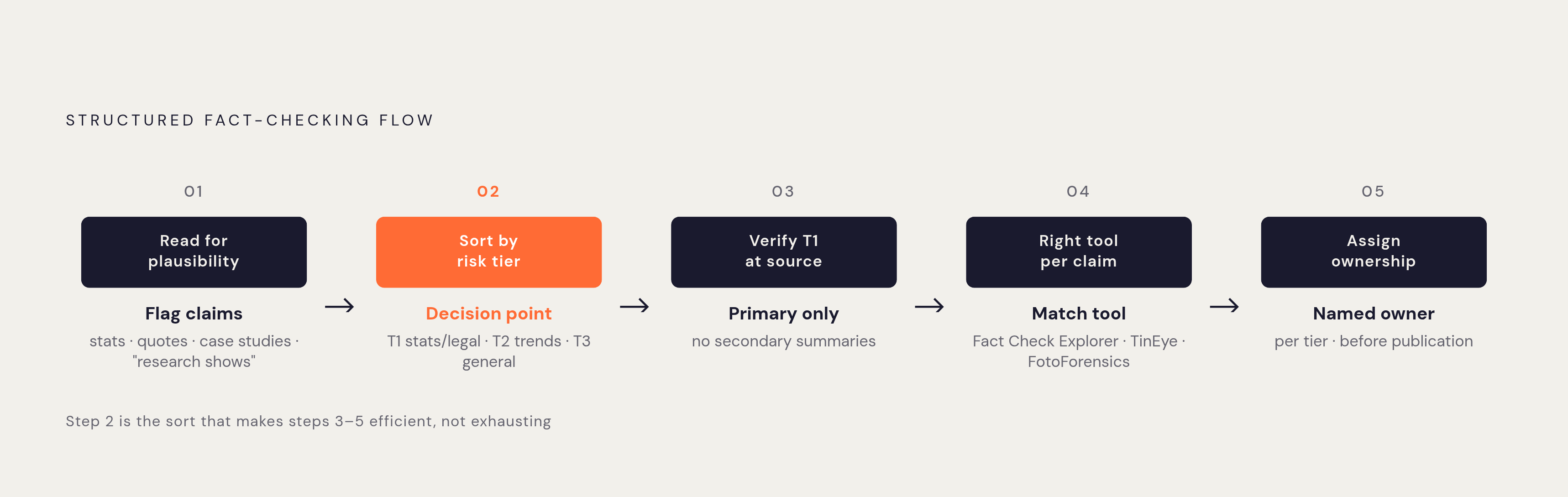
The first pass through a draft is a highlight pass: read the whole piece once and mark every sentence that depends on something outside the writer's own reasoning to be true. Every statistic, every quote attributed to a named person, every case study, every "research shows" or "studies indicate," and every sentence that gestures at a study without naming one, all get flagged before any research begins.
The reason to separate flagging from checking is cognitive. Do both at the same time and a reviewer starts verifying whatever catches their eye first and quietly skips the claims that read smoothly enough to glide past. A dedicated flag pass forces coverage of the whole draft instead of whatever happened to look wrong on first read. A suspiciously round number, a percentage stated with unusual precision but no study attached, "the first ever" framing, or a quote that reads more like ad copy than something a person actually said in conversation should be flagged even without an obvious named source.
By the end of this step, the draft should be marked up claim by claim, with nothing left to memory or to a second read that may or may not happen before publication.
Step 2: Sort claims by risk tier before verifying any of them
Not every flagged claim deserves the same amount of work, and treating them all identically wastes time on the low-risk ones while under-checking the high-risk ones. A three-tier system solves this. Tier 1, the highest risk, covers statistics with a named source, direct quotes from named individuals, specific product or company details, and legal or regulatory statements, and every one of these must be verified before the piece goes live. Tier 2 covers general industry trends stated as fact, comparative claims, and historical statements, and these need at least a plausibility check against a source that's actually reliable. Tier 3 covers broad, generally accepted professional knowledge, the kind of statement that rarely needs a citation but should still hold up if a reader pushes back on it.
Any sentence shaped like "According to McKinsey, 68% of…" should default to Tier 1 regardless of how plausible it reads, because that pattern, percentage plus authoritative source, is a classic hallucination structure. The output of this step is a ranked list, so the next hour of work goes toward the claims that actually carry risk instead of getting spread evenly across everything the draft contains. The claim types that consistently fall in Tier 1 for AI-generated marketing content specifically are statistics and percentages, named quotes, case study details, competitor feature or pricing claims, and legal and regulatory claims (Lilach Bullock).
Step 3: Verify Tier 1 claims at the original source, not a secondary summary
Verification means locating the actual report page from the organization that ran the study. If the original can't be located, the statistic comes out of the draft. "It was in the AI's output" won't hold up when a reader flags it publicly, and it shouldn't.
For statistics, check not just the number but the year, the sample, and the scope: the McKinsey self-serve example shows the 73% figure was for reordering existing products, while the correct figure for new purchase contexts was 32%. Same study, same organization, completely different claim depending on which number gets copied. For quotes, search the person's name alongside a distinctive phrase from what they supposedly said; a real quote from a real interview appears in that search, and one that doesn't appear anywhere gets cut. Legal and regulatory claims carry their own risk on top of all this, since training data has a cutoff and regulations change by jurisdiction. Legal content needs review against a current primary source rather than a general AI summary. Reliable places to check against include research organizations that publish their findings directly (Pew, the BLS, the ONS for UK figures), an analyst firm's own original report page rather than someone else's coverage of it, and official guidance from the relevant regulatory agency. For case study details, real case studies are detailed and messy while AI case studies have suspiciously round numbers and clean timelines, so verify the company, the strategy, the metric, and the timeframe independently (Lilach Bullock 2026).
Step 4: Use the right verification tools for each claim type
No single tool covers every kind of claim. The right approach cross-checks facts across more than one platform: one tool for a quick claim check, another for deeper research, a separate one again for anything involving an image or a piece of media.
For general claim verification, Google's Fact Check Explorer is usually the fastest first stop, since it searches fact-checks already published by credentialed organizations and shows whether a claim has already been reviewed by someone else. FactCheck.org, running since 2003 out of the Annenberg Public Policy Center, and PolitiFact, with more than 22,000 fact-checks published since 2007, function as institutional benchmarks for how a verified claim gets documented and are useful references when a claim sits in genuinely contested territory.
Image and media claims need a different toolset entirely. TinEye runs a reverse image search and shows everywhere an image has appeared before, which is often the fastest way to catch reuse or spot an image that doesn't belong where it's being used. FotoForensics goes a step further with forensic analysis that reveals signs of editing or inconsistent compression in an image, worth reaching for specifically when manipulation is already suspected.
An arXiv study found only five popular AI content detectors scored above 70% accuracy, and some misclassify human writing as AI-generated due to formal tone, so these tools assist but don't replace judgment. These tools narrow the search. They don't replace a person deciding whether a claim is actually true.
For teams publishing at real volume, an automated pipeline changes the math entirely. TripleDart's architecture runs claim extraction, verification, and a synthesis report as three sequential stages, using Claude Sonnet alongside three other AI models, and processes a 1,800-word article in 2 to 3 minutes with no manual handoff between stages. Stage one pulls out every verifiable claim as a numbered list, tagged by type, cited source, location in the piece, and priority. Stage two, the deep pass, checks source traces, study originals, and bias assessment, following a surface pass covering names, numbers, and superlatives verifiable in under 60 seconds. Stage three produces a report with replacement text ready for anything that got flagged. Run across existing archives, this kind of audit tends to reveal a 15% to 25% stale-stat rate lilachbullock.com tripledart.com. Fact-checking has to run before the humanization pass, not after, so that verified language survives downstream rewrites intact.
A newer category of tooling checks accuracy at the brand level rather than the article level. Profound FactCheck, launched July 14, 2026, continuously evaluates what AI answer engines are actually saying about a brand against that brand's own verified information, using a Knowledge Base the customer maintains as the source of truth. The problem it's built for is specific: language models now answer questions about a company's products, pricing, and policies before a customer ever reaches the company's own website, and until this category existed, marketing teams had no systematic way to check whether what the AI said was even correct. The platform checks responses sentence by sentence with a proprietary claim detection model, and its customer list includes Figma, Walmart, Ramp, MongoDB, Chime, and U.S. Bank. Inside Profound's own platform, FactCheck now sits as a third analytical pillar alongside Visibility and Sentiment. The Manus AI fact-checker searches academic journals, official institutions, and reputable media sources in real time to verify each statement's accuracy. Full Fact AI, developed by Full Fact, is used by fact-checkers globally to monitor public debate, find misinformation, and take action. Brand-level AI accuracy monitoring is a new category as of July 2026. Profound's research across 50,000 LLM responses found that 47% of response content is completely unsolicited (the AI isn't answering the question asked, it's adding its own claims), a finding James Cadwallader, CEO of Profound, points to.
Step 5: Assign ownership so the checklist doesn't collapse under ambiguity
A checklist with no named owner tends to fail quietly. If everyone on a team assumes someone else is running the verification pass, the pass often doesn't happen at all, and nobody notices until a reader points out the error publicly. The fix isn't complicated: a named person owns each tier of the checklist before anything publishes, and that doesn't require hiring a dedicated fact-checker, it just requires that responsibility for each tier has an actual name attached to it rather than a shared assumption.
For teams publishing at higher volume with AI content tools in the mix, the checklist works better built directly into the CMS as a required pre-publish step, so the system itself blocks a piece from going live until the review is marked complete. That's a structural barrier, not a reminder, and the difference matters when deadlines are tight and a busy afternoon is exactly when a skipped step becomes the norm.
None of this replaces editorial judgment, and none of it is meant to. AI has a legitimate place in the workflow for research, first drafts, and editing support, but the decision about whether a claim is true, in context, for this audience, stays with a person. Tools narrow the work. What they can't do is decide, on their own, that a claim is safe to publish.
Sources
- How to Fact Check AI Generated Marketing Content
Provided the fabricated Gallup statistic example, the claim-count estimate for B2B SaaS posts, and guidance on verifying case study details and Tier 1 claim types.
- Fact-Checking Guide for Writers (2026): Catch Every Error
Provided the two-layer verification framework (surface layer and deep layer) and the recommendation to tag claims while drafting rather than running a single QA pass.
- Claude Skill for Fact-Checking: Verify Every Stat Before Publishing
Provided the McKinsey self-serve statistic example (73% vs 32%), the BBC/EBU 45% accuracy finding, time estimates for verification, and the automated three-stage pipeline architecture.
- Attacks by Content: Automated Fact-checking is an AI Security Issue
Provided the finding that only five popular AI content detectors scored above 70% accuracy and that some misclassify human writing as AI-generated due to formal tone.