AI Content Detection and What It Means for SEO
Detection tools are unreliable and Google ranks on quality, not origin.

AI content detection tools can't reliably do the one job they claim to do, and marketing teams that chase clean detection scores are optimizing for a number Google never uses to judge pages. Google never asks whether a human or a machine wrote the first draft. It asks whether the page holds up on accuracy, usefulness, and whether it's worth a reader's time. Treating a detection score as a quality gate solves the wrong problem, and it pulls attention away from the metrics that actually move rankings.
Detection tools spot patterns: predictable word choices, flat sentence rhythm, the statistical fingerprint left behind by how a language model predicts its next word. None of that reads intent. A tool can flag a sentence as "probably AI" for the crime of being short and declarative. According to AI Content Detection in 2026: Trends to Watch, only five AI detection tools tested scored above 70% accuracy, a low bar that most tools still failed to clear. That's the state of the field, not a floor. No content strategy should treat a detection score as gospel when the best tools available still miss three times out of ten.
Vendors and independent testers don't even agree with each other. Turnitin advertises a false positive rate below 1%. The Washington Post, working with a smaller sample, found a false positive rate of 50%, meaning half the human writing tested got flagged as machine-made. Turnitin's own checker also misses roughly 15% of AI-generated text in a document, so the tool fails in both directions at once: it wrongly accuses people, and it wrongly clears the content it was built to catch.
Beating these tools takes almost no effort. Paraphrase a paragraph, drop in a personal detail, vary the sentence length, or run the draft through a second AI model, and accuracy drops further still. A system this easy to fool, and this inconsistent under independent testing, has no business governing a professional content operation. Call it what it is: a coin flip dressed up as a diagnostic.
Who gets hurt most by false positives, beyond academia
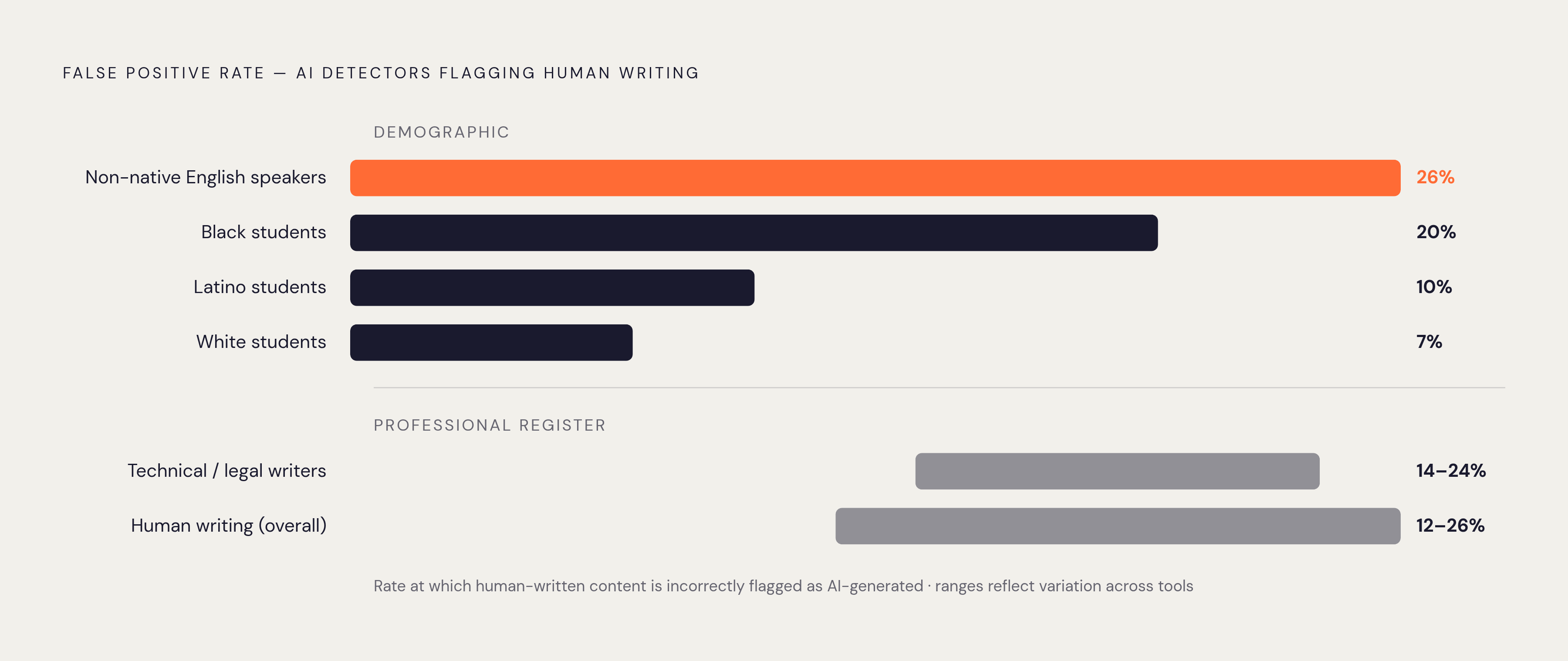
False positive rates for human-written content run between 12% and 26% across the leading detectors. One in every four or five genuinely human pieces gets mislabeled, and the mislabeling follows a pattern rather than falling randomly.
Non-native English speakers face false positive rates up to 26% in formal writing, because their sentences often read as more uniform and rule-bound, the exact texture detectors associate with machine output. Technical and legal writers are between 14% and 24%, for a similar reason: precise, structured language trips the same wire. A report from Common Sense Media documented a 20% false positive rate for Black students, against 10% for Latino students and 7% for White students. That gap is demographic, and it should worry anyone who assumes these tools are neutral.
For a marketing team, the lesson is direct. A tool that mislabels skilled writers, especially those working in formal or technical registers, manufactures noise and calls it signal. Build a content workflow around detection scores as a stand-in for quality, and the writers most worth keeping are the ones who get penalized. That's the opposite of what any hiring or editing process should reward.
What Google's systems actually evaluate instead of AI origin
Google's public stance hasn't moved since 2023: content gets judged on helpfulness, originality, and trustworthiness, full stop. Whether a human or an AI tool wrote the first draft never enters that equation directly.
SpamBrain and the helpful content system look for shallow coverage, unverified claims, duplicated text, and pages published at industrial scale with no real differentiation. Those are quality signals, and they say nothing about who or what typed the sentence. Google's SynthID can watermark output from its own tools, including Gemini, though how or whether that capability connects to Search ranking decisions has not been publicly confirmed. For content from ChatGPT, Claude, Grok, or any other non-Google tool, no publicly confirmed detection layer in Search has been announced.
In 2025, Google added a human-rater instruction telling raters to flag main content created by automated or generative tools "without real value or originality." The operative words are "without real value," not "generated by AI." That's a quality test wearing a label meant for a different kind of check.
The March 2024 Core Update caused 45% of low-value sites to lose traffic overnight. Content quality caused that drop, not some layer built to catch machine-made text. The March 2026 Core Update ran on the same logic: pages built on real expertise gained ground, thin pages lost it, and the tool used to draft them had nothing to do with the outcome.
What the ranking data shows about AI-assisted content
Survey data backs up what Google's own updates suggest. In the Web Strategy Survey, 46% of marketers said AI-assisted content ranked higher, 36% saw no change, and 10% saw rankings fall. That 46% is down from 65% reporting a ranking boost in 2023, which tracks with a tightening quality bar rather than a crackdown on AI use itself.
Broader survey data similarly finds no automatic link between AI-generated content and ranking outcomes. The variable that predicted performance was process: teams that edited and refined AI drafts tended to see gains, while those who saw rankings fall tended toward publishing with less human oversight.
The failure modes repeat in predictable ways. Prompt an AI tool to "optimize for SEO" and it tends to churn out repetitive, keyword-stuffed phrasing that trips spam filters, a pattern especially common in law, healthcare, and local-services content. Hallucinated statistics or outdated claims wreck E-E-A-T signals and reader trust in the same stroke. Mass-publishing near-identical templated pages gets flagged by SpamBrain for the volume and repetition alone, regardless of how the pages were written.
Detection scores tell a marketer nothing useful about ranking risk. Quality signals tell them everything they need to know.
Obsessing over detection scores as the wrong optimization target
Chasing a low detection score is an arms race with no finish line. Circumvention takes minutes, detectors keep retraining, and a score a team hits today can mean something entirely different after next month's update. It's a moving target dressed up as a fixed one, and teams that treat it as fixed are wasting hours on the wrong problem.
Google's systems check a short, consistent list of things instead: whether claims are accurate and verifiable, whether the page shows real expertise and an original point of view, how users behave once they land there (dwell time, click-through rate, bounce), whether the page adds something the current top results don't already say, and basic technical health like page speed and mobile layout. Edit toward those signals, and the content ranks regardless of what a detector says about it. Edit to fool a detector while ignoring those signals, and the traffic bleeds out eventually, exactly as the March 2024 and March 2026 updates showed.
Most teams already have the right instinct, even where the framing hasn't caught up. Over 86% of marketers already edit AI-generated drafts to add human perspective and real expertise. That's the correct workflow, already in motion, whether or not anyone calls it that. Detection scores belong in academic integrity checks.
Ranking through traditional SEO losing ground regardless of content quality
Even content that clears every quality bar Google cares about is running into a structural problem that has nothing to do with detection. AI Overviews showed up in 25.11% of queries in the first quarter of 2026, across a very large sample of searches. One dataset weighted toward informational queries put the figure at 48% of all queries by March 2026, up from 31% in February 2025.
When an AI Overview appears, organic click-through rate falls hard, somewhere between 50% and 61% depending on the dataset. Seer Interactive (September 2025) measured a drop from roughly 1.76% to 0.61%, a 61% fall. A Pew Research Center behavioral study found users click a traditional organic result only 8% of the time when an AI Overview is present, versus 15% when it isn't, a 47% relative decline. That's a 47% relative decline. More than 60% of searches today end without any click at all. For news publishers specifically, Research found the zero-click rate jumped to 69% in May 2025, up from 56% a year earlier.
Ranking first no longer guarantees a reader ever sees the page. Getting cited inside the AI Overview itself has become a separate visibility layer, sitting on top of traditional ranking rather than following from it. Being cited inside an AI Overview rather than left out on the same results page creates a meaningful click advantage, a gap that has become the visibility signal that actually matters now.
The risk cuts both ways. When Google switched over to Gemini 3 on January 27, 2026, a large share of previously cited domains were replaced, in some cases overnight. AI visibility can vanish as fast as it showed up, and a strong traditional ranking did nothing to predict who kept their spot.
What marketers should actually optimize for and measure
The target now is citation presence inside AI-generated answers. Getting represented accurately, and favorably, in what an AI tool tells a user is where buyer discovery increasingly starts, and it's a different game than ranking a blue link.
AI tool queries tend to be substantially longer and more detailed than typical Google searches, reflecting a user who has already done some thinking about what they need. Someone typing 60 words into an AI tool has already done some thinking about what they need. They're further along in the decision and more likely to act on whatever the AI recommends, which makes the citation itself closer to a conversion event than a simple mention ever was.
A Princeton study on generative engine optimization, running 10,000 queries, found that adding machine-extractable provenance (direct quotations, cited statistics, named sources) drove roughly 25 to 40% more visibility inside AI answers. Plain relevance to the source query still matters most. Research using benchmarks like C-SEO Bench suggests that many tactical optimization tricks offer limited benefit for AI citation visibility. One format stands out clearly: AI engines cite well-ranked "best of" listicles more than almost any other content type, which makes earning a mention inside the right listicle one of the higher-leverage moves available going into 2026.
Generative engine optimization runs roughly 80% strategic (positioning, ecosystem presence, brand authority) and only 20% technical, which lines up with the quality-first argument running through all of this. The numbers don't hold still, either: expect swings of 40 to 60% month to month in AI citation counts, driven by index updates, model fine-tuning, and the plain probabilistic nature of how these answers get generated. Monitoring is essential here. It's the whole job now.
By most accounts, only a small minority of brands track AI search performance in any systematic way. That gap, between how fast AI adoption moves and how little of it gets measured, is exactly where agencies and marketing teams have room to move, before the gap closes on them.
Traditional SEO tools have no window into what ChatGPT or Claude actually say when someone asks for a recommendation. Tracking citation presence needs purpose-built platforms instead. Profound pairs AI visibility analytics with agent-driven workflows and captures real, front-end user data across the major AI engines. WorkDuo offers a visibility platform built for this newer category of search, with a direct connection into Looker Studio for live client dashboards.
The practical move for any marketing team is blunt: pull the detection score out of the content QA checklist and replace it with a citation tracking workflow. That's where ranking outcomes actually get decided now, and no amount of worrying about what a detector thinks will change it.
Sources
- AI Content Detection in 2026: Trends to Watch
Provided accuracy benchmarks for AI detection tools, false positive rate ranges by writer type, and the 80/20 strategic-to-technical split for generative engine optimization.
- Guides: Generative AI Detection Tools: The Problems with AI Detectors: False Positives and False Negatives
Sourced the Turnitin false positive rate claim and the tool's failure to catch AI-generated content, cited directly in the article.
- https://arxiv.org/pdf/2511.19863
Provided the Princeton study findings on generative engine optimization, including the 25–40% visibility gain from adding machine-extractable provenance across 10,000 queries.