Structured Data and Context Documents for AI Writing Quality
Structured data helps AI systems understand content relationships, not just keywords.

Structured content is not a formatting choice. It's a method for breaking information into units that stand on their own, get reused without drifting from their original meaning, and carry explicit labels about what they are. Marketers who treat it as a stylistic preference, something a copywriter can take or leave, are missing what's actually at stake: whether an AI system can parse the content at all.
Structured content frameworks rest on four principles, and skipping any one of them undercuts the rest. Modularity means each piece of content covers one discrete concept, task, or reference point, rather than sprawling across a document that mixes five topics into one wall of text. Separation of content from format means writers think about the information itself, not how it renders on a page. Reusability means the same module can surface in a product page, a support article, and a chatbot response without contradicting itself. Consistency means the structure is enforced, so there's no ambiguity left for an AI system to resolve by guessing.
DITA, the Darwin Information Typing Architecture, is a working example of what happens when those four principles get applied rigorously. It tags content as "task," "concept," or "reference," semantic distinctions that let AI systems retrieve, summarize, or recommend content with some understanding of what kind of information they're handling. A healthcare organization that adopted DITA across a fragmented set of documentation systems saw, per MadCap's account of the shift, a 30% reduction in content retrieval time and a 25% improvement in accuracy across global teams. The tags didn't just tidy things up. They defined relationships between pieces of content, and relationships are exactly what an AI system needs to generate something contextually correct instead of something merely plausible-sounding.
That principle doesn't stay confined to internal documentation. It scales outward to public web content, and that's where schema markup takes over.
How schema markup gives AI engines a usable map of your content
Schema markup is a standardized vocabulary, built through Schema.org, which Google, Microsoft, and Yahoo created in 2011 (Yandex joined that November). It annotates a webpage so a machine can understand what the content means, not just which words appear on it.
Traditional search crawlers indexed pages for keyword matching. AI systems need something closer to comprehension: context, relationships, hierarchy. Schema supplies that layer. Google's own guidance, as of May 2025, recommends JSON-LD as the preferred implementation format, since it sits in a script tag separate from the page's HTML and is easier to maintain without touching the visible content.
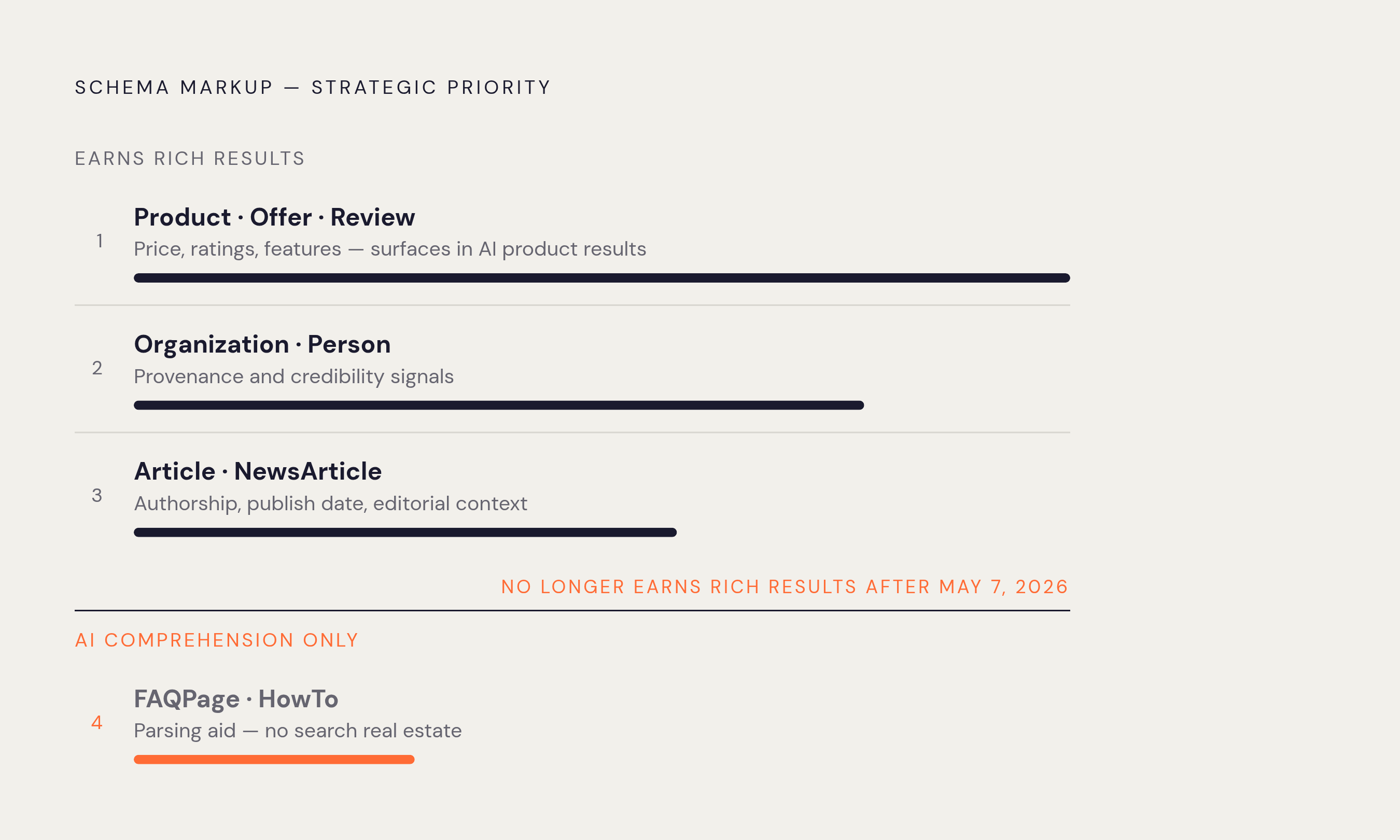
Not every schema type deserves the same effort anymore, and treating them as interchangeable is a mistake. FAQPage marks question-and-answer content, but Google stopped showing FAQPage rich results in Search as of May 7, 2026, and per LLM Pulse it isn't a requirement for AI Overviews either. It still helps AI comprehension, just without the rich-result payoff, so treat it as a parsing aid rather than a traffic lever. HowTo sits in the same spot: no more rich results, but the structure still helps a model follow a sequence of steps. Product, Offer, and Review schema matter far more, since they carry price, ratings, and features, exactly the data an AI system needs when it's effectively recommending a solution to someone. Organization and Person schema establish provenance, tying content to a named, credible entity. Article and NewsArticle schema establish authorship, publish date, and editorial context. If a marketing team only has budget for one thing this quarter, it should be Product and Review schema on commercial pages, not another round of FAQPage tagging that no longer earns a rich result.
None of this gets read word-for-word to generate an AI's answer. What it does is make a page legible to the knowledge graphs and crawlers that AI systems draw on during response generation. SearchVIU ran tests in October 2025 and found that ChatGPT, Claude, Perplexity, and Gemini all failed to extract information that existed only in schema markup when accessing content directly, a reminder that schema supports the pipeline rather than substituting for visible content. Both Google and Microsoft confirmed publicly in 2025 that they use schema markup for generative AI features, and ChatGPT confirmed that structured data influences which products surface in its results. Still, valid markup doesn't guarantee AI citation. It makes a page eligible, nothing more. Content quality and authority still do the rest of the work, and no amount of markup substitutes for either.
The visibility numbers that show what structured data changes
Schema is one variable among several, and that needs saying before any number gets thrown around, because the numbers get abused constantly in this space. The Digital Bloom's 2026 data shows pages at position 1 have a 33% probability of appearing in AI Overviews, versus 13% at position 10. That single comparison says more than a stack of citation-lift percentages ever could: schema amplifies content that already ranks. It doesn't rescue content that doesn't, and any pitch claiming otherwise is selling something.
That's the number worth holding onto. Ranking strength and content quality still decide most of the outcome, and schema sits downstream of both, not above them.
The reason any of this matters at increasing scale is that the surface area itself keeps growing. AI Overviews appeared in 13.1% of all Google searches as of March 2025, and AI-generated content's presence in Google search results grew from 2.27% in 2019 to 17.31% in 2025. Whatever mattered at the margin two or three years ago now sits closer to the center of the whole search experience, which means the cost of getting structure wrong keeps rising too.
Context documents that tell AI who a brand is, not just what a page says
Schema clarifies what's on a page. It says nothing about how an AI system should represent a brand across dozens of different queries, which content deserves priority, or how a company's positioning ought to be read when the AI is stitching together an answer from multiple sources.
Part of the problem is mechanical, and it's a specific one worth naming precisely. When an AI tool fetches a webpage, it pulls in raw HTML, and that HTML is full of navigation menus, cookie banners, JavaScript bundles, and footer links, all competing for space inside a fixed context window alongside the content that actually matters. One research team reported their AI agent was pulling in so much HTML noise that the API documentation it actually needed got crowded out before the model could use any of it. That's a failure mode that occurs in practice, not a hypothetical one. It's what happens by default, every time, unless something intervenes.
llms.txt is the proposed fix. It's a plain-text, Markdown-formatted file placed at a site's root, listing key content in a clean format built for language models to read, functioning something like robots.txt but for comprehension instead of crawl control. It tells models like ChatGPT, Claude, and Gemini which content to prioritize, acting as a machine-readable brand summary that reduces how much an AI has to lean on third-party or outdated sources to figure out who a company is.
Adoption has moved fast without any formal mandate behind it. BuiltWith recorded over 844,000 websites with llms.txt implemented as of October 25, 2025, including Anthropic's Claude documentation, Cloudflare, and Stripe. Worth being honest about the limits here: no major AI platform has officially confirmed it reads these files. Google's Agent2Agent protocol documentation, launched in April 2025, does include an llms.txt file, though llms.txt itself is a separate convention not codified in the A2A specification. It's one proposed protocol nested inside another proposed protocol, a strange place for so much adoption to be happening. Yoast SEO and Rank Math both added native llms.txt generation in 2025, a toggle in the plugin dashboard that auto-generates and updates the file. Implementation is reported to be relatively quick, with no demonstrated downside so far.
For a brand deciding whether it's worth doing, that's about as clean a risk calculus as marketing gets: low cost, no known drawback, plausible upside if adoption keeps climbing. Skip it, and the choice is to hope AI systems rely on accurate cached data rather than outdated or third-party sources that might misrepresent the brand, while competitors who did implement it show up looking more authoritative by comparison. Those aren't good enough odds to gamble on.
DITA, the Darwin Information Typing Architecture, is a working example of what happens when those four principles get applied rigorously.
Brand voice context documents as a structured input for consistent AI writing
Left without explicit voice instructions, an AI model defaults to the statistical average of whatever it was trained on. The result reads fine on a technical level and says nothing distinctive at all. The failure mode worth naming here is not broken grammar and not factual errors. It's flatness, a brand voice reduced to the industry mean, indistinguishable from three competitors saying the same thing in the same register.
Traditional style guides were written for a human to interpret, and a human can read between the lines of a word like "friendly" or "professional." An algorithm can't do that. That's the shift an AI-operable voice document has to make: replace vague adjectives with instructions a system can act on directly. Per Yugasa's 2025 framework, a "Brand Voice DNA" document looks less like a mood board and more like a rulebook. Use active voice. Avoid jargon unless the document defines it first. Hold a tone of confident collaboration. Specify sentence-length ranges, name which words to use and which to avoid, and settle point-of-view conventions in advance rather than leaving them to be inferred somewhere downstream.
This is a structured data problem before it's a copywriting problem. The document has to be machine-readable and retrievable on demand, not a PDF an employee reads once during onboarding and never opens again.
The stakes of getting it wrong aren't abstract, either. Research cited by Atom Writer found that 45% of consumers question a brand's authenticity when its value messaging comes across as inconsistent, while consistent brand voice correlates with revenue increases in the range of 23 to 33%. Part of what's driving the stakes higher is the nature of the queries themselves: AI queries average 23 words, against roughly four for a traditional Google search. Longer, more conversational prompts mean the AI is making more interpretive decisions per query, and every one of those decisions is a chance for inconsistent voice input to produce an inconsistent brand impression. Persistent memory systems, already in early deployment, point toward a future where voice guidelines don't need re-injecting with every single prompt. The voice document becomes something the AI carries forward as a foundation, rather than a patch applied session by session.
What breaks when structured inputs are missing across a multi-brand operation
A single brand missing its schema, its llms.txt, or its voice document has a manageable problem. An agency running a dozen brands with the same gaps has a compounding one, since each brand needs its own implementation of all three, and each is an independent point of failure if neglected.
Hallucination risk scales with portfolio size, and this is where most agencies underestimate the exposure. More brands means more surface area for an AI system to get something wrong, whether it's an outdated product description, an incorrect feature claim, or a brand voice that reads nothing like the actual company. Without centralized context documents, every brand in that portfolio is exposed on its own, with no shared safety net catching the errors before a client notices them.
There's a signal from late 2025 worth sitting with: some leading tech platforms reported that 10% of all new signups came directly from AI referrals, a figure that points to how consequential AI-driven discovery has become. For an agency managing growth across client accounts, that's the kind of outcome that needs to be demonstrable, not anecdotal.
Consistency at that scale isn't something achieved project by project, and treating it that way is exactly how agencies fall behind. It requires the same modularity and reusability principles that make structured content work inside a single organization, applied instead across a whole portfolio: shared schema libraries, templated context documents, a standardized format for voice guides that doesn't get reinvented for every new client. Without that baseline, measuring whether any of this worked becomes close to impossible. Schema changes, llms.txt additions, and voice document updates all need tracking against AI brand mentions and citation frequency, or there's no way to show a client what the investment bought them. Dedicated platforms exist for exactly that layer of the problem, tracking AI brand mentions, citation frequency, and visibility trends across a client portfolio so agency teams have evidence behind what they recommend.
A practical implementation sequence for raising AI output quality at the source
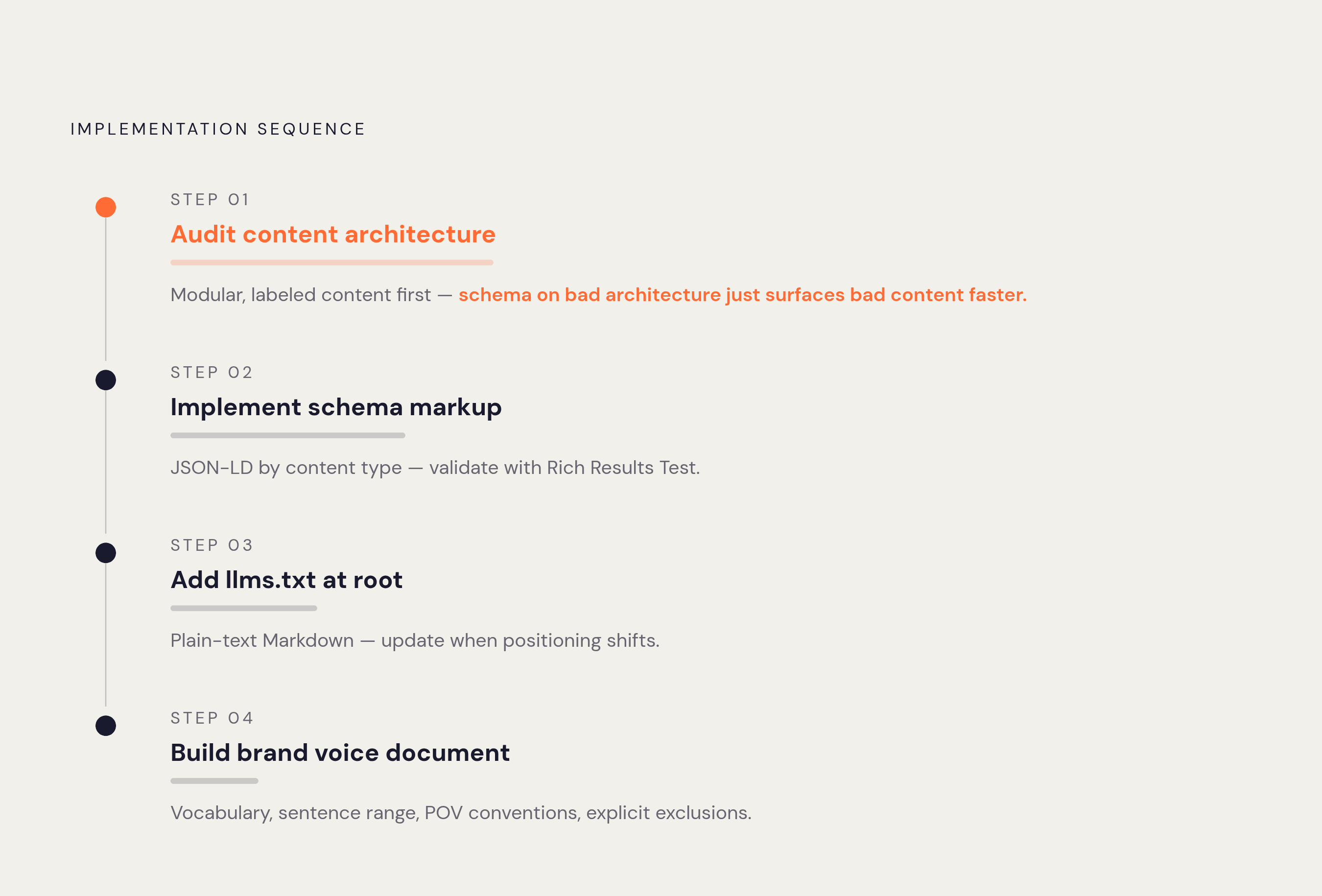
None of this works done out of order. Each layer depends on the one beneath it, and skipping a step just leaves a gap that some downstream AI tool has to fill in with a guess, usually the wrong one.
Start with an audit of the content architecture itself, before touching schema at all. Is content organized as modular, labeled units, or is it long, undifferentiated documents that bury five ideas in one page? Fragmented, inconsistent documentation is the root problem, and applying schema on top of it doesn't fix anything. It just helps machines find bad content faster, arguably worse than not being found at all.
From there, implement and validate schema markup by content type. Match the schema to what's actually on the page: Organization for brand pages, Product and Review for commercial pages, Article for editorial content. Use JSON-LD, and validate results with Google's Rich Results Test or a Schema.org validator. Keep prices, dates, and version numbers current, since retrieval-based AI systems favor fresh data over stale entries. Never apply a schema type that doesn't match what's visibly on the page: that mismatch erodes trust signals instead of building them. And keep the FAQPage and HowTo caveat in mind. Rich results for both are gone from Google Search, so the value left is comprehension for AI systems, not search real estate. Don't budget for them expecting a traffic bump.
Next comes an llms.txt file: plain text, Markdown-formatted, sitting at the site's root directory, listing key documentation and brand-critical pages in a format built for a model to parse. If the site runs on Yoast SEO or Rank Math, this is a dashboard toggle rather than a manual build. Treat it as a living file, one revisited whenever product lines, services, or brand positioning shift.
Finally, build the brand voice context document. Replace every vague adjective with a rule a system can follow: specific vocabulary, sentence-length ranges, point-of-view conventions, explicit exclusions for words or phrases the brand doesn't use. Format it as something retrievable, not a static file nobody opens twice, and revisit it as brand positioning evolves and as persistent memory architectures make it possible for that document to function as a lasting foundation rather than a one-time reference.
Sources
- Structured Content Sets You Up for AI Success
Provided the DITA framework explanation and the healthcare organization case study with 30% retrieval time reduction and 25% accuracy improvement figures.
- How Structured Data Schema Transforms Your AI Search Visibility in 2026 | Medium
Provided the statistics on AI Overviews appearing in 13.1% of Google searches and the growth of AI-generated content from 2.27% in 2019 to 17.31% in 2025.
- Structured data: SEO and GEO optimization for AI in 2026
Provided the statistic that AI queries average 23 words compared to roughly four for a traditional Google search.
- Structured Data for AI Citations: The 2026 Guide
Provided the Digital Bloom 2026 data on pages at position 1 having a 33% probability of appearing in AI Overviews versus 13% at position 10.
- Structured Data for AI: what it is and best practices
Cited regarding FAQPage schema not being a requirement for AI Overviews and Google's deprecation of FAQPage rich results.
- https://www.yugasa.com/blog/the-ultimate-brand-voice-consistency-checklist-for-2025
Provided the 'Brand Voice DNA' framework concept describing AI-operable voice documents as rulebooks with specific vocabulary and sentence-length conventions.