AI Writing for Long-Form SEO Articles vs Short-Form Ad Copy
Long-form content needs human judgment; short-form copy doesn't.
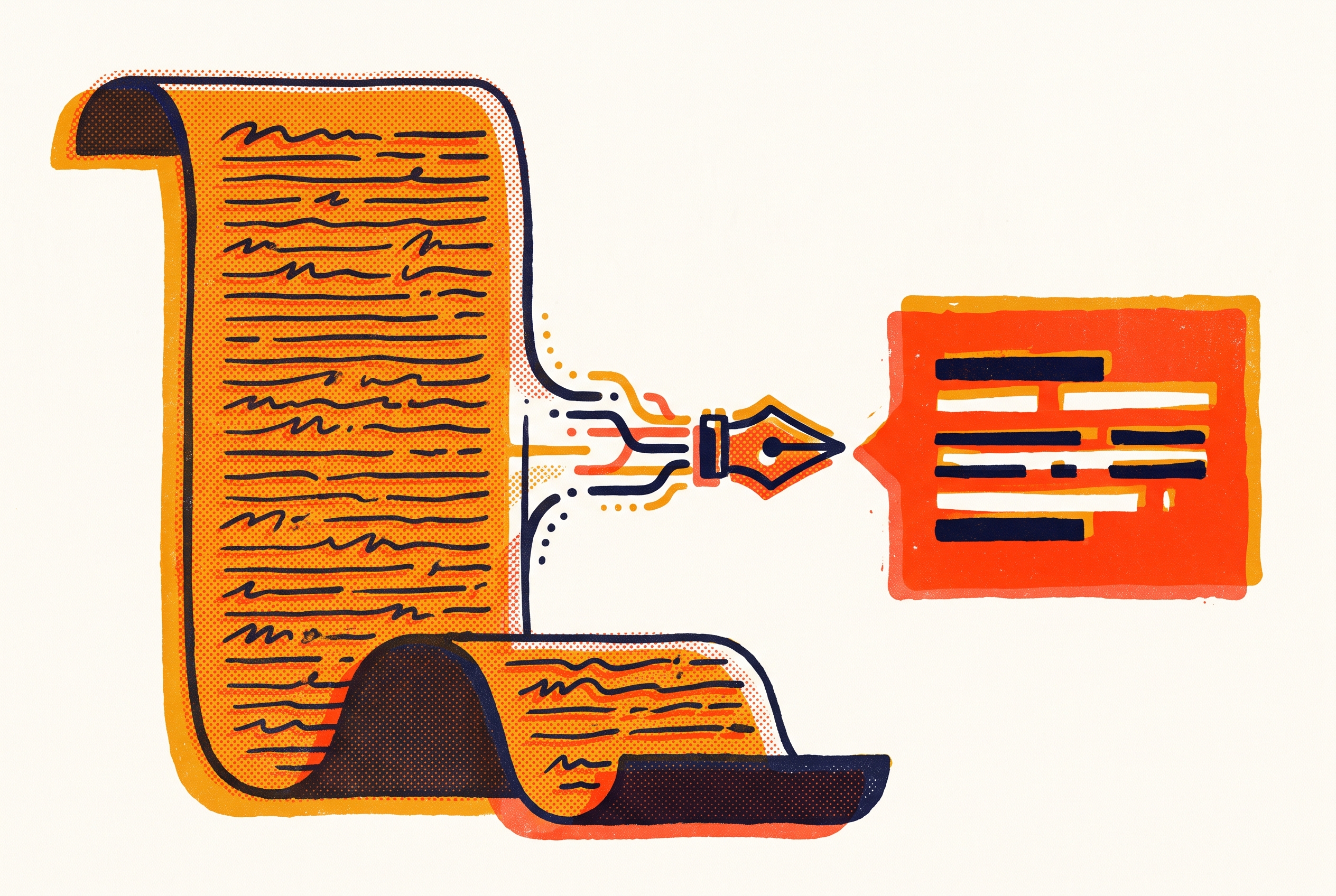
AI writing tools are not one tool doing one job. Long-form SEO articles and short-form ad copy make different demands on language, structure, and judgment, and the tools perform differently depending on which demand they're meeting. Understanding that split, rather than treating "AI content" as a single category, is what separates marketers getting real output from those burning budget on drafts nobody publishes.
The two formats aren't just different lengths. Long-form work, blog posts, guides, reports, usually runs 1,200 words or more and exists to build depth and get indexed for a topic over time. Short-form work, ads, captions, headlines, product descriptions, is defined by brevity and exists to move fast and convert. But length is a proxy, not the real distinction. A 1,500-word listicle that skims the surface behaves like short-form content no matter its word count, and a tight 700-word FAQ that actually resolves a complicated question can carry long-form weight. What matters is intent: what is the reader supposed to do next, and how much depth does answering that question honestly require?
Marketers are adopting AI for both formats at a pace that outstrips their understanding of where it actually helps. Surveys point to widespread planned use of AI in content creation heading into 2026, with generative AI already common in SEO workflows specifically. Deployment decisions made without a clear read on format fit will waste a lot of that investment. The conversation has also shifted. Nobody serious is still asking whether AI replaces writers. What matters is which tasks pay off, and where human judgment has to stay in the loop no matter how good the model gets.
Where AI genuinely outperforms humans in short-form ad copy
Speed is the obvious win, and it's not a small one. Producing 40 ad variants from a brief takes a language model minutes, where a junior copywriter working the same brief needs the better part of a workday. That gap doesn't just save time once. It compounds every time a campaign runs another testing cycle, because more variants means more data means faster convergence on what actually works.
Performance marketing has already priced this in. Generative AI for ad creation and automated bidding are now standard practice among PPC professionals, not experimental add-ons. A large-scale survey comparing AI and human output found AI beat humans on short-form formats like captions and ad snippets in a clear majority of cases. That's not surprising once you think about what short-form copy actually rewards: pattern recognition, formulaic structure, keyword placement. Product descriptions are the sharpest example. AI-written descriptions have shown a real conversion lift over human-written ones, precisely because the format cares more about clarity and keyword density than emotional nuance.
Personalization at scale is the other place AI pulls ahead almost by default. A meaningful share of businesses already use AI for personalized advertising, and the reason is arithmetic. Once a campaign needs dozens of audience segments each getting their own variant, human bandwidth runs out long before the segments do. The value in short-form AI lies in something other than writing one perfect ad. It's about writing many decent ones fast enough to let the data pick the winner.
Where short-form AI copy hits its limits, and why human editing stays essential
The performance gap between human and AI sales copy is real but narrower than the hype suggests, human copy converts a bit better than AI copy on average. In high-stakes campaigns, though, even a small conversion difference translates into serious revenue, so "narrower than expected" doesn't mean "safe to ignore."
Most professionals already treat AI output as a draft rather than a finished product, only a small minority say they rely on AI to finalize copy without further review. That instinct is correct. AI-generated ad copy needs a tone pass almost every time it's produced, the structure and keyword logic can be right while the voice is flat, off-brand, or emotionally tone-deaf. Editing isn't polish here, it's where the actual performance lives: human-edited AI copy consistently outperforms raw AI output by a wide margin, not a marginal one.
The specific failure points are consistent. AI struggles with genuine emotional register, with industry jargon that signals credibility to an informed reader, and with the kind of nuance that tells a niche B2B audience "this was written by someone who actually knows the space." That's exactly the terrain a lot of B2B ad copy has to cover. For an agency running ad copy at volume, the real operational question centers on how AI and human effort combine. It's how many minutes of human editing time each variant gets, and at what stage of the pipeline that editing happens.
What AI can and cannot do for long-form SEO articles
Long-form is where AI's contribution looks completely different. Outlining, research assistance, drafting section scaffolds, suggesting headings, working in keywords, these are setup tasks. They save time before the real writing starts, but they don't replace the judgment that decides whether an article says anything worth reading.
Bloggers using AI tools report meaningfully less time spent writing, but the savings show up at the drafting stage, not in reduced editorial oversight. Brands that pair AI drafting with human editing see production time drop substantially, and that hybrid model, not raw AI output published as-is, is where the efficiency actually lives. Left alone, AI's long-form failure mode is predictable: generic, surface-level coverage. That's the opposite of what strong SEO content needs now, because AI has made shallow volume cheap for everyone, which means depth is the only thing left to differentiate on.
Adoption numbers back this up in an uncomfortable way. A large share of businesses already use AI for long-form written content like website copy, but that adoption doesn't mean raw output is going live unedited, it means the editing step is happening somewhere in the process, whether disclosed or not. Meanwhile only a small fraction of brands consistently publish long-form pieces past 2,000 words, and that gap is the opportunity. Longer articles earn dramatically more backlinks than shorter ones. That payoff is measurable, which raises the cost of treating an unedited AI draft as a finished long-form asset. The article that could have earned links instead sits there, competent but forgettable.
Marketers are adopting AI for both formats at a pace that outstrips their understanding of where it actually helps.
How AI-powered search has changed what long-form SEO articles need to do structurally
Search itself has changed the assignment. Modern search technology evaluates whether content actually answers the question a user has, weighted more heavily than whether it hits a keyword density target. That shift rewards structure: clear headings, short extractable answer blocks, FAQ sections that a machine can lift cleanly out of the page. Writing for a human reader and writing for an AI summarizer used to be roughly the same task. Now they overlap but aren't identical, and long-form content has to do both at once.
The traffic math has gotten harder, too. A majority of Google searches now end without a click at all, so ranking well isn't the same as getting read. Top-ranking pages have seen click-through rates drop sharply as AI Overviews answer the question directly in the results page, a jump from where that decline sat just a year earlier. The counterweight is that citation within AI-generated answers has emerged as a metric that matters alongside traditional ranking, even as click volumes from those positions shift.
Practically, that means an article optimized for this environment needs sourced statistics woven through it, since adding data points has emerged as one of the single strongest levers for AI visibility. It also means earning citations and mentions across other content, not just polishing the page itself, has become a more prominent part of the visibility strategy. Tools that build SERP analysis into the writing process are solving a different problem than tools that only generate fluent sentences, and long-form SEO work now needs both.
How the leading AI writing tools divide along the long-form / short-form axis
The tools on the market split roughly into two camps, with a few straddling both. On the short-form side, some platforms are built and priced around fast commercial copy: quick ad variants, social captions, first drafts, at budget-friendly monthly rates. They're fast and cheap, and they show their limits the moment the task gets long or structurally complex, output in that territory tends to need a heavier editing pass.
On the long-form and cross-format side, general-purpose assistants like Claude, ChatGPT, and Gemini can each handle long documents, sustained research threads, and custom workflows, with Gemini positioned toward deep-research tasks given its capabilities as a general-purpose assistant. Jasper positions itself around holding a consistent brand voice across landing pages, ads, email, and long-form blog content in the same workspace, which matters for teams juggling many formats under one brand. Platforms with SEO built directly into the writing flow, competitor analysis, keyword and structure recommendations, relevance scoring against top-ranking pages, serve a more specific need: producing SEO-optimized long-form content at volume rather than just fluent prose.
A smaller category takes a more deliberate stance against generic AI output altogether. These tools put human expertise first structurally, conducting interviews with subject-matter experts before a draft ever gets written, then using an AI research layer to pull live data and check claims against it. That workflow is built specifically for SEO and answer-engine content, thought leadership, and the mid-funnel guides where genuine expertise is the differentiator competitors can't copy. The broader pattern across the market: it's splitting between one-click prompt-to-article tools and tools that require expert input before drafting starts, and the second approach maps far more directly onto what competitive long-form SEO actually needs in 2026. Some creative services also pair AI drafting with expert human copywriters as a managed offering, giving teams the hybrid model without having to build and supervise that AI-human handoff themselves.
How agencies managing multiple clients need to think about AI format strategy differently than in-house teams
Agencies running AI-powered production report large cuts in content turnaround time, and at portfolio scale, that saved time compounds across every account rather than just one campaign. But scale also multiplies the risk of getting the format strategy wrong.
Short-form work across a client roster runs into a consistency problem: keeping brand voice steady across dozens of simultaneous campaigns is hard when every account manager is prompting from scratch. Tools that store brand guidelines centrally cut down on the voice drift that creeps in otherwise. Long-form work has the opposite problem. Generic AI output looks even more generic once the same tool produces near-identical articles for ten clients competing in the same industry, differentiation there has to come from actual subject-matter input, not just having access to the tool.
A large share of SEO specialists expect their roles to change directly because of generative AI, and for agencies that reshapes team structure as much as it changes workflow. The format question also has a pricing dimension. Fast, automated short-form copy can reasonably be billed as a volume service, while long-form SEO work that requires expert sourcing, editorial oversight, and structure built for visibility in newer search tools justifies a different tier. An agency that can't explain that difference to a client, why fast ad copy and carefully sourced long-form content aren't priced the same way, can't sell either one with much confidence. Account teams need enough grip on the format distinction to have that conversation without stumbling through it. Managing that distinction consistently across every client, rather than deciding it ad hoc per account, is an operational problem as much as a strategic one, one that per-client controls and portfolio-level reporting exist specifically to solve.
Where human judgment stays non-negotiable regardless of format
Across both formats, the same gaps keep showing up, including emotional resonance, industry-specific nuance, a brand voice that actually sounds like the brand, and the kind of original insight that competitors using the same AI tools simply don't have access to.
For long-form work, AI cannot manufacture first-hand experience or original research, and that's exactly what signals genuine authority to a human reader and, increasingly, to an AI search engine deciding what to cite. Interviewing sources and capturing a real point of view before drafting starts is a structural fix for that gap, not a workaround bolted on afterward. For short-form work, the fix looks different: judgment about what a brand should never say, what emotional register actually fits a given moment, how to handle a sensitive or regulated topic without stepping wrong. The fact that AI copy needs a tone adjustment nearly every time it's produced isn't a bug to patch out. It reflects something structural: the model doesn't know the room it's writing into.
Visibility in AI search also isn't a one-time deposit. Research on AI search behavior shows only a minority of brands stay visible from one AI-generated answer to the next, and fewer still hold that visibility across several consecutive queries. Staying present requires ongoing monitoring and adjustment, not a single well-optimized article filed away and forgotten.
The operating principle that falls out of all this is straightforward: hand AI the low-judgment work in each format, variant generation for ads, outlining and SERP research for articles, and protect human time for the work that actually requires judgment: strategy, voice, expert insight, editing, watching how content performs in AI search over time. For agencies specifically, accountability lives here too. When a client's automatically generated ad underperforms, or a long-form piece never gets cited anywhere, the agency's credibility rests on having a human editorial layer it can point to and stand behind. Raw AI output has no one behind it to answer for how it turned out.
Sources
- https://www.ritnerdigital.com/blog/ai-copywriting-vs-human-copywriting-what-actually-converts
Provided data on the performance gap between human and AI sales copy and how human-edited AI copy outperforms raw AI output.
- Long-Form vs. Short-Form Content for AI-Powered SEO
Informed the discussion of how AI-powered search rewards structured long-form content and how the SEO assignment has changed.
- AI Tools & Long-Form SEO Content | Features & Benefits
Supported the points about AI's role in outlining, drafting scaffolds, and time savings in long-form SEO content production.
- Long Form vs Short Form Content: What’s Best in 2026 | Devenup Blog
Provided context on the distinction between long-form and short-form content by intent rather than word count.
- AI-Generated Ads vs Human-Made Ads: What 10,000+ Campaigns Reveal | Lapis
Provided the large-scale campaign data showing AI outperforming humans on short-form formats like captions and ad snippets in a majority of cases.
- The State of AI Ad Creation in 2026 — What the Data Shows
Supplied data on AI adoption for personalized advertising and generative AI as standard practice among PPC professionals.
- https://eseospace.com/blog/long-form-vs-short-form-content-in-geo/
Informed the discussion of citation within AI-generated answers as an emerging metric alongside traditional ranking.
- https://searchatlas.com/blog/short-form-vs-long-form/
Supported the claim that longer articles earn dramatically more backlinks than shorter ones.