Content QA Checklist Before Publishing
Update your publishing checklist for an AI-driven world where citations matter more than clicks.
Publishing checklists were built for a world that no longer exists in the shape it used to be. Grammar checks, broken-link scans, meta titles, alt text, canonical tags, a readability score above some arbitrary threshold: that's the gate most editorial teams still call "publish-ready." None of it addresses whether a large language model will ever read the page, extract a claim from it, or cite it in an answer a user never clicks through to the source of.
Those old gates matter, but they were designed to satisfy a search engine crawler indexing pages for a results list, back when ranking on page one was the whole game. That game is shrinking fast. AI Overviews now cut click-through rates on top-ranking content by 58%, down from 7.3% to 1.6% on the keywords where they appear. A separate study from Seer Interactive, covering 3,119 informational queries, found organic click-through on AI Overview queries falling 61%, from 1.76% to 0.61%. Ranking first still counts for something. It just counts for a lot less than it used to, because the reader increasingly never makes it to the page.
What AEO and GEO require from a piece of content
AEO, or Answer Engine Optimization, structures content to be lifted whole into a featured snippet, a knowledge panel, or an AI Overview, where the user gets the answer without a click, and trade publications in 2026 tend to use the terms interchangeably. AEO, or Answer Engine Optimization, structures content to be lifted whole into a featured snippet, a knowledge panel, or an AI Overview, where the user gets the answer without a click. GEO, Generative Engine Optimization, is a step further downstream: it's about shaping what tools like ChatGPT, Claude, and Perplexity say when they generate an answer from indexed material, rather than where a link lands on a results page. One competes for a ranking position. The other competes for a citation inside a sentence someone else's model writes. Other labels floating around, AI SEO, AIO, AI search optimization, all describe roughly the same overlapping discipline.
One enterprise guide finds that GEO runs roughly 80% strategic (positioning, ecosystem presence, brand authority built over time) and only 20% technical, a distinction publishing teams tend to miss. Most teams grab the technical 20% first because it fits neatly into a checklist, and skip the harder strategic work that actually earns citations.
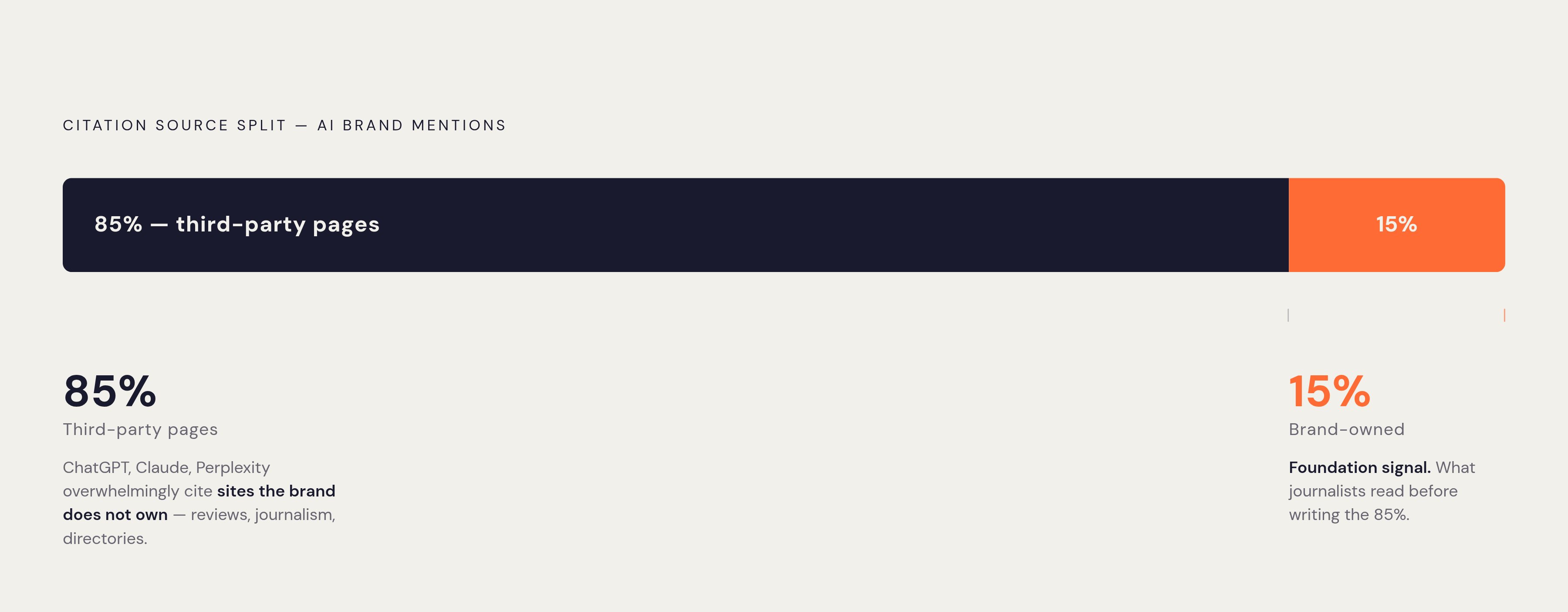
A publishing checklist cannot fix the fact that most brand mentions originate on pages the brand doesn't own, which limits how much direct control a brand has over its own citations. Across a large dataset of brand mentions on ChatGPT, Claude, and Perplexity, roughly 85% originated from third-party pages rather than brand-owned domains, meaning brands are several times more likely to be cited through someone else's site than their own. A pre-publish checklist governs the 15% a brand actually controls. That's a small slice of the total citation surface, but it's the foundation slice: first-party content is the signal base that journalists, reviewers, and forum contributors draw from when they write the third-party coverage that actually drives citations. Get the first-party layer wrong, and the 85% has nothing accurate to repeat.
Layer 1: Technical foundations that AI crawlers need
AI crawlers don't parse a page the way a search engine crawler does. Messy markup, heavy client-side scripting, or a document object model that only resolves after multiple render passes can cause an AI assistant to skip a page outright, not just rank it lower. Clean HTML and a heading hierarchy that actually nests in order (H1 to H2 to H3, no skipped levels) is a prerequisite now. It's a prerequisite for the page being read.
Schema markup sits in the same category. Structured data, specifically Schema.org JSON-LD, is the clearest and most consistent signal available to both search engines and language models trying to figure out what a page is and what it's claiming. Two checks matter here: confirm the JSON-LD block exists, validates cleanly, and actually matches the content type on the page, and confirm there's no malformed or missing markup that would fail a structured data validator.
FAQPage schema deserves its own line item, precisely because it's easy to forget. It does nothing for traditional Google rankings, so a team optimizing purely for search-engine placement has no reason to add it. That's why it gets skipped. Brand mentions, linked or unlinked, are among the strongest predictors of AI citation, well ahead of backlinks and domain authority in the research that has examined these signals. FAQPage schema doesn't outrank authority signals, and content quality, recency, and topical relevance predict citation better than any markup choice, but it remains a useful structural signal worth implementing. One rule governs all of it: never hide an answer inside schema that isn't visibly on the page. Markup wrapping content the page doesn't actually display gets ignored by the systems it's meant to signal.
Then there's the llms.txt file, an AEO-specific artifact that confirms AI bot access and spells out crawling permissions for LLM agents. Check that it exists. Check, just as carefully, that it doesn't inadvertently block sections of the site the team actually wants surfaced.
Layer 2: Content structure checks that make answers extractable
For retrieval-based systems like Perplexity and Google AI Overviews, what appears at the top of a page shapes what gets extracted. That changes how the first paragraph has to work. The first 200 words need to answer the primary query directly and completely, not warm up toward it with three sentences of throat-clearing before the actual point arrives. Every major section underneath should follow the same discipline: a direct, complete answer in the first 40 to 60 words, with context and supporting detail coming after, never before.
A visible FAQ section works alongside schema markup in a way that serves both readers and AI systems. Readers can quote it. AI systems can lift it. The schema from Layer 1 tells a search engine where the structure lives, but the visible FAQ block, phrased the way an actual person would type a question into a chat window, not the way a marketer would phrase a keyword, is what gets extracted. Each answer needs to stand alone: a reader (or a model) should be able to read just the answer, without the surrounding paragraph, and get the full picture.
Headings carry more navigational weight than most editorial teams give them credit for. An H2 that teases ("The Surprising Truth About X") gives an AI system nothing to match against a query. An H2 that describes what the section covers gives it everything. And topical completeness matters in a way no amount of schema cleanup can compensate for: a page with thin coverage on a topic the brand wants to own in AI answers has a structural problem, not a technical one. Check whether an obvious follow-up question, the kind a user would type next in the same chat thread, goes unanswered anywhere on the page.
The other competes for a citation inside a sentence someone else's model writes.
Layer 3: E-E-A-T and citation signals reviewers must verify before publishing
Named authorship carries real weight in how AI models assess trustworthiness. "Staff" as a byline, or no byline at all, is a missed signal, not a neutral choice. The author should be a named person with a bio that states actual credentials or professional experience relevant to the topic, and that bio should link to a consistent author page showing a body of other published work. A one-off byline with no history behind it reads as thin to a model evaluating expertise the same way it would read as thin to a human editor.
Organization details matter just as much and get checked less often: business name, address, contact information, and an About page that's complete and, critically, consistent with how the same brand is described across third-party directories. Models cross-reference these details, and inconsistency (a different address on the About page than on a business listing, say) reads as a trust gap rather than an oversight.
Publication and update dates need to be visible on every page, not buried in metadata a human reader never sees. Freshness functions as both a ranking and a citation signal for anything time-sensitive, and AI engines actively deprioritize pages carrying no visible date.
Outbound citations to credible external sources, academic papers, government data, established industry research, do measurable work for E-E-A-T and for how confidently a model treats the claims on the page. Research consistently finds that adding quotations from credible sources, relevant statistics, and citations each produces meaningful lifts in a source's share of AI-generated answers. Those numbers show that this is the highest-return editorial move available before a piece goes live, not a nice-to-have tucked at the bottom of a style guide. It's the highest-return editorial move available before a piece goes live, and it costs an editor maybe fifteen minutes of work.
Layer 4: The AI visibility pre-publish spot check
Quarterly audits are useful. They're also too slow to catch a specific problem: each AI platform evaluates and surfaces content differently, so a brand's visibility on Google AI Mode tells a team almost nothing about its visibility on Perplexity. A piece that publishes directly into a gap nobody knew existed can't close that gap, because nobody's looking for it until the next scheduled review, months later.
The spot check itself runs through a handful of questions at the moment of publishing, not after. Does the brand currently surface at all when the target query gets asked in ChatGPT, Perplexity, and Google AI Mode, and if it does, is it recommended outright or listed as a secondary alternative? Does the new URL itself show up in Perplexity or Google AI Mode when someone queries the exact topic the page covers? Which competitors are currently being cited for this same query, and what's actually driving that? None of these are one-time questions. A brand can appear reliably in Google AI Overviews and be entirely absent from Perplexity, because these are separate surfaces with separate retrieval logic, and treating them as one problem is how gaps stay invisible.
Share of model, or SoM, is the metric built for this exact problem: how often a brand shows up in AI-generated answers relative to competitors, coined by Jack Smyth and Tom Roach and described in a July 2026 industry guide as the AI-era successor to share of voice. Unlike paid share of voice, share of model can't be bought. It has to be earned page by page. And that's precisely why the monitoring gap around it matters: agencies broadly report struggling to track how users discover brands through AI tools in the first place, and without a pre-publish baseline for a given page, there's no fixed point to measure improvement against later.
Layer 5: Freshness and maintenance checks that publishing teams skip
A page that was the definitive source on a topic six months ago can now be feeding a model outdated numbers it repeats as current fact. AI engines weight freshness heavily for anything time-sensitive. The maintenance schedule matters as much as the initial publish did.
Four categories go stale fastest. Statistics and data points need re-verification against whatever the most recent study actually says, because an AI answer citing a two-year-old figure as current does real damage to the credibility of the brand it's citing. Product and tool references (version numbers, feature names, pricing) drift constantly, and a model trained or last updated on a cached version of the page will happily repeat whatever it said at crawl time, accurate or not. Screenshots and worked examples that look visibly dated signal neglect even to a casual reader, let alone a model weighing trust signals. And external links that now 404 or redirect somewhere unrelated quietly erode the E-E-A-T scoring built up by the rest of the page.
A quarterly review cadence on the pages carrying the most AEO weight is the baseline. High-traffic or high-citation pages earn more frequent attention than that, because the cost of an error compounds faster the more often a page gets surfaced. Every review should re-run the Layer 4 spot check alongside the freshness pass: re-baseline share of model, recheck citation status, and confirm the page is still earning ground rather than quietly losing it to a competitor that updated more recently.
Why Agencies Need This Checklist Systematized
Most agency workflows were built around a single brand at a time: one editorial voice, one approval chain, one discovery strategy running through one funnel. Multi-brand operations need walls between accounts, not shared shortcuts, and that principle applies to AI visibility exactly as much as it applies to editorial voice or creative direction. A pest control brand and a debt collection agency sharing a visible chunk of operational infrastructure damages both of them if a client or a competitor ever notices. The same logic holds for a shared AI visibility footprint: if two client brands trace back to identical structured data patterns, identical author bios, or identical FAQ phrasing, the arbitrage of running one operation across many brands becomes visible in exactly the surface AI models are best at cross-referencing.
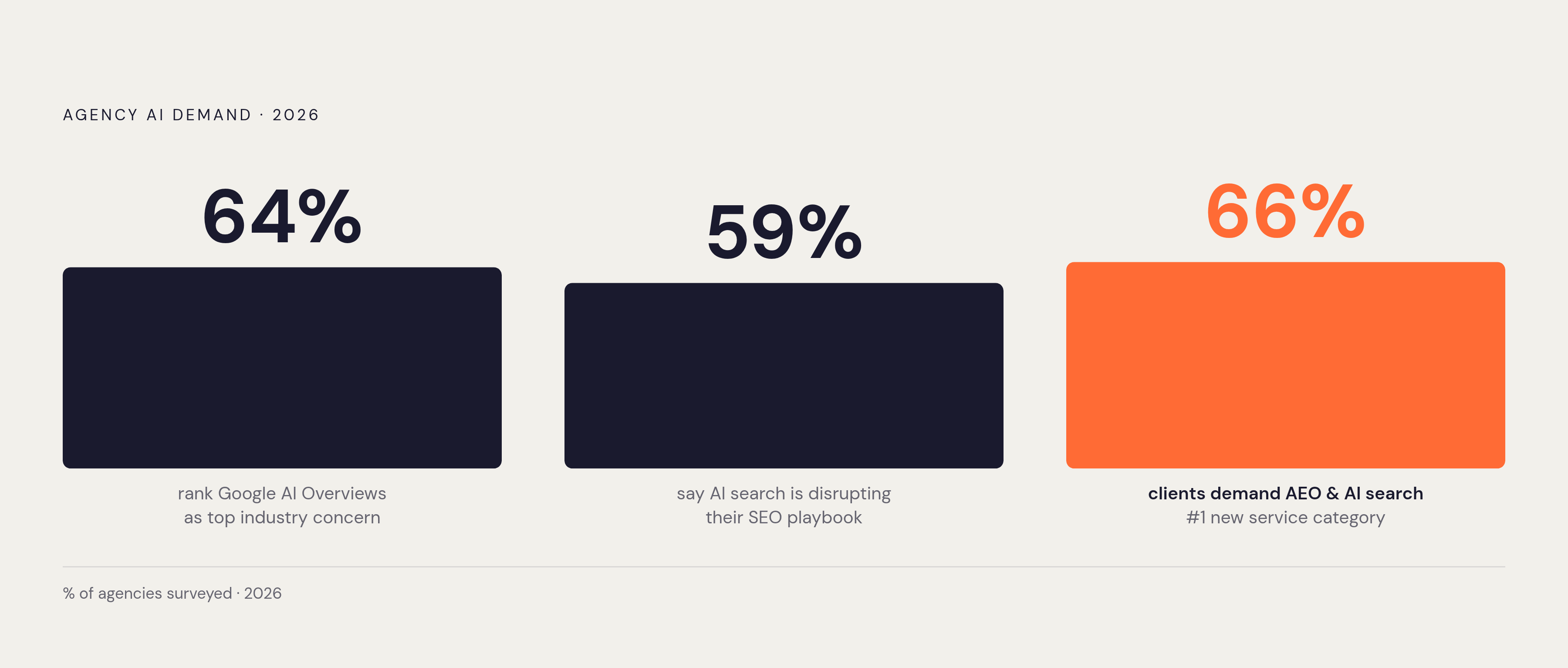
The demand curve backs this up. Google's AI Overviews rank as the top industry concern for 64% of agencies, and 59% say AI-driven search is actively disrupting the traditional SEO playbook they built their business on. Client demand for AEO and AI-driven search optimization work hit 66%, making it the #1 new service category agencies are asked to deliver in 2026.
None of that demand gets met by an editor manually re-checking JSON-LD syntax on every page for every client, on top of the grammar pass, the link check, and the meta description review that already exists. A checklist run inconsistently, brand by brand, editor by editor, is a hope, not a checklist. It's a hope. The five layers above only earn their keep as a fixed process, applied the same way every time a page goes live, across every account an agency manages, whether that agency runs three brands or thirty.
Sources
- What is Generative Engine Optimization? GEO vs AEO vs SEO Guide 2026 | The Jasper Blog
Provided the click-through rate figures showing AI Overviews cut CTR by 58%, from 7.3% to 1.6%.
- https://www.anagram.ai/blog/what-is-blocking-ai-crawlers-from-seeing-your-site-2026-crawlability-checklist
Informed the discussion of AI crawler behavior, including how heavy client-side scripting and DOM rendering issues cause AI systems to skip pages.
- https://agencyanalytics.com/agency-benchmarks-2026
Provided the agency benchmark statistics: 64% citing AI Overviews as top concern, 59% on AI search disruption, and 66% client demand for AEO services.
- https://totheweb.com/blog/beyond-seo-your-geo-checklist-mastering-content-creation-for-ai-search-engines/
Informed the content structure layer, particularly the guidance on answering queries directly in the first paragraph and structuring FAQ sections for AI extractability.
- https://gigawattgroup.com/generative-engine-optimization/generative-engine-optimization-report-2026/
Informed the claim that roughly 85% of brand mentions in AI-generated answers originate from third-party pages rather than brand-owned domains.
- https://foglift.io/blog/content-freshness-ai-search
Informed the freshness section, specifically the point that AI engines weight freshness heavily and that stale statistics can damage brand credibility when repeated as current fact.