Content Approval Process That Doesn't Slow Publishing
Agentic workflows cut approval time in half, freeing teams to publish at campaign speed.

What the approval gap costs teams in publishing cadence
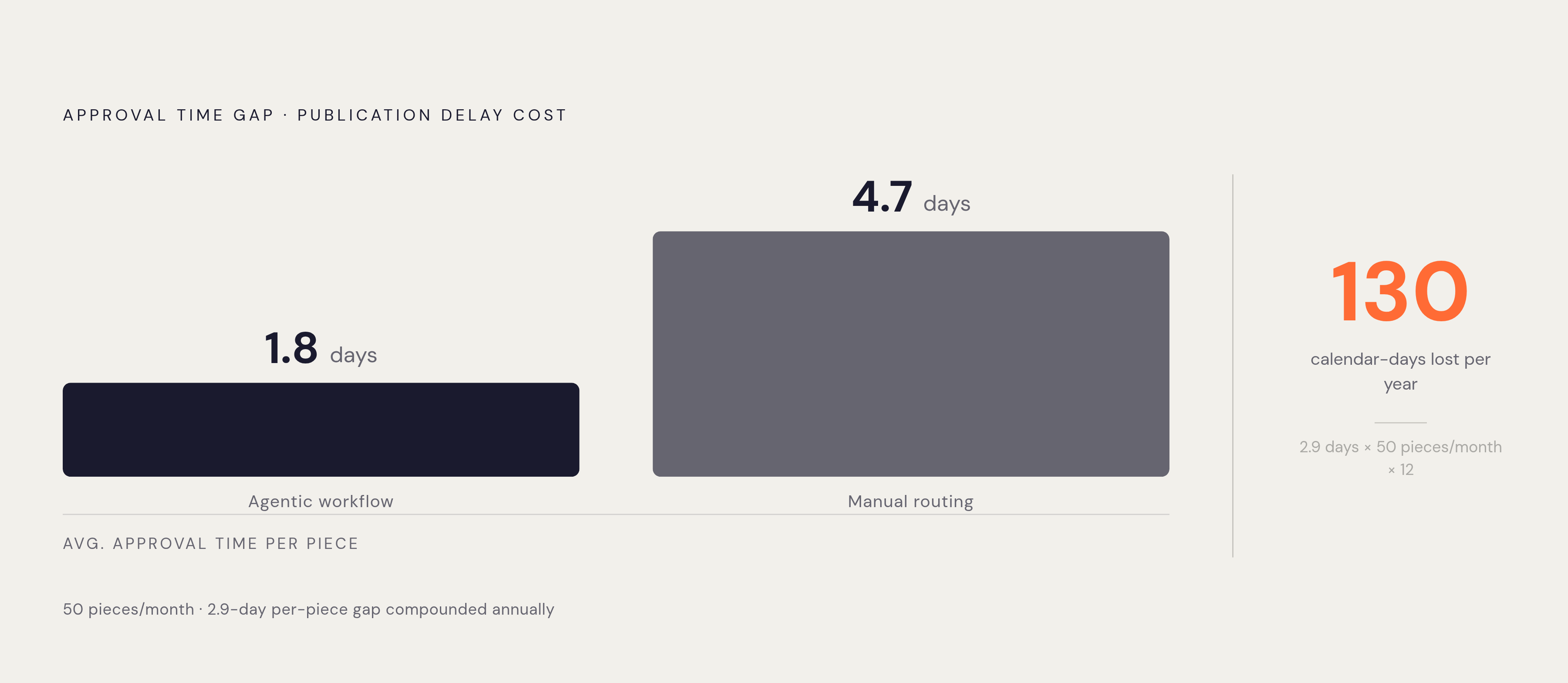
Agentic approval workflows close in 1.8 days on average. Manual routing takes 4.7 days. That gap, reported in a content-operations dataset from theaicmo.com, more than doubles the time between a finished draft and a published page. Running that math across a team shipping 50 long-form pieces a month shows the slower path costs roughly 130 calendar-days of delayed publication over a year. That's campaign timing, product-launch timing, and revenue timing, sitting in a queue somewhere waiting for someone to open an email.
The volume hitting that queue keeps climbing, and most review chains were never built to absorb it. theaicmo.com reports AI-assisted first drafts reached 68% adoption in Q1 2026, up from 22% in 2023. Meanwhile the average asset needs 4.2 people to sign off, 74% of content requires multiple stakeholder approvals, and a typical piece runs through 2.9 revision rounds before it clears. Only 46% of teams run a structured approval workflow at all, and just 33% track how that workflow performs. Most organizations genuinely have no idea where their own time goes.
The cost isn't only measured in days, either. A Canto report found 44% of employees report burnout tied specifically to poor content workflow management, and that number reads as a diagnostic, not a staffing complaint. It means too many people touch too many gates. The fix is fewer hands on the review, not more heads added to the team, a distinction most operations leads get backwards when they see a bottleneck and reach for a hire.
The damage compounds forward, too. When a campaign lands late, its performance data lands late, and the next campaign gets planned on stale numbers. A slow approval chain doesn't delay one asset. It delays the whole feedback loop a marketing team depends on to get sharper.
If the problem is structural, the fix has to be structural too: approval treated not as a courtesy step tacked onto the end of content creation, but as a system built on purpose, with owners, stages, and deadlines that actually hold.
Why most approval processes were never designed (they accumulated)
Most approval chains were never built. They grew. A reviewer got added after one bad launch, a sign-off step got bolted on after one legal scare, and nobody ever circled back to ask whether either one still earns its place. Five years on, the chain has six gates, and nobody remembers why three of them exist.
Role ambiguity is the most common failure point, and the one worth fixing first. When ownership of a decision is unclear, and everyone technically has authority to approve something, nothing gets approved on any schedule anyone can predict. blogsync.io points to the RACI model as the fix: assign who is Responsible for doing the review, who is Accountable if the outcome goes wrong, who is Consulted for input, and who is merely Informed after the fact. Skip that separation and "everyone's an approver" quietly turns into "no one's an approver."
Tool fragmentation makes the ambiguity worse. In a fragmented stack, drafting happens in one platform, discussion spills into a messaging app or email, approval runs through a project-management tool, and publishing lives somewhere else entirely. Context gets lost in the handoff between them. A duplicate draft sits around that nobody's sure is current, and a piece stalls because the right person never saw the right notification in the right tool.
Sequencing is its own quiet failure. Most teams default to linear review, one stage after another, when a meaningful share of those stages don't actually depend on each other and could run at the same time. Running them one after another anyway adds wait time with nothing to show for it in return.
Escalation is usually missing. A reviewer goes quiet, or calls in sick, and the content just sits, because no one told the system what happens next. blogsync.io's fix is an escalation ladder built before anyone needs it: an automated alert first, then routing to the content manager, then routing to the next decision-maker if the delay keeps going.
The opposite failure mode doesn't fix anything either, and teams that swing there make things worse, not better. Handing regional or functional teams full independence, with no shared guardrails at all, just trades one slow, centralized bottleneck for a scattered one: inconsistent brand voice, uneven compliance from market to market. The actual fix is a designed system with clear ownership, routing that matches real risk, and handoffs that don't depend on somebody remembering to send an email.
Designing approval as an operating system with defined stages and SLAs
Start with an audit. Pull the last several pieces of content a team shipped and trace every step each one actually went through, the steps taken rather than the ones the org chart claims should happen. Some of those steps earned their place. Others exist because someone asked for them once and nobody ever took them back off the list. Telling those two groups apart is the entire point of the exercise.
From there, build the stage ladder on purpose, and keep it at four stages. Stage one covers brief and creation, where requirements get nailed down before a single word gets written, which kills the most expensive kind of rework there is: a draft rejected because nobody agreed in advance what it was supposed to say. Stage two is internal review, catching typos, tone drift, and factual gaps so the final approver isn't burning senior time on cleanup. Stage three is stakeholder review, and it only fires when the content type or its risk level genuinely calls for it, never as a reflex. Stage four is final approval and scheduling, where one person, and only one person, says yes and the piece moves to publish.
Every content type needs its RACI assigned before it enters the queue, not improvised mid-review once a piece is already late. Who's Responsible for the review, who's Accountable if it goes wrong, who's Consulted but doesn't hold the pen, and who's simply Informed once the decision is made.
SLAs sit at every gate, and they need to be realistic but binding. A social post might clear review in a few hours. A major campaign announcement might reasonably take several days. Emergency content gets its own expedited path with a specific, pre-agreed turnaround window, so nobody's negotiating urgency in real time while the clock runs.
Escalation gets designed in before it's needed, on the same logic as the audit. The fix is an automated alert firing when a review window lapses, escalating to the content manager if nothing happens, then escalating again to the next decision-maker if the delay continues.
Parallel versus sequential review deserves real scrutiny, too. Any stage that doesn't genuinely depend on another stage's output should run alongside it, not after it. Sequential review is justified only where one stage's output is actually required as input to the next, and defaulting to sequential out of habit is where most of the wasted time in a four-stage chain actually hides.
Every gate needs entry and exit criteria. Content doesn't enter a review stage unless it meets defined entry conditions, and it doesn't leave that stage until it meets defined exit conditions. That single discipline keeps half-finished drafts from clogging a queue meant for finished work. All of it gets documented, too: the audit trail protects a team when a compliance question comes up later, and it's the raw data a team needs to see where cycle time actually gets lost.
Only 46% of teams run a structured approval workflow at all, and just 33% track how that workflow performs.
Risk-based routing: matching review depth to content risk, not content type
Treating all content as equally risky is the most common design mistake, and the one that wastes the most senior time. Routing a routine social post through the same heavy chain as a regulated product claim doesn't make the social post any safer. It just burns reviewer hours on something that never needed them, while the genuinely high-risk piece waits behind it in the same line.
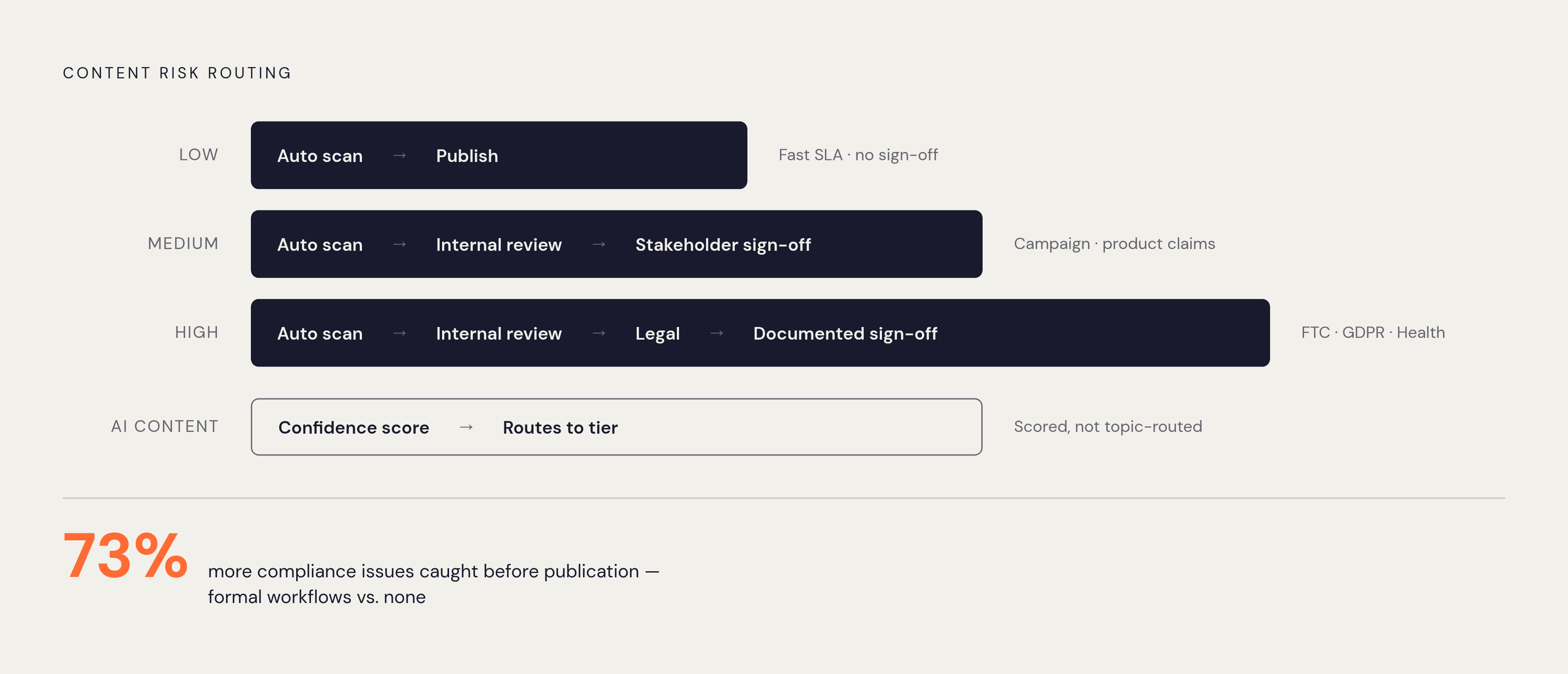
Risk tiers fix this by matching review depth to actual exposure, not to format. Low-risk content, evergreen educational material consistent with established brand voice and carrying no regulatory exposure, gets a lighter chain, a faster SLA, and possibly an automated first pass with no human touch. Medium-risk content, campaign material, product claims, anything touching a regulated topic, gets internal review plus one stakeholder sign-off. High-risk content, legal, financial, health, or compliance-sensitive material, influencer content under FTC or GDPR obligations, anything crossing international borders, gets the full chain including legal, with a documented sign-off trail ready to produce if anyone asks.
AI-generated content needs its own place in this routing logic, separate from whatever topic it covers. Volume runs high, first-draft quality is inconsistent, and brand-voice consistency needs a structured check instead of a hopeful skim. Confidence scoring or flagging from the generation tool itself can decide which tier a piece enters, rather than treating every AI draft the same regardless of how polished or risky it actually is.
At the high-risk tier, regulatory compliance isn't optional. An influencer workflow guide notes that FTC disclosure rules, GDPR, and platform-specific guidelines all need checking before anything publishes, and the approval workflow is what makes that check systematic instead of something someone remembers occasionally. The goal is an automated review layer sitting between creation and human review, scanning output against regulatory frameworks and brand guidelines before a person ever sees the draft. Humans don't leave the loop under this model. They move up it, handling judgment calls and final sign-off while the system absorbs the first pass.
Research cited by influenceflow.io found companies running formal approval workflows catch 73% more compliance issues before publication than companies without a structured process. Risk-based routing is what makes that kind of formal workflow workable at scale in the first place, since it stops every piece from demanding the same maximum-effort review regardless of what it actually is. Every routing decision, especially the ones sending content down a lighter path, should get logged with a reason attached. That record protects the team later and gives it real data for recalibrating the tiers over time.
Automating handoffs and notifications without losing human accountability
Automation's job here is narrow: it kills the manual handoff. The moment one reviewer finishes their stage, the next reviewer gets notified without anyone sending an email, pinging a channel, or checking a spreadsheet to figure out whose turn it is.
Routing belongs on the automated side, so content type and risk tier determine the reviewer queue without a person assigning it by hand. Notifications fire automatically at submission, at every stage transition, and as deadlines close in. Escalation triggers the moment an SLA gets missed, following a fixed schedule rather than waiting for a human to notice. Status stays visible to every stakeholder in real time, so nobody has to ask where a piece sits. Version control keeps every draft, comment, and revision stored, so there's never a question about which copy is current.
Some things stay firmly human, and that line matters as much as the automation does. Judgment calls on edge cases, where the right risk tier genuinely isn't obvious, need a person's eyes. Legal and compliance sign-off at the high-risk tier stays human, full stop. Override authority has to exist, too, for the moments when automated routing gets it wrong, because it will, now and then, get it wrong.
Batching is one of the more underused speed levers on the table. HubSpot's 2025 Influencer Marketing Report found campaigns using batch approvals, reviewing a group of related pieces together instead of one at a time, saw 40% faster publication timelines than post-by-post review. Batching works best when the pieces share the same risk profile and the same reviewer set, so the review stays coherent instead of turning into a scattershot of unrelated judgment calls.
AI-powered content scanning functions as the pre-human filter here. Sprout Social's 2025 research found brands using this kind of scanning cut approval time by 35%. That's the automated first pass at work: it catches what a machine can catch, and sends forward only what genuinely needs a person's judgment.
None of this holds up if the underlying stack stays fragmented, though. A process that drafts in one tool, discusses in a second, and approves in a third can't be automated in any meaningful way, because there's no single system of record for the automation to act on. CMS integration closes the loop on the far end: approved content should move straight into scheduling or publication without a separate manual step, because every manual handoff in the chain is a place an asset can get lost, delayed, or published in the wrong version.
Measuring the approval system so it improves over time
Measurement itself moves the needle here, not just the changes that follow it. A Sprout Social study found companies that track approval metrics cut approval time by 40% compared to companies that track nothing. Watching where time actually goes seems to change behavior around it on its own.
Five metrics carry most of the diagnostic weight. Cycle time per stage shows where time is actually lost, rather than where people assume it's lost. Revision rounds per content type matter because the 2.9-round average cited earlier is a benchmark: anything running consistently higher points to unclear entry criteria, or reviewers who don't agree on what "done" looks like. SLA compliance rate tracks what share of reviews finish inside their defined window. Escalation frequency, when it runs high, usually means the SLA itself was unrealistic, or that one reviewer is chronically unavailable, not that the content is uniquely hard to review. Compliance catch rate tracks issues caught before publication against issues caught after, the metric that ties the whole system back to actual risk.
Every routing decision, sign-off, and exception generates a record, and that record is worth more than legal cover. Treated as operating data, it's the raw material for recalibrating risk tiers and rebalancing reviewer load, not something that only gets pulled up after a problem has already happened.
Review chains deserve a recurring audit on a regular schedule. Ask, on a set cadence, whether each reviewer in the chain still adds value proportional to actual risk; some steps accumulated at some point in the past and simply never got questioned since. Stages that no longer serve a clear purpose get retired, not kept out of habit.
Burnout numbers belong in this conversation too, as a lagging indicator rather than a separate HR issue. The Canto figure cited earlier, 44% of employees reporting burnout tied to workflow management, points the audit toward a specific question: is review responsibility spread too thin across too many hands. Concentrating review authority, not adding headcount and not just cutting the number of stages, is usually what actually relieves the load.
An agile approach to content operations, sprint-based planning, iterative review cycles, Kanban-style visibility into what's in progress, keeps pile-ups from forming. It builds frequent feedback loops instead of a once-a-year overhaul after everything's already broken. Teams that track these metrics and act on them don't just publish faster. They build a loop between workflow performance and content strategy, where faster publication and better-calibrated risk management start reinforcing each other.
Approval speed as an AI visibility problem, not just an operations one
The stakes around approval speed changed the moment search itself changed. Gartner predicted in 2024 that traditional search volume would fall 25% by 2026, and writer.com reports that prediction had already come true. Where AI Overviews now appear in results, Ahrefs' analysis of 300,000 keywords found click-through rates on top-ranking pages fell from 7.3% to 1.6%. That's most of the traffic a page used to earn, simply gone, and no amount of ranking skill recovers it once the answer gets served without a click.
Zero-click behavior is the majority pattern now, not the exception. Similarweb reports that in May 2025, 69% of news-related Google searches resolved without a single click, up from 56% a year earlier, a 13-point jump in twelve months following the AI Overviews rollout. Consumers increasingly get their answer without ever landing on a publisher's page.
Discovery has moved upstream of search, too. Similarweb's Generative AI Brand Visibility Index found 35% of US consumers now use AI tools at the product discovery stage, against 13.6% still using traditional search for the same task. By the time someone opens a search bar, in a growing share of cases, an AI system somewhere upstream has already set the shortlist.
The approval process no longer tests back-office efficiency alone. It decides visibility now, and treating it as a pure operations question is the mistake most content teams are still making. The Princeton GEO study from Aggarwal et al., published at KDD 2024, found content built for AI discovery, structured with machine-extractable provenance, direct citations, real statistics, and quotable claims, earns measurably more visibility in AI-generated answers, with each element worth roughly 25% to 40% more visibility on its own. But that structure only pays off if the content carrying it clears review fast enough to matter. A four-day approval queue can leave a team behind a competitor whose version, built the same way, clears review in under two. Speed to publish and visibility to machines have stopped being separate problems. They're the same problem now, and the approval chain is where it gets decided which team wins it.
Sources
- Influencer Content Approval Workflows & Deliverables...
Provided statistics on compliance issue detection rates, batch approval timelines, and AI content scanning speed improvements cited in the article.
- Content Approval Workflows: A Guide to Fast Reviews
Provided the core statistics on agentic vs. manual approval timelines, AI-assisted draft adoption rates, stakeholder approval counts, revision rounds, and workflow tracking rates.
- How To Build A Bullet-Proof Content Approval Process [2026]
Provided the RACI model recommendation and the escalation ladder framework, as well as the burnout statistic tied to poor workflow management.