Synthetic Data Generation Using LLMs for Fine-Tuning
Synthetic data quality depends on filtering and diversity, not volume alone.

Synthetic data generation using LLMs for fine-tuning succeeds when generation strategy, quality filtering, and collapse prevention form one pipeline. Producing examples is only the first step. The work that matters most is to shape those examples for the training objective, test them against real requirements, and keep the real-data foundation in place across training iterations.
Why synthetic data alone is not enough, and why pipeline thinking changes the outcome
The dataset looks complete, training runs, and the metrics change. Yet the student may be learning the wrong patterns. Most enterprise fine-tuning failures with synthetic data start when teams build the dataset, generating examples before they ask how good those examples are. Teacher biases, blind spots, and capability limits enter the training set before anyone decides how to detect them. Even when training runs well, it can leave that earlier failure hidden.
The appeal nevertheless remains concrete because real labeled data is expensive, scarce, or legally restricted. A well-run synthetic pipeline can expand a small real-data seed by an order of magnitude at a fraction of the labeling cost. But volume is not evidence of useful coverage. LIMA demonstrated that a model fine-tuned on only 1,000 carefully curated examples could perform effectively, establishing curation as consequential as scale. Generation technique must therefore be connected to acceptance criteria and long-term data retention.
What synthetic data for fine-tuning actually is, and how the format must match the training objective
Synthetic fine-tuning data is a set of structured rows that fit the training recipe’s loss function and schema. It is not arbitrary teacher output. Supervised fine-tuning uses instruction-response pairs, while preference-data generation for DPO, IPO, and KTO organizes prompts with chosen and rejected responses. Tool-use tuning needs lists of messages that include assistant tool calls and tool responses. RAG quality fine-tuning uses query, retrieved chunks, and gold-answer triples so that the training example includes the evidence the model must use.
Safety and refusal tuning through Constitutional AI uses prompt-safe-response pairs made through critique and revision. Reasoning distillation requires teacher reasoning chains. Microsoft’s Orca research showed that students trained on full explanatory traces significantly outperformed students trained on answers alone, even when answer accuracy was identical. The schema determines which behavior training can teach. Filtering cannot repair a dataset that omits the structure required by its objective.
Five generation strategies and what each one is actually good for
Knowledge distillation teaches a smaller student the behavior a teacher shows, without needing access to the teacher’s weights. It supports format transfer, task specialization, and lower inference costs. The team pays for teacher generation before serving the smaller model. Its boundary is the behavior the teacher can demonstrate, because weak teacher performance can become repeated training signal. DeepSeek-R1 used just one teacher, DeepSeek-R1 itself, to make samples for smaller students.
Self-Instruct and Evol-Instruct address instruction coverage. Wang et al.’s Self-Instruct, introduced in 2022, uses in-context examples to build on seed instructions written by people. Stanford Alpaca used 175 seeds to generate tens of thousands of examples. Xu et al.’s 2023 WizardLM work extended that approach by evolving instructions through deeper reasoning, added constraints, concretization, and more complex inputs. WizardCoder applied evolution to CodeAlpaca examples and significantly outperformed the original model, but rapid expansion still requires heavy filtering.
Constitutional AI targets safety and refusal behavior. Anthropic’s Bai et al. introduced the method in 2022, using a written constitution to guide self-critique and revision. The revised output becomes a safer response or the chosen response in a preference pair. Its practical 2026 use is narrower than general safety training. Generation should address the harmful and borderline prompts the production system actually faces.
Preference-data generation supports the DPO, IPO, and KTO alignment path. For each prompt, candidates vary by model, temperature, or system prompt, and a rubric-based judge ranks them into chosen and rejected pairs. As of 2026, this is the default alignment path for open-source fine-tunes. A preference label is useful only when it distinguishes task performance.
RAFT extends generation into domain-specific, retrieval-grounded work. UC Berkeley’s approach trains models on retrieved context that includes irrelevant distractors, teaching them to ignore noise and use relevant evidence. It is significantly better at domain-specific question answering than standard fine-tuning or RAG alone. Its scope is specific rather than universal. It fits objectives where selecting and using retrieved content is part of the behavior being trained.
Building the generation layer: three patterns that produce usable diversity instead of stylistic uniformity
Generation often makes many examples but misses uncommon cases. Persona-prompted generation addresses phrasing and intent variation by specifying a user’s sophistication, mood, dialect, and context. A frustrated mobile user and a methodical desktop user may express the same support need differently. But made-up personas can repeat the generator’s stereotypes. Derive personas from support transcripts, interviews, and segmented analytics, sample-label their outputs, and reject personas that produce caricature.
Taxonomy-stratified generation makes coverage explicit through a grid of intent, complexity, sentiment, and dialect, with a quota for each cell. Teams can see empty cells before deployment, without waiting for production failures to reveal them. Using production traces to build the grid’s dimensions keeps teams from filling combinations that never occur while missing ones that do. Cells with no real-world counterpart should be dropped.
Evolution operators reach the difficult tail by deepening reasoning, broadening intent, introducing ambiguity, or adding adversarial content. Each evolved example still needs a judgment about whether it belongs to the original task. Scale AI’s NeurIPS 2024 research found answer augmentation most effective under limited query budgets, while question rephrasing remained reliable with weaker augmentation models. These patterns address different gaps and should run together. Personas vary expression, taxonomy enforces coverage, and evolution supplies difficult cases that ordinary generation undersamples.
Quality filtering: the stage that separates a shippable dataset from one that silently ships bias
The sequence begins with embedding-based deduplication, which catches semantic near-duplicates that exact string matching misses. This must happen before judging because approved duplicates inflate coverage statistics without adding useful variation. The remaining examples then pass to a hostile judge from a different model family. Its rubric evaluates helpfulness, safety, faithfulness, and conciseness against the task specification, with rejection as the default.
After automated judging, people spot-check the labels to see whether they can be trusted. Teams should re-label roughly 5 percent of LLM-labeled examples and gate acceptance on inter-rater reliability. Agreement below kappa 0.6 indicates that the labels encode bias the team is not tracking. Human review calibrates the rubric. Without that check, automated scoring can give consistent scores for the wrong behavior.
Calibration against real data completes the sequence. The surviving set must be compared with the production distribution through centroid distance, label distribution, and held-out utility on a real evaluation set. Clean examples can still form the wrong distribution. A set optimized for synthetic patterns may perform well in the lab while producing a production regression.
The appeal nevertheless remains concrete because real labeled data is expensive, scarce, or legally restricted.
Judge contamination and why the evaluator choice compounds every other pipeline decision
Judge contamination occurs when shared model-family preferences distort the measurement of improvement. The teacher generates examples in its characteristic style, and the student learns that style during fine-tuning. A judge from the same family then rewards the student’s resemblance to the teacher, so the measured gain may be stylistic. This is a measurement problem.
Evaluator selection must therefore precede dataset acceptance. GPT-family generation requires a non-GPT-family judge, just as Claude-family generation requires judging from another family. Mixing teachers can reduce the dominance of one teacher’s dialect, but it does not establish evaluator independence by itself. It is still an open question for testing whether ensembles remove shared blind spots or just average them. Cross-family judging is a necessary condition for trustworthy signal, though it does not by itself establish that repeated synthetic training will remain stable.
Model collapse: what it is, how it compounds across training iterations, and how to prevent it
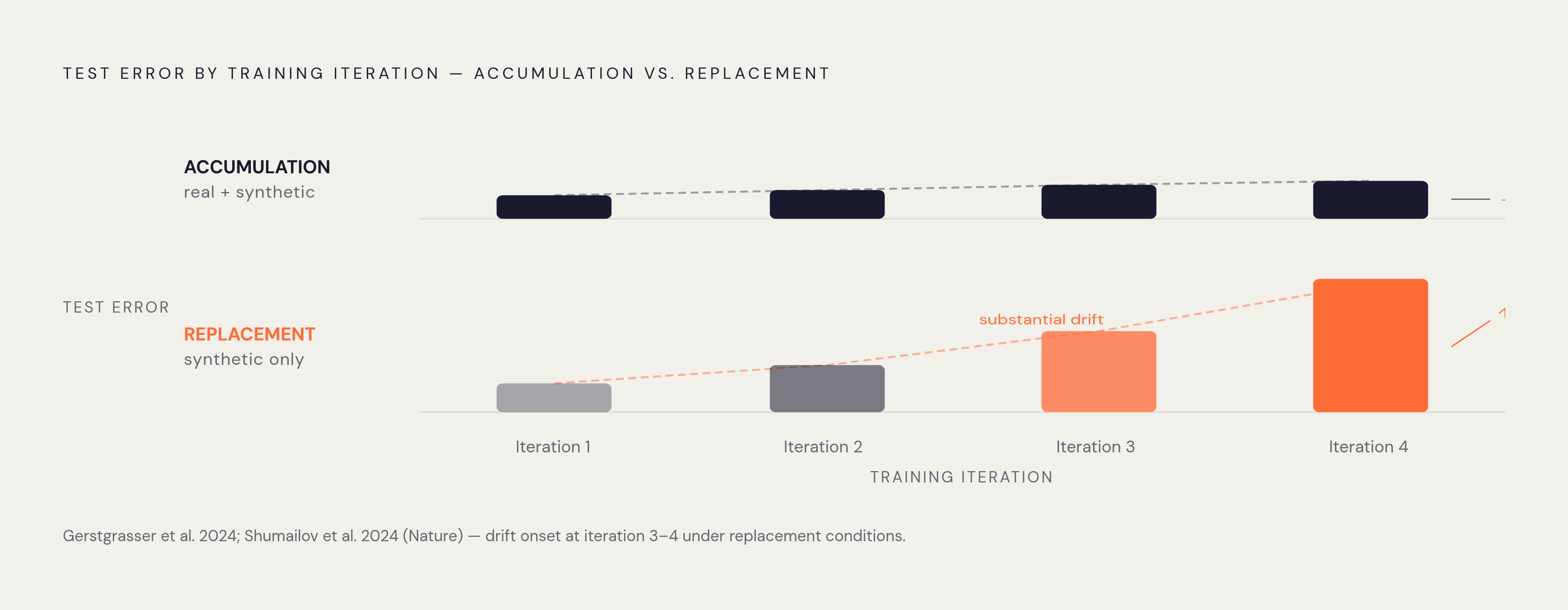
Shumailov et al.’s 2024 Nature paper showed that recursive training on generated data can erase the tails of the original distribution in different generative families. Rare outputs disappear, and responses grow more generic. The mechanism compounds existing imbalances in writing styles and reasoning patterns. Each synthetic generation reflects those imbalances, and the next model reinforces them. Under replacement conditions, recursive training can cause substantial drift in the model’s output distribution by the third or fourth training iteration.
Gerstgrasser et al. proved analytically in 2024 that test error has a finite upper bound when synthetic data accumulates with real data, but grows without bound when synthetic data replaces it. The real-data seed must stay in the training set through each iteration. This distinguishes expanding the dataset from recursively substituting a model’s approximation for the original distribution.
The ACL 2026 paper “Synthetic Eggs in Many Baskets” found that higher source diversity can mitigate distribution collapse. It also identified a separate safety trade-off. Human-data fine-tuning reduced adversarial robustness and output quality, while synthetic fine-tuning tended to remove safeguards but keep output quality. These findings require robustness to be tracked separately from answer quality when choosing the real-data seed size. Microsoft’s phi-4 illustrates the hybrid approach at scale, with synthetic data central to training but synthetic-only models underperforming on knowledge-heavy benchmarks and showing increased hallucinations.
Terms-of-service and legal constraints that shape which teacher models can actually be used
Teacher selection also determines contractual deployment constraints. OpenAI’s Usage Policies, effective October 29, 2025, do not impose a general prohibition on using GPT outputs to train other models. They do prohibit using outputs to generate, prepare, select, or supply training material or signals for models intended as alternatives to or substitutes for OpenAI models or services. Anthropic’s Claude Commercial Terms of Service, §D.4, also ban using the Services to build competing products, which includes training competing AI models.
The scope of direct competition has not been definitively litigated. The xAI case illustrates the uncertainty through reports that xAI distilled Claude outputs into coding models and continued after access was cut off, using private accounts and Blackbox AI. Most internal enterprise fine-tuning falls outside these restrictions, but that boundary requires explicit verification against the current terms. These are contractual constraints to assess for a particular deployment, including internal use.
Copyright exposure adds the distinction between lawfully and unlawfully acquired material. Teams building on GPAI models in the EU or for EU users must also understand what upstream providers have and have not disclosed. Teacher access does not settle those questions. The practical course is to verify terms before selecting a teacher, prefer open-weight teachers for deployment flexibility, and document training-data provenance. Open weights do not remove the need to examine the applicable terms.
Putting the pipeline together: how each layer compounds into a dataset that ships or silently fails
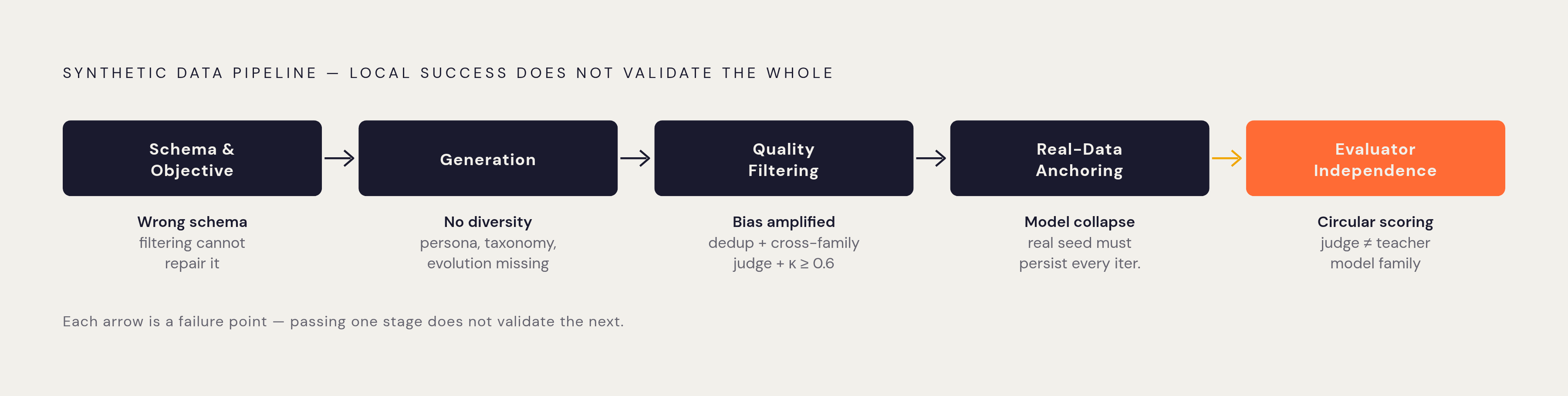
The layers interact because each constrains what the next can establish. A judge cannot repair a schema that provides the wrong training signal, and it cannot approve difficult cases that generation never produced. Human spot-checks can calibrate a rubric only if that rubric targets the relevant failures. Even a well-filtered dataset can compound collapse when it displaces the real seed. Local success at one stage does not validate the pipeline.
The phi-4 case connects these decisions in a concrete result. Its training centrally incorporated synthetic data, maintained hybrid mixing, and used reasoning traces, substantially surpassing the teacher on technical question answering. Yet removing real data reintroduced knowledge gaps and hallucinations. Kaddour and Liu demonstrated another upstream intervention, finding that fine-tuning the teacher on a small labeled set before generation improved synthetic quality as measured by downstream generalization.
For a team starting a project, the sequence begins with the training objective and row schema, followed by a teacher whose terms fit the deployment. Generation should combine all three diversity patterns and produce substantially more examples than the target dataset size. Examples are then accepted through the filtering sequence, and each training iteration keeps the real-data seed and tracks adversarial robustness separately from output quality.
Sources
- Synthetic Data Generation in Low-Resource Settings via Fine-Tuning of Large Language Models
Provided the 5 percent re-labeling threshold cited in the quality filtering section.
- On LLMs-Driven Synthetic Data Generation, Curation, and Evaluation: A Survey
Surveyed LLM-driven synthetic data generation, curation, and evaluation methods that inform the pipeline structure described throughout the article.
- Learning from Synthetic Data without Model Collapse in Iterative Instruction Tuning
Provided findings on preventing model collapse through iterative instruction tuning, relevant to the article's discussion of collapse prevention across training iterations.
- Synthetic Eggs in Many Baskets: The Impact of Synthetic Data Diversity on LLM Fine-Tuning
Provided findings on how source diversity mitigates distribution collapse and the safety trade-off between human and synthetic fine-tuning data.
- Model collapse
Provided background on the model collapse phenomenon, including the Shumailov et al. and Gerstgrasser et al. findings cited in the collapse section.