Thought Leadership Content That Earns Backlinks
Original data attracts citations that opinion content simply cannot generate.
Generic content stopped earning links because AI made it free. When any brand can produce a 2,000-word how-to guide in seconds, another one adds almost nothing to what already exists online, and the CMO Alliance's 2026 B2B thought leadership playbook states the marginal value of that guide is close to zero. Bloggers and journalists cite facts, not opinions, and generic advice contains no facts worth citing. The only asset left with real linking power is information nobody else has published yet: an original number, a proprietary dataset, a survey result that didn't exist last week. Everything that follows in this piece is about how to produce that kind of information on purpose, and how to get it in front of the people who cite it.
How original research becomes the asset others cite
Original research earns backlinks because it creates a dependency that opinion content can't replicate. A reporter covering how marketers plan to spend budgets in 2026 needs a statistic to anchor the story, and if a company's benchmark survey produced that statistic, the citation is a requirement of writing the piece at all. The CMO Alliance names original research as one of three forces behind Information Gain, the measure search engines and AI systems now use to reward content that adds something the web didn't already contain.
Two conditions decide whether a piece of research actually gets picked up once it's published. Surprise is the other: a finding that confirms what the industry already assumes isn't news, but a finding that contradicts the consensus, or exposes a trend nobody had named yet, is exactly the kind of thing a trade reporter builds a story around. The gap this creates between research-driven content and opinion content, as reported by Asset Linkable, is structural. It's structural, meaning research and commentary aren't competing on a sliding scale of link value, they're playing entirely different games.
The evidence for this isn't abstract. One firm, unnamed in the source reporting it, published a single original research report and picked up more than 150 high-quality backlinks from industry publications and academic institutions within six months, generating more traffic and leads than every blog post the company had published before it combined, Earned Media Hub reports. That result didn't come from better writing. It came from producing a fact that didn't exist anywhere else, which meant anyone who wanted to cite that fact had to cite the source. If a company wants to be cited, it has to give the industry something to cite.
The thought leadership formats that generate citable original information
Original information doesn't have to mean a massive annual survey. Several formats produce citable data, and they suit different budgets, timelines, and audiences, so choosing between them is a matter of fit rather than hierarchy.
Proprietary surveys and benchmark reports are the most direct route: asking a defined population about behavior, spending, or attitudes produces primary data that exists nowhere else once it's published. Lounge Lizard's 2026 content strategy guide suggests starting with five to seven research questions tied to revenue, risk, or operational friction, questions an audience is already asking that no existing public dataset answers. The TopRank Marketing and Ascend2 survey of senior marketing leaders, cited by MarketingProfs, shows the format working in practice: a defined survey population produced findings that trade publications picked up and linked back to.
Analysis of proprietary or first-party data works differently but just as well. A company that has accumulated implementation records, platform usage logs, or customer outcome data can publish findings that no outside researcher could reproduce, because nobody else holds that dataset. This tends to land harder than a survey, since the numbers describe verified behavior rather than what respondents say they do.
Experiments and original testing earn citations through reproducibility. Publishing a methodology alongside results lets another researcher check the work or challenge it, and that transparency is part of what makes it citable. Results that cut against a widely held assumption in an industry draw disproportionate attention from trade press, precisely because they give a reporter something to argue about.
Proprietary frameworks with named models take a different route to the same outcome: instead of new numbers, they give a name to something practitioners already feel but haven't had language for. BCM Public Relations' 2026 framework points to the "Big Idea" approach, locating the exact overlap between an emerging industry trend, a company's technological capability, and an underlying tension in the market, as one structural basis for thought leadership that gets cited. A framework with a real name also survives being repurposed. The same concept can anchor a full report, a webinar, a slide in a sales deck, and a LinkedIn series without losing the thing that made it citable in the first place.
Expert roundups round out the list, but only when they gather named practitioners rather than curated quotes assembled to fit a thesis. Lounge Lizard treats roundups built around real operators as a standing part of a company's research output, not a one-off content format, because the combination of specific named perspectives on a defined question is itself information that existed nowhere until that piece assembled it.
Two conditions decide whether a piece of research actually gets picked up once it's published.
Why the research must come from subject matter experts
None of these formats work if the wrong person is producing them. Original research earns links through its content, but it earns credibility through the person standing behind the data, and by 2026 that credibility depends on the visible expertise of an individual, not the reputation of the brand publishing the report. The CMO Alliance describes this as the "SME pivot," a shift already underway among leading B2B brands away from brand-voiced content and toward subject matter experts publishing under their own names, sharing judgment and perspective rather than institutional messaging.
The reasoning behind the shift has to do with how AI models are built. Those models train on consensus, so content that simply restates what the industry already agrees on blends into that consensus and gives an AI system nothing distinct to attribute. A named expert who takes a specific position, especially one that runs against convention, gives both human editors and AI systems something concrete to cite and someone specific to cite it to.
Time, not willingness, is the obstacle. Domain experts are usually the busiest people in an organization, and a thought leadership plan that depends on them sitting down to write articles will collapse within a quarter. The fix is a structured extraction process rather than a writing assignment. BCM Public Relations calls this SME Extraction: short monthly interviews, voice notes recorded between meetings, and live Q&A sessions that capture how an expert actually thinks, without asking that expert to produce a draft. Lounge Lizard recommends pairing that capture process with a clear editorial standard: AI can help with research synthesis, outlining, and repurposing content into different formats, but a human stays responsible for accuracy, narrative, point of view, and the way the final piece sounds.
Skipping that discipline carries a real cost. AI-written thought leadership measurably erodes the trust that makes research worth citing in the first place, and disclosing that AI was involved only helps if the disclosure explains how it was used, The SaaS Library reports. AI belongs in this pipeline as an amplifier of what an expert already thinks. Identify two or three internal experts worth building around, put a lightweight extraction system in place to capture their judgment on a regular schedule, and keep a single editorial voice accountable for what goes out under their name.
Building a research-to-spinoff pipeline so one study earns links across many channels
A research report that runs once and disappears has already left most of its value on the table. Lounge Lizard's 2026 guide lays out a pipeline structure that treats a single study as raw material for a sequence of derivatives: the full report, an executive summary, short-form clips, a webinar, sales enablement material, and a point-of-view series, with every derivative pointing back to the original research as its source.
Each derivative opens a different door to a link. A webinar built from the findings gets mentioned in event roundups that link to the underlying data behind it. A short-form data visualization, a single chart pulled from the report and built for sharing, picks up embeds and shares that carry links back to the full study. A bylined article written by the expert for a trade publication, citing the company's own research, produces a link from a domain the company doesn't control and couldn't buy, which is exactly the kind of link that carries weight.
Running the research on a recurring schedule multiplies this further. BacklinkSense's guide points out that surveys and benchmark reports repeated at set intervals let a business document how a market is actually shifting over time, turning a single article into a resource other publications return to and compounding the link equity of the original study instead of resetting it with every new campaign. Interactive and live formats extend the reach again: MarketingProfs' coverage of the TopRank/Ascend2 survey found that B2B marketers themselves point to video, live or virtual events, and interactive experiences as the formats they expect to make thought leadership most effective, and every one of those formats can be built to carry a citation straight back to the original data. A single study, treated this way, becomes the seed of a distribution calendar that runs for the better part of a year.
Distributing research so journalists and AI systems cite it
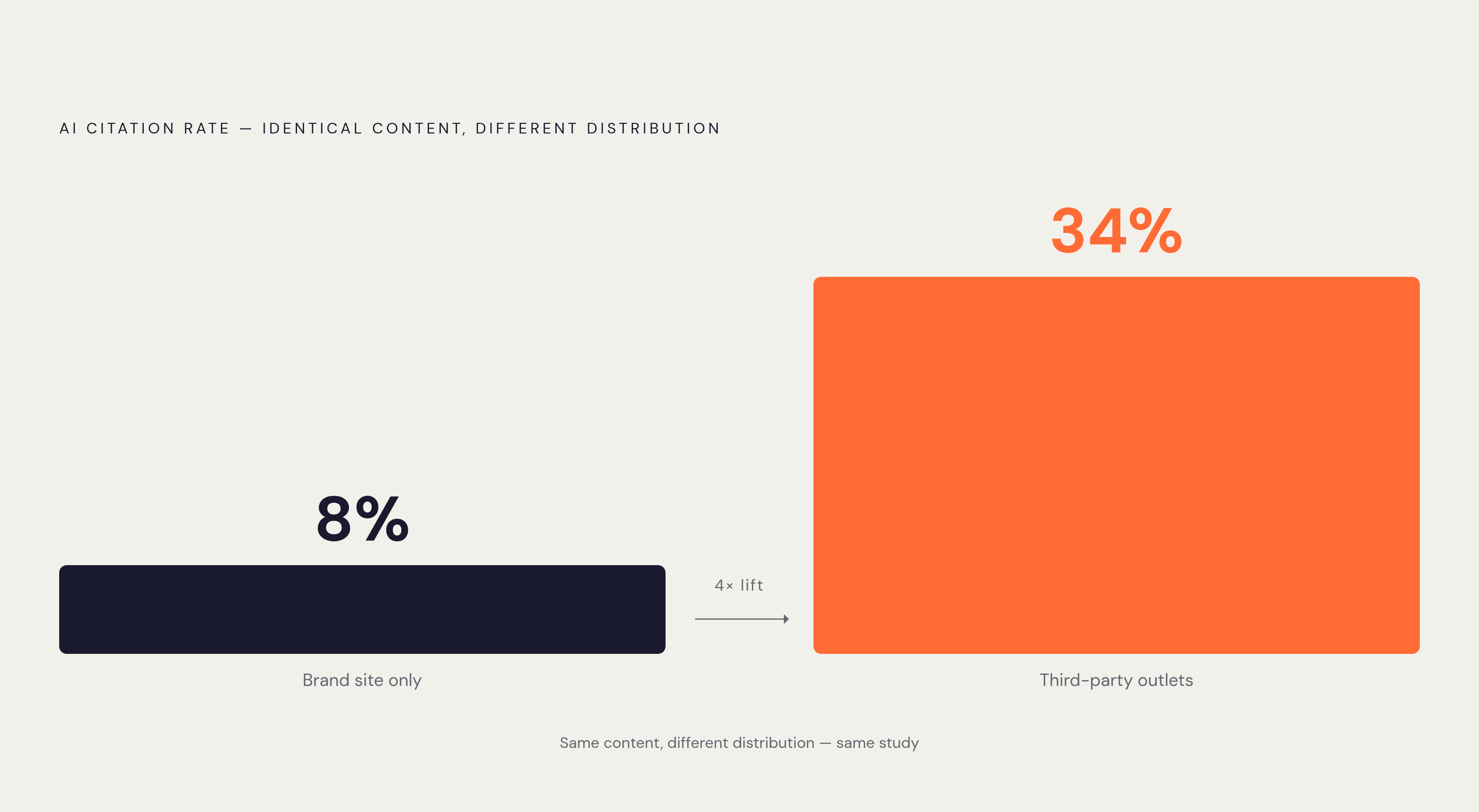
Publishing research on a company's own domain is only half the job. Distribution through high-authority third-party outlets is the actual mechanism that makes a piece of research citable, both to journalists looking for a source and to AI systems generating a summary, and those two audiences now respond to the same signal.
The evidence for that signal is specific. Authority Tech's analysis of a study by Stacker and Scrunch found that identical content earned an 8% AI citation rate when it lived only on a brand's own site, and a 34% citation rate once the same content ran through third-party news outlets. The content in the study was identical in both cases, so the AI system's citation decision came down to where it found the content. AI systems weight the authority of the domain doing the citing, not just the underlying material, so a story that runs in a high-authority outlet generates AI citations that point back to that outlet as the authority, which pulls the original research along with it.
Getting earned media placement in 2026 means pitching outlets that maintain real editorial standards and hold an audience's attention, rather than link farms with no readership to speak of, and it means arriving with original findings, real case studies, and material that teaches something rather than repackaged marketing copy. Colab DXB's 2026 backlink strategy guide is blunt about what survives scrutiny going forward: links that hold up are earned editorially, sit in a relevant context, and can withstand Google's periodic re-evaluation of the web, while low-quality guest post networks are now easier to detect and riskier to rely on than they've ever been.
Bylined thought leadership in trade publications does double duty here. A named expert publishing an original finding in a publication relevant to the industry earns a contextual editorial link back to the source data, and it signals topical authority to search engines and AI systems at the same time. The byline itself carries weight, because it reinforces the same SME attribution that made the research credible to begin with, closing the loop between who did the work and who gets cited for it.
Formatting the research shapes whether an AI system can extract it. The CMO Alliance's 2026 playbook recommends concise summaries at the beginning of sections, direct declarative language, and content addressing specific high-intent questions, since ambiguous or overly narrative content is less likely to be extracted into AI summaries. That formatting discipline is the same discipline that lets a journalist skim a report and pull a clean quote, so writing for AI extraction and writing for a human editor turn out to be the same job.
Sources
- B2B Thought Leadership Strategy for 2026
Provided the concept of Information Gain, the 'SME pivot' shift, and formatting recommendations for AI extraction that are cited multiple times throughout the article.
- Marketing Content - B2B Thought Leadership Content Trends for 2026
Supplied the TopRank Marketing and Ascend2 survey findings on B2B thought leadership formats, including video, live events, and interactive experiences.
- Winning Content Strategy & Thought Leadership in 2026 | Lounge Lizard
Provided the pipeline structure for repurposing a single research report into derivatives, the survey question framework, and guidance on pairing SME extraction with editorial standards.
- Backlinks in 2026: Advanced Strategy, Real Data, and What Actually Works
Supplied the assessment that editorially earned links in relevant contexts are what survives scrutiny, while low-quality guest post networks are increasingly detectable and risky.
- Thought Leadership Content Strategy for B2B: A Strategic Framework for 2026
Provided the 'Big Idea' framework concept and the SME Extraction process involving monthly interviews and voice notes to capture expert thinking.